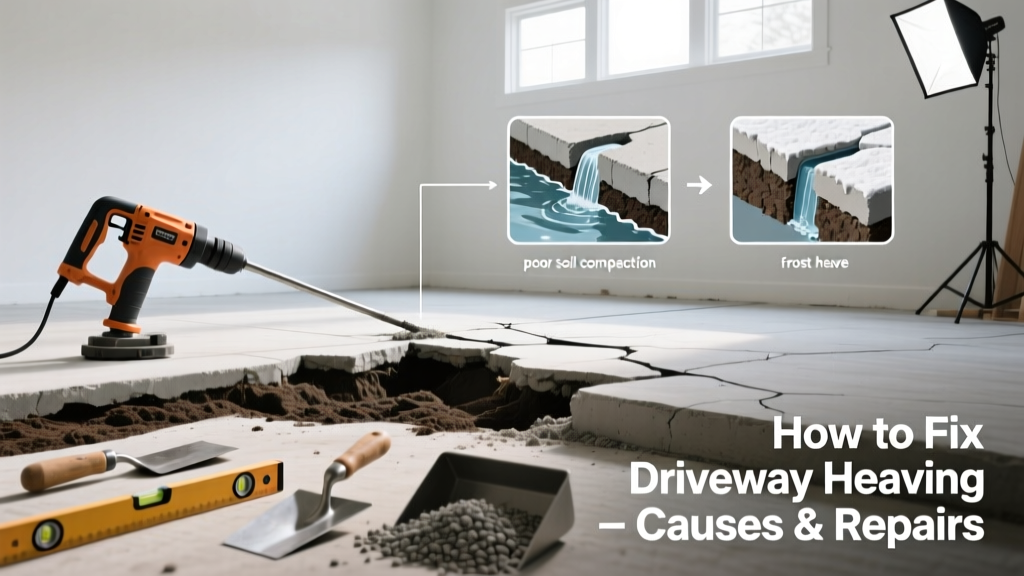
That sudden bump in your driveway isn’t just an eyesore—it’s a warning sign. Heaving often starts as a subtle rise near the garage or at expansion joints, but left unaddressed, it can crack concrete, jam garage doors, and create tripping hazards. Most cases stem from predictable causes—not mystery forces—and many are fixable before they escalate.
Quick Diagnosis
Driveway heaving rarely happens without reason. Pinpointing the cause saves time, money, and misapplied fixes. Here are the top culprits:
- Frost heave (especially in clay soils with poor drainage and shallow footings)
- Tree root intrusion—maple, willow, and poplar roots commonly lift slabs within 10–15 feet of the driveway edge
- Soil swelling from expansive clays (common in Texas, Arizona, and Colorado)
- Broken or clogged subsurface drain lines beneath or adjacent to the slab
- Improper compaction during original installation—evident when heaving occurs within 3–5 years of pouring
Tools & Materials Needed
| Item | Purpose | Estimated Cost |
|---|---|---|
| Rotary hammer drill with 1/2" masonry bit | Drills precise holes for mudjacking or slab leveling ports | $120–$280 |
| Concrete patching compound (polymer-modified) | Fills voids after lifting; resists shrinkage and cracking | $18–$32 per 50-lb bag |
| Pressure washer (3,000 PSI minimum) | Cleans debris and exposes cracks or root entry points | $140–$400 (rental: $65/day) |
| Root barrier fabric (HDPE, 30-mil) | Blocks lateral root growth when installed along driveway perimeter | $1.25–$2.40 per sq ft |
| Laser level + grade rod | Measures elevation changes across slab (critical for detecting >1/4" lift) | $95–$220 |
Step-by-Step Fix
Not all heaving requires full replacement. Try these methods in order of increasing complexity:
- Mudjacking (for minor lifts under 1.5 inches): Drill 1–2 inch holes every 2–3 feet along the raised edge, inject grout under pressure to fill voids and gently lift the slab back into place. Let cure 24 hours before driving.
- Slab grinding (for localized bumps under 3/8 inch): Use a walk-behind concrete grinder with diamond cup wheel to level the high spot. Vacuum dust and seal with acrylic concrete sealer.
- Root excavation and barrier install: Cut exposed roots 12 inches below slab edge using a reciprocating saw with carbide blade, then trench 24" deep along affected side and install HDPE root barrier angled outward at 30°.
- Void filling with expanding polyurethane foam: Preferred over mudjacking for tight spaces or where water infiltration is suspected. Foam expands to fill irregular cavities and stabilizes soil—average lift accuracy: ±1/16" (American Concrete Institute, 2022).
When to Call a Pro
Some heaving signals deeper structural trouble. Skip DIY if you observe any of these:
- Vertical displacement greater than 2 inches—or horizontal shifting (cracks widening >1/4" over 3 months)
- Heaving coincides with foundation wall cracks, sticking windows/doors, or sloping interior floors
- Multiple adjacent slabs lifting simultaneously (suggests regional soil instability or failing footer drains)
- Water pooling near the raised area during rain, especially if it persists >48 hours post-storm
"Over 68% of driveway heave repairs fail within 3 years when performed without soil moisture monitoring or subsurface drainage correction." — National Ready Mixed Concrete Association, Driveway Durability Report, 2021
Prevention Tips
Long-term success hinges on controlling what pushes up from below. Focus on water and roots:
- Install French drains 3–4 feet beyond the driveway edge, sloped at 1% minimum, with 4" perforated pipe wrapped in landscape fabric
- Maintain gutters and downspouts—extend them at least 5 feet from the slab edge, and clean quarterly
- Replace aggressive-root species within 15 feet of concrete with low-impact alternatives like serviceberry or hawthorn
- Apply a hydrophobic soil conditioner (like calcium chloride) in early fall in frost-prone zones to reduce ice lens formation
Can I use bleach to kill roots under my driveway?
No—bleach is ineffective against mature woody roots and corrodes metal rebar and soil microbes. It also leaches into groundwater. Instead, use a targeted herbicide like glyphosate applied directly to freshly cut root surfaces, or better yet, physically remove and barrier.
Will sealing my driveway stop heaving?
Sealing protects surface integrity but does nothing to prevent subsurface pressure. In fact, non-breathable sealers can trap moisture beneath the slab and worsen frost heave in cold climates. Use breathable silane/siloxane sealers only—and never on cracked or lifted concrete.
How long does mudjacking last?
Properly executed mudjacking lasts 8–12 years in stable soils with corrected drainage. In expansive clay or high-water-table areas, expect 4–7 years. Polyurethane foam injections typically outlast mudjacking by 3–5 years due to lighter weight and moisture resistance.
Can I pour new concrete over a heaved slab?
Never. Overlaying adds weight without addressing the underlying pressure source—and often accelerates failure. The existing slab must be removed, subgrade stabilized, and new base compacted to 95% Proctor density before repouring.
Does homeowner’s insurance cover driveway heaving?
Rarely. Most standard policies exclude gradual earth movement, including frost heave and root pressure. Some umbrella policies or endorsements may cover sudden collapse—but only if tied to a covered peril like a burst underground pipe. Document everything with photos and licensed contractor assessments.
Is asphalt more resistant to heaving than concrete?
Not inherently—but asphalt’s flexibility lets it absorb minor soil shifts without cracking. However, it’s more vulnerable to root penetration and softens in heat, allowing greater deformation. In freeze-thaw zones with clay soil, properly reinforced 6-inch concrete with control joints performs more predictably than 3-inch asphalt.
A little heave today can become a full slab replacement tomorrow—if ignored. But with the right diagnosis, timely intervention, and smart prevention, most driveways recover cleanly and hold strong for another decade. For persistent issues, pair your repair with a French drain installation and consult a licensed concrete contractor who provides soil testing reports—not just estimates. And always check local code requirements before trenching or injecting beneath slabs; some municipalities require engineering sign-off for lifts over 1 inch.