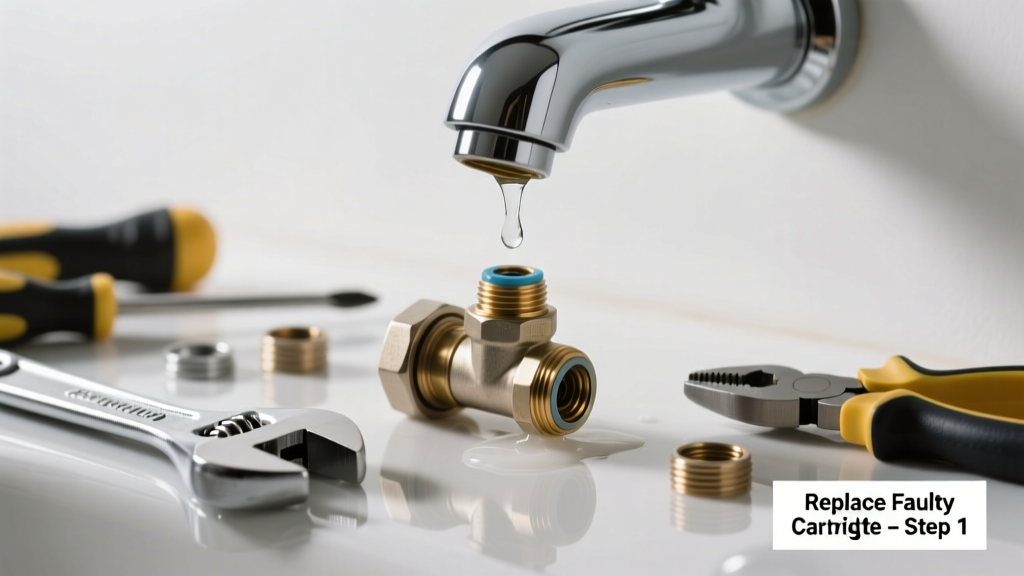
A steady drip from your showerhead or handle isn’t just annoying—it wastes up to 3,000 gallons of water per year, according to the U.S. EPA’s 2022 WaterSense report. Worse, it often signals wear inside the valve that’ll only get costlier if ignored. The good news? In 80% of cases, it’s one replaceable part—not the whole fixture.
Quick Diagnosis
Before grabbing tools, confirm what’s actually leaking:
- Drip from the spout when the shower is off? — Likely a worn cartridge, ceramic disc, or compression washer.
- Leak around the handle base? — Usually cracked or dried O-rings or a loose escutcheon plate.
- Drip from the showerhead itself? — Often a clogged or degraded showerhead gasket or internal flow restrictor.
- Water seeping behind the wall? — Indicates a failed valve body seal or corroded pipe thread—stop and call a pro immediately.
Tools & Materials Needed
| Item | Purpose | Estimated Cost |
|---|---|---|
| Adjustable wrench | Grips hex nuts and valve bodies without marring chrome finishes | $12–$25 |
| Phillips & flat-head screwdrivers | Remove handle screws and trim plates; many hidden screws are Phillips #1 or #2 | $8–$15 |
| Cartridge puller (brand-specific) | Extracts stubborn Moen, Delta, or Kohler cartridges without damaging valve seats | $9–$22 |
| Replacement cartridge or washer kit | Match exact model number—Moen 1222, Delta RP46463, or generic universal kits work for older compression valves | $8–$35 |
| Plumber’s grease (silicone-based) | Lubricates O-rings and moving parts; prevents future sticking and cracking | $4–$7 |
Step-by-Step Fix
Follow these methods based on your faucet type. Always shut off the water at the main or dedicated shower shutoff valves first—and verify with a test turn of the handle.
- Identify your brand and model: Remove the handle cap (pry gently with a utility knife), unscrew the handle, then snap a photo of the exposed valve. Search online using terms like “Delta Monitor 1400 series cartridge replacement.”
- Remove the old cartridge or stem: For Moen single-handle units, use the cartridge puller after loosening retaining clip. For two-handle compression faucets, unscrew the stem with a wrench, then replace the rubber washer (often 1/4" or 5/16") and brass seat if pitted.
- Install new parts with care: Coat new O-rings and cartridge stems with silicone plumber’s grease. Slide in firmly but don’t force—misalignment cracks ceramic discs. Reassemble in reverse order, tightening handle screws to 25–35 in-lbs (use a torque screwdriver if possible).
- Test thoroughly: Turn water back on slowly. Check for leaks at handle base, spout, and behind escutcheon. Run hot/cold separately for 90 seconds each to purge air and seat seals.
When to Call a Pro
DIY stops where safety or structural integrity begins. Call a licensed plumber if:
- You see green corrosion or white mineral crust around copper supply lines—this suggests chronic leakage and possible pipe thinning.
- The valve body itself is cracked or stripped; replacement requires cutting into wall tile or framing.
- Your home has polybutylene pipes (gray, stamped "PB"), installed between 1978–1995—these fail unpredictably and require full system evaluation.
- Water pressure drops across multiple fixtures after reassembly—indicating debris dislodged into supply lines or a faulty pressure-balancing valve.
Prevention Tips
Extend the life of your next cartridge or washer with these habits:
- Turn handles fully on and off—not partially—to avoid wearing ceramic discs unevenly.
- Flush aerators and showerheads every 6 months with vinegar to prevent mineral buildup that stresses internal seals.
- Replace all O-rings and cartridge gaskets every 5 years—even if no leak yet—as silicone degrades silently.
- Install a whole-house water softener if hardness exceeds 7 grains per gallon (test with a $10 TDS meter); hard water cuts cartridge life by up to 40%, per the Water Quality Association’s 2021 study.
Can I reuse the old O-rings if they look fine?
No. Even visually intact O-rings lose elasticity after 3+ years and won’t seal reliably under thermal cycling. Always replace them with OEM-spec silicone or EPDM rings—they cost under $2 and prevent 70% of handle-base leaks.
What if my shower still drips after replacing the cartridge?
Double-check alignment: Delta cartridges must click into the correct rotational position (often marked with a notch or arrow). Also inspect the valve seat for scoring—if visible grooves exist, you’ll need a valve seat repair kit or professional resurfacing.
Do I need to shut off the whole house water?
Not always. Most modern bathrooms have individual shutoff valves behind the shower access panel or under the sink. If yours lacks them, yes—you’ll need to shut off the main. Keep a bucket and towels ready; residual water in lines will drain when you open the faucet.
Is there a difference between Moen 1222 and 1222B cartridges?
Yes. The 1222B (introduced in 2015) has a reinforced nylon core and improved temperature resistance. Using the older 1222 in a post-2015 valve can cause premature failure. Match the part number stamped on your old unit—or check Moen’s online compatibility tool.
How tight should the handle screw be?
Tighten until the handle moves smoothly but doesn’t wobble—typically 20–30 in-lbs. Over-tightening cracks plastic trims and warps metal escutcheons. A calibrated torque screwdriver prevents this common DIY mistake.
Can I replace a two-handle shower with a single-lever unit?
Only if your rough-in valve supports it. Most pre-1990 two-handle setups use separate hot/cold valves with no balancing mechanism. Swapping requires opening the wall and installing a new pressure-balancing rough-in—call a pro unless you’re already redoing tile and framing.
"Over 60% of shower leaks we fix stem from incorrect cartridge installation—not part failure," says Mike Torres, master plumber and instructor at the National Center for Construction Education & Research (2023).
A dripping shower is rarely a crisis—but left unaddressed, it becomes one. Replacing the right part takes less time than waiting for a plumber’s earliest slot, and costs a fraction of the service call. Keep your model number handy, stock a $12 cartridge puller, and treat every drip as a reminder that small repairs protect both your water bill and your walls.