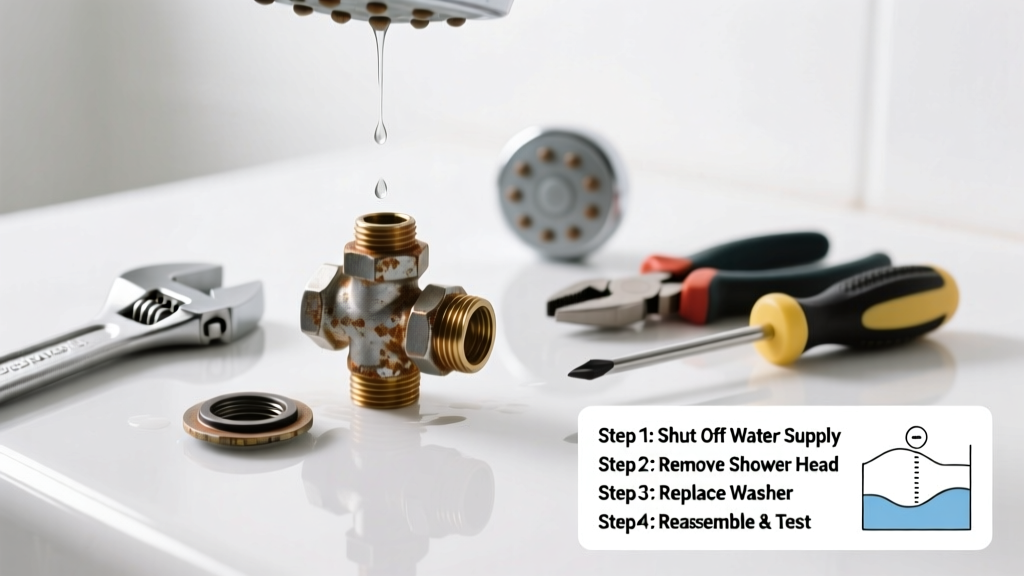
A dripping shower isn’t just annoying—it wastes up to 3,000 gallons of water per year and can raise your water bill by $100 annually, according to the U.S. EPA’s 2022 WaterSense report. Worse, persistent leaks accelerate wear on valves and tiles, and may hide deeper plumbing issues. The good news? Most drips are fixable in under an hour with basic tools.
Quick Diagnosis
Before grabbing tools, identify where the drip originates:
- Shower head: Drip continues after turning off—likely worn rubber washer or clogged aerator.
- Handle base or spout: Moisture around the handle or tub spout points to a faulty cartridge or stem seal.
- Behind the wall (audible hissing or wet drywall): Suggests cracked supply line or failing valve body—stop and call a pro.
- Drip only when hot water is on: Often indicates thermal expansion stress on a worn thermostatic mixing valve.
Tools & Materials Needed
| Item | Purpose | Estimated Cost |
|---|---|---|
| Adjustable wrench | Loosens stubborn nuts without stripping threads | $12–$25 |
| Phillips & flat-head screwdrivers | Removes handle screws and access plates | $8–$15 |
| Replacement washers/cartridges | Match your brand (Moen, Delta, Kohler) and model—check stamped code under escutcheon | $4–$22 |
| Vinegar soak cup & soft brush | Cleans mineral buildup from shower head nozzles and internal parts | $3–$8 |
| Plumber’s grease (silicone-based) | Lubricates rubber seals and O-rings without degrading them | $5–$10 |
Step-by-Step Fix
Try these methods in order—start simple, escalate as needed:
- Clean the shower head: Unscrew it, soak overnight in white vinegar, scrub nozzles with a soft toothbrush, rinse, and reattach tightly.
- Replace the washer or O-ring: Shut off water at the fixture shutoffs (or main), remove handle and trim, extract the stem or cartridge, swap the worn rubber washer (often ¼" flat or beveled) or O-ring, apply plumber’s grease, and reassemble.
- Swap the cartridge (for single-handle valves): Match the exact part number (e.g., Delta RP46463 or Moen 1222), insert with correct orientation (align tabs), and test before sealing the wall plate.
- Check the diverter (if tub/shower combo): A stuck or corroded diverter valve causes residual drip at the shower head—clean or replace its rubber seal.
When to Call a Pro
Stop and call a licensed plumber if you encounter any of these:
- Water pressure drops significantly across multiple fixtures after attempting repairs.
- You see mold, warped drywall, or discoloration behind the tile—indicating chronic leakage inside the wall.
- The valve body itself is cracked or leaking at the solder joints (common in older copper systems).
- Your home has PEX-aluminum composite tubing and the leak is at a crimped fitting—specialized tools and certification are required.
"Over 68% of shower leaks stem from neglected O-rings or improperly seated cartridges—not pipe failure," says plumbing contractor Marcus Lee in Modern Residential Plumbing Handbook, 2021 edition.
Prevention Tips
Extend the life of your shower components with these habits:
- Wipe down the shower head and handles weekly to prevent mineral crust buildup.
- Turn handles gently—force accelerates stem wear and misalignment.
- Install a whole-house water softener if your hardness exceeds 7 gpg (grains per gallon), per USGS 2023 water quality data.
- Replace rubber seals every 3 years—even if they seem fine—especially in homes with well water or high chlorine content.
Can I use bleach on this?
No. Bleach corrodes brass, damages rubber seals, and reacts dangerously with vinegar residue. Stick to white vinegar or citric acid solutions for cleaning.
Why does my shower drip only after I turn it off?
This is usually thermal contraction: hot water expands internal parts, then contracts as it cools, loosening a worn seal just enough to leak. Replace the cartridge or stem assembly—it’s almost always the culprit.
Do I need to shut off the main water supply?
Not always. Most modern showers have individual shutoff valves behind the wall access panel or in the basement directly below. Test them first—if they fully stop flow, you’re safe. If unsure, shut off the main to avoid surprises.
What’s the difference between a washer and a cartridge?
Washers are small rubber discs used in older two-handle (hot/cold) valves; cartridges are plastic/metal assemblies that control flow and temperature in single-handle models like Delta or Moen. Mixing them up causes leaks—or worse, cross-threading.
How tight should I tighten the shower head?
Hand-tight plus one-quarter turn with adjustable wrench—overtightening cracks ceramic finishes and crushes rubber gaskets. Use Teflon tape on threaded connections, but never on compression fittings.
Is a dripping shower a code violation?
Not directly—but persistent leaks that cause moisture damage may violate local building codes requiring habitable conditions. Inspectors often cite damp drywall or peeling caulk during resale inspections, especially in states like California and Washington with strict moisture mitigation rules.
A working shower shouldn’t sound like a metronome. With the right diagnosis and a few targeted fixes, most drips vanish quietly—and you’ll save water, money, and the headache of watching droplets pool on your tile. If you’ve tackled a washer replacement before, try upgrading to a ceramic-disk cartridge next time—it lasts 2–3× longer and resists mineral buildup better. For deeper issues, don’t hesitate to reach out to a licensed plumber near you or explore our guide on how to detect hidden shower leaks.