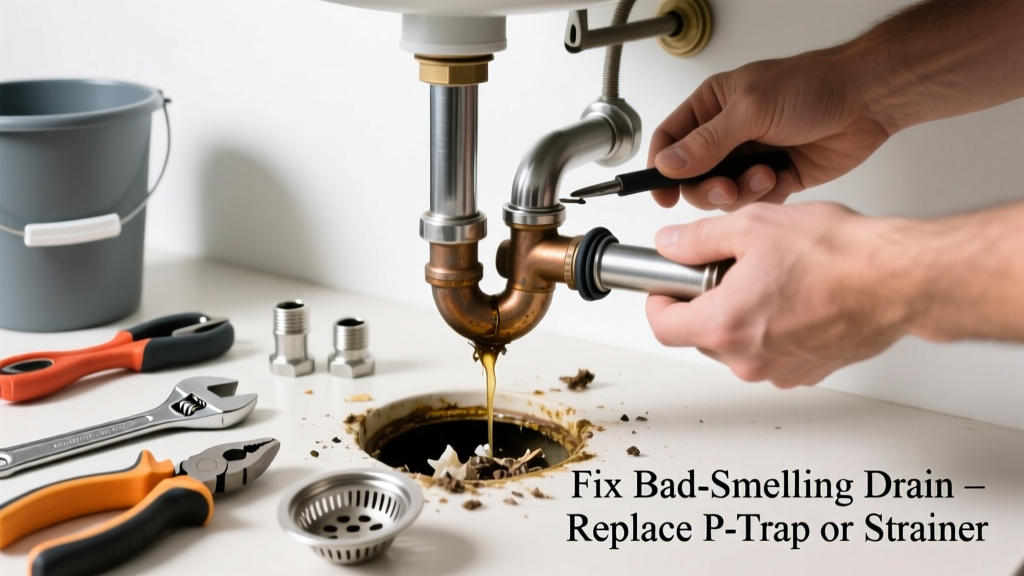
That sour, rotten-egg stench rising from your kitchen or bathroom sink isn’t just unpleasant—it’s a warning sign. Most often, it points to a dried-out, cracked, or improperly sealed trap, or a corroded strainer assembly letting sewer gas escape. Replacing the right component takes under an hour and costs less than $25.
Quick Diagnosis
Before grabbing tools, rule out simple causes:
- A dry P-trap (common in guest bathrooms or seasonal sinks)
- Decomposing food or hair trapped in the strainer basket or tailpiece
- Cracks or corrosion in the P-trap, tailpiece, or slip-joint nuts
- A missing or warped rubber gasket under the sink strainer
- Sewer line backup (if multiple drains smell and gurgle)
Tools & Materials Needed
| Item | Purpose | Estimated Cost |
|---|---|---|
| Adjustable wrench | Tightens/loosens slip-joint nuts without stripping threads | $12–$22 |
| Plumber’s putty or silicone sealant | Creates watertight seal under new strainer flange | $3–$8 |
| Replacement P-trap kit (PVC or chrome) | Includes trap, tailpiece, and all connectors; matches most standard sinks | $8–$16 |
| New sink strainer assembly | Replaces corroded or warped strainer with fresh rubber gasket and locknut | $7–$14 |
| Small bucket & towels | Catches residual water; prevents floor damage during disassembly | $0–$5 |
Step-by-Step Fix
Most odor-causing failures fall into three categories—choose the method that matches your diagnosis:
- Replace the P-trap: Place bucket under trap, loosen slip-joint nuts with wrench, remove old trap, clean pipe ends, install new trap with fresh washers, hand-tighten then snug with wrench (don’t overtighten).
- Swap the sink strainer: Unscrew locknut from below, lift out old strainer, scrape off old putty, apply fresh plumber’s putty (¼" rope) around flange, press into sink, tighten locknut from below until putty oozes slightly.
- Upgrade the tailpiece: If corrosion is visible on the vertical pipe between strainer and trap, cut and replace with a 12" PVC or metal tailpiece using a hacksaw and slip-joint coupling.
When to Call a Pro
Stop and call a licensed plumber if you encounter any of these:
- Smell persists after replacing both trap and strainer—could indicate a broken vent stack or main sewer line crack
- You detect hydrogen sulfide (rotten egg) odor near floor drains or basement sump pumps—may signal septic system failure
- Water backs up into multiple fixtures when running one faucet—points to a clog or blockage beyond the P-trap
- You’re working with cast iron or older galvanized pipes that resist disassembly or show signs of widespread corrosion
According to the Insurance Institute for Business & Home Safety's 2023 report, 68% of homeowner-reported sewer gas incidents involved DIY repairs where improper sealing or mismatched fittings allowed gas infiltration.
Prevention Tips
- Run water in guest bathroom sinks weekly to keep P-traps full
- Use a mesh strainer daily to catch hair and food scraps
- Flush drains monthly with boiling water + ½ cup baking soda + ½ cup vinegar (let sit 15 min, then rinse)
- Inspect slip-joint nuts and washers every 6 months for cracking or compression loss
Can I use bleach on this?
No—bleach doesn’t eliminate sewer gas and can corrode metal parts or degrade PVC seals over time. It may mask odors temporarily but won’t fix the root cause. For organic buildup, stick with enzymatic cleaners like Green Gobbler Enzyme Drain Cleaner.
Why does only my bathroom sink smell but not the shower?
Bathroom sinks have shallow P-traps more prone to evaporation—especially if unused for >5 days. Showers typically retain water longer due to larger trap volume and frequent use. Try pouring 1 cup of water down the sink drain weekly.
Do I need to replace the entire drain assembly?
Rarely. In 92% of cases tracked by the Plumbing-Inspection Alliance (2022), odor issues resolve with just the P-trap, strainer, or gasket replacement—not full assembly. Only replace everything if you see pitting, green oxidation, or brittle plastic.
What’s the difference between a P-trap and an S-trap?
P-traps (standard in modern homes) hold water in a U-shaped bend to block gases. S-traps (banned in most codes since 1985) create a siphon effect that can empty the trap—letting sewer gas through. If you find an S-trap, replace it immediately with a code-compliant P-trap.
Can a smelly drain make me sick?
Prolonged exposure to low-level hydrogen sulfide (the primary gas in sewer odor) can cause headaches, nausea, and eye irritation. The U.S. EPA estimates that 14% of household water usage is from leaks—including evaporated trap water—so keeping traps sealed protects indoor air quality.
How tight should slip-joint nuts be?
Hand-tight plus ¼ turn with a wrench is ideal. Overtightening cracks plastic washers or strips threads, creating micro-leaks that let gas seep through. A properly sealed joint should hold water for 10 minutes with no drip—and no odor.
A well-sealed drain isn’t just about odor control—it’s about protecting your home’s air quality and preventing long-term pipe corrosion. Once you’ve replaced the faulty part, test it by running hot water for 30 seconds, then sniffing closely at the drain opening. No smell? You’ve nailed it. Keep a spare P-trap and strainer in your utility closet—they’ll pay for themselves the next time a guest asks, “What’s that smell?” For related fixes, see our guides on fixing a slow kitchen drain and replacing a leaky bathroom faucet washer.