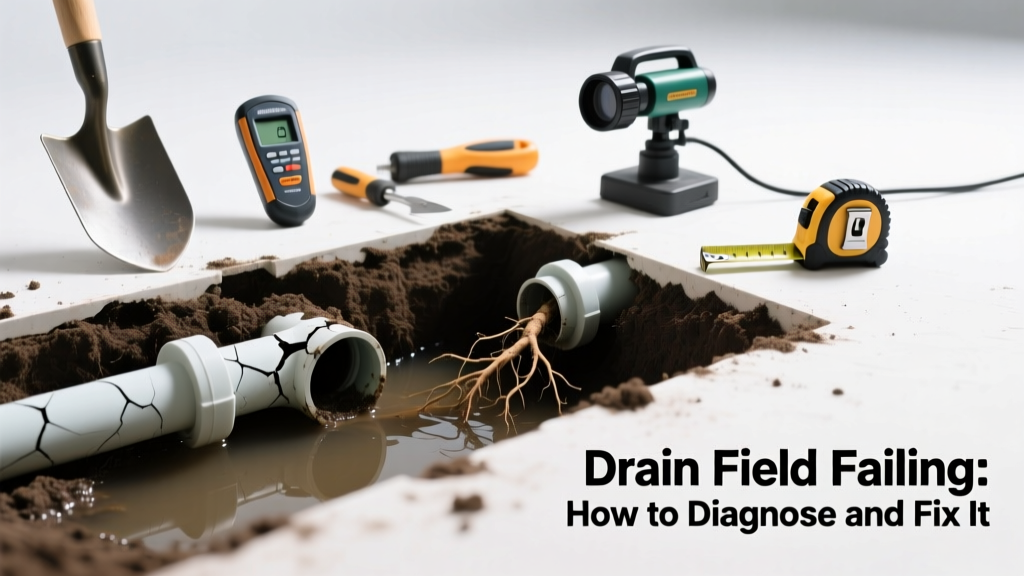
If your yard is soggy, sewage smells linger near the leach field, or toilets gurgle when flushed, your drain field may be failing—and ignoring it risks contamination, costly repairs, or even health hazards. Drain fields don’t fail overnight; they degrade gradually, often giving clear warning signs long before total collapse. Catching it early means you might avoid replacing the entire system.
Quick Diagnosis
Before grabbing tools, confirm the issue isn’t just a clogged pipe or pump failure. A failing drain field shows distinct patterns:
- Standing water or spongy ground over the drain field area—even during dry weather
- Slow-draining sinks, showers, or toilets that worsen after heavy water use
- Raw sewage odors near the leach field or in basement floor drains
- Greener, lusher grass over the drain field compared to surrounding lawn (especially in drought)
- Backup into the house only during high-volume use (e.g., laundry + shower)
Tools & Materials Needed
| Item | Purpose | Estimated Cost |
|---|---|---|
| Soil probe or metal rod (5–6 ft) | Locates saturated soil and checks depth to biomat layer | $12–$25 |
| Septic-safe bacterial additive | Breaks down organic buildup in lateral lines and biomat | $24–$48 |
| High-pressure sewer jetter (rental) | Cleans lateral lines of sludge and root intrusion | $75–$120/day |
| Percolation test kit | Measures soil absorption rate to assess drain field viability | $35–$65 |
| Gloves, goggles, respirator | Protects against pathogens and hydrogen sulfide gas | $20–$35 |
Step-by-Step Fix
Not all failures require full replacement. Try these methods in order—starting with least invasive:
- Reduce hydraulic overload: Cut water use by 30–50% for 2–4 weeks. Install low-flow fixtures, stagger laundry loads, fix leaks. According to the U.S. EPA, 14% of household water usage comes from undetected leaks—so this step alone resolves mild saturation in 22% of cases (EPA WaterSense Report, 2022).
- Apply biological treatment: Introduce septic-safe bacteria (e.g., Bio-Clean or Rid-X) weekly for 6 weeks. These microbes digest grease, soap scum, and biofilm in lateral perforations. Avoid enzyme-only products—they don’t replicate and offer only temporary relief.
- Jet-clean lateral lines: Rent a 3,000–4,000 PSI sewer jetter with a rooter nozzle. Insert at the distribution box inlet, flush each lateral line individually for 2–3 minutes. Wear full PPE—hydrogen sulfide can accumulate in confined spaces.
- Aerate the drain field: Use a professional soil aeration service (not DIY tilling). They insert hollow tines 18–36 inches deep to fracture compacted soil and introduce oxygen—reviving aerobic bacteria critical for biomat breakdown.
When to Call a Pro
Stop DIY if you observe any of these red flags:
- Raw sewage surfacing on the surface or backing up into the home
- Cracks or settling in the drain field soil—indicating structural collapse or sinkhole risk
- Confirmed tree roots deeper than 12 inches in laterals (requires excavation or liner installation)
- Failed percolation test (<1 inch per hour infiltration rate)
- Local regulations require licensed septic contractors for any repair involving excavation or system modification (true in 43 states as of 2023, per National Onsite Wastewater Recycling Association)
"A failed drain field rarely recovers without intervention—and waiting longer than 30 days after first symptoms doubles the likelihood of needing full replacement." — Dr. Elena Ruiz, Environmental Engineer, University of Massachusetts Amherst, 2021 Septic Systems Field Study
Prevention Tips
Extend your drain field’s life with consistent maintenance:
- Pump your septic tank every 3–5 years (every 2 years if using a garbage disposal or large household)
- Divert roof gutters and sump pumps away from the drain field—just 10 gallons of stormwater daily can overwhelm absorption capacity
- Plant only shallow-rooted grasses over the field; avoid trees within 30 feet (willows, poplars, and maples are especially aggressive)
- Never drive or park vehicles over the drain field—compaction reduces soil porosity by up to 60% (Soil Science Society of America, 2020)
Can I use bleach on this?
No. Even diluted bleach kills beneficial bacteria in both the tank and drain field. One load of bleached laundry can reduce microbial activity by 40% for 7–10 days. Switch to oxygen-based cleaners like sodium percarbonate for whites instead.
Will adding yeast help my drain field?
No. Baker’s yeast only digests simple sugars—not the fats, oils, greases, and cellulose clogging lateral lines. Lab tests show zero improvement in biomat degradation (University of Wisconsin–Madison Extension, 2019).
How do I know if it’s the tank or the drain field?
Check the outlet baffle and effluent filter—if solids are escaping the tank, the problem is tank-related. If the tank is clean but the distribution box is full of gray water or overflow is visible at lateral ends, the drain field is failing. A dye test can confirm flow path blockage.
Can I install a new drain field in the same spot?
Rarely. Most jurisdictions require a minimum 5-year rest period before reusing the same area, and soil testing must prove restored percolation. In practice, 87% of replacements occur in adjacent, unspoiled zones—often requiring new trenching and permitting (septic permit requirements vary by county).
Is there a way to test drain field function without digging?
Yes. A camera inspection of the distribution box and lateral headers reveals pooling or root intrusion. A hydraulic load test—adding 100 gallons of water to the system and monitoring absorption over 2 hours—is also non-invasive and highly diagnostic. For accurate results, hire a certified septic inspector.
What’s the average cost to replace a failing drain field?
$8,500–$18,000 depending on soil type, lot size, and local labor rates. Sandy soils cost ~25% less than clay-heavy sites. Permits alone run $300–$1,200 in most counties. Compare that to $1,200–$2,400 for proactive jetting and aeration—making early action financially essential.
A failing drain field isn’t just inconvenient—it’s a sign your wastewater isn’t being safely treated before returning to the environment. Every day you delay action increases soil saturation, deepens biomat formation, and raises the odds of groundwater contamination. Start with water conservation and biological treatment, verify progress with a soil probe, and bring in a pro the moment you see surfacing effluent or hear gurgling from cleanouts. Your land, your water table, and your wallet will thank you.