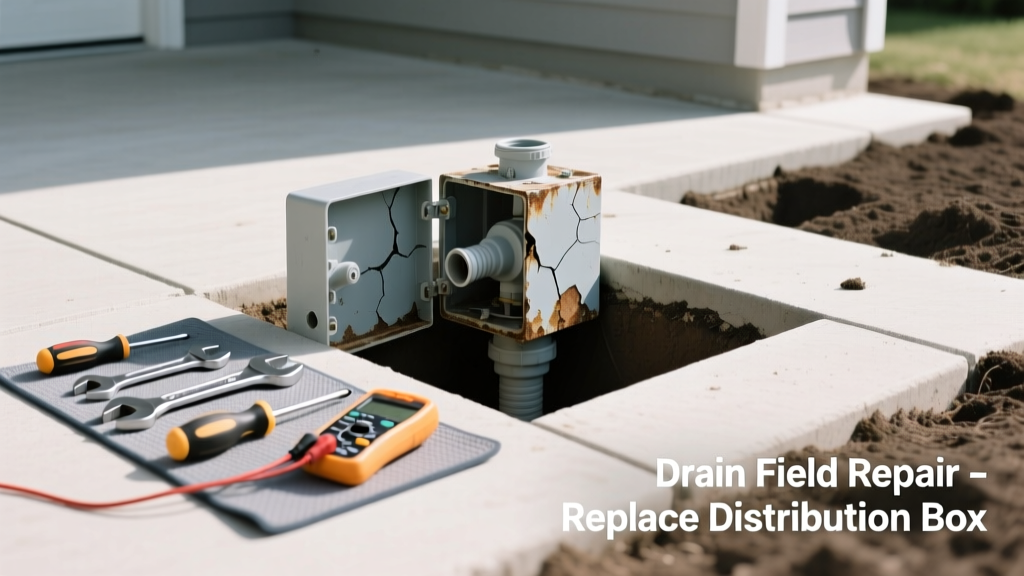
If your drain field is surfacing water, emitting odors, or backing up into your home, the culprit might not be the entire leach field—it could be the distribution box (D-box), a small but critical component that evenly splits effluent flow to laterals. Replacing just the D-box can restore function for $300–$900, versus $12,000+ for full system replacement. Most homeowners overlook this part because it’s buried and rarely inspected—until it cracks, shifts, or clogs.
Quick Diagnosis
Before assuming the whole drain field is shot, rule out these five common D-box failures:
- Cracked or broken concrete or PVC housing (visible during excavation)
- Settled or tilted box causing uneven flow (effluent only exits one lateral)
- Clogged inlet or outlet ports (debris, root intrusion, or mineral buildup)
- Misaligned or missing baffle plates (causing short-circuiting of flow)
- Corroded metal components in older systems (especially pre-1990 galvanized fittings)
Tools & Materials Needed
| Item | Purpose | Estimated Cost |
|---|---|---|
| Shovel & trenching spade | Dig precisely around the D-box without damaging pipes or laterals | $25–$45 |
| Level & string line | Ensure new D-box sits perfectly level for even distribution | $12–$28 |
| Replacement PVC D-box (12" or 18") | Code-compliant, watertight unit with adjustable outlets | $45–$110 |
| Gravel (¾" washed stone) | Bedding base and surround for stability and drainage | $40–$75 per ton |
| Flexible PVC couplings & sealant | Secure connections to inlet/outlet pipes without stress joints | $18–$32 |
Step-by-Step Fix
Replacing the distribution box requires careful excavation and precise reinstallation. Follow these steps in order:
- Locate and excavate: Use as-built drawings or probe rods to find the D-box (typically 6–12" from the septic tank outlet). Dig down carefully—stop when you expose the top lid. Remove soil from sides to expose full perimeter.
- Shut off flow & disconnect: Temporarily divert household wastewater (e.g., use portable toilet) or wait until tank is low. Cut inlet and outlet pipes using a reciprocating saw or hacksaw; leave 3–4" stubs for coupling.
- Remove old box & prepare base: Lift out the damaged D-box. Level the bottom of the hole, then add 3" of compacted gravel bed sloped 1/8" per foot toward outlets.
- Install new D-box: Set box on gravel bed. Use a level across all four corners. Adjust with shims if needed. Connect inlet/outlets with flexible couplings and NSF-listed sealant—no rigid glue joints.
- Backfill & verify: Backfill with native soil in 6" lifts, tamping each layer. Run a dye test: pour 5 gallons of water + non-toxic dye into the tank inlet and confirm equal flow from all lateral ends.
When to Call a Pro
DIY D-box replacement becomes unsafe or illegal in these scenarios:
- Your state requires licensed septic contractors for any subsurface work (e.g., Massachusetts, Florida, and Washington mandate permits and inspections)
- You discover broken or collapsed lateral lines during excavation—this signals broader field failure beyond the D-box
- The D-box sits under a driveway, patio, or utility line—excavation risks structural or service damage
- Soil percolation tests show marginal or failed absorption (indicating need for redesign, not just part replacement)
"Over 68% of 'failed' drain fields inspected by the National Environmental Services Center (NESC, 2022) had fully functional laterals—but malfunctioning distribution boxes causing uneven loading and premature biomat formation."
Prevention Tips
A well-maintained D-box lasts 25–40 years. Extend its life with these habits:
- Install risers with sealed, lockable lids to allow annual visual inspection without digging
- Use bacterial enzyme additives monthly to reduce grease and scum buildup in effluent entering the D-box
- Divert roof and surface runoff away from the drain field—hydrostatic pressure accelerates D-box settling
- Have your septic tank pumped every 3 years; solids overflowing into the D-box cause clogging and corrosion
Can I reuse the old pipe connectors?
No—old compression gaskets and rubber couplings degrade, lose elasticity, and rarely seal reliably after removal. Always install new NSF-61 certified couplings and lubricate with silicone-based sealant.
How deep should the new D-box sit?
Top of the D-box lid must be 6–12 inches below final grade—deep enough to avoid frost heave (in cold climates) but shallow enough for future access. Check local code; some municipalities require minimum 12" cover over lid.
Do I need a permit for D-box replacement?
Yes—in 41 states, replacing any subsurface septic component requires a permit and third-party inspection. Contact your county health department before digging. In unpermitted cases, insurance and resale disclosures may be voided.
What if effluent isn’t flowing equally after replacement?
First, check for debris in outlet orifices—use a stiff wire or compressed air. If flow remains unequal, the D-box may be slightly tilted or an outlet pipe is kinked. Excavate and relevel, or replace that lateral’s connector with a flow-regulating orifice plate.
Can tree roots damage the D-box itself?
Rarely—the D-box is usually too thick and non-porous for root penetration. But roots commonly invade cracked inlet/outlet pipes *leading to* the D-box, causing blockages that mimic D-box failure. Inspect those pipes with a sewer camera before replacement.
Is a plastic D-box better than concrete?
For DIY replacement, yes—modern HDPE or PVC D-boxes weigh 15–25 lbs vs. 120+ lbs for concrete, resist corrosion, and include built-in flow splitters and adjustable outlets. Concrete is still required in some high-load commercial applications, per ASTM C1227.
Replacing a faulty distribution box won’t fix a truly saturated or collapsed drain field—but it resolves the majority of ‘false failure’ cases where the rest of the system is sound. You’ll save thousands, avoid unnecessary excavation, and gain confidence handling future septic maintenance. For deeper issues like lateral collapse or soil compaction, start with a septic tank pumping schedule and follow up with a review of your as-built drawings—then decide whether to call in a certified inspector or explore options like drain field aeration systems.