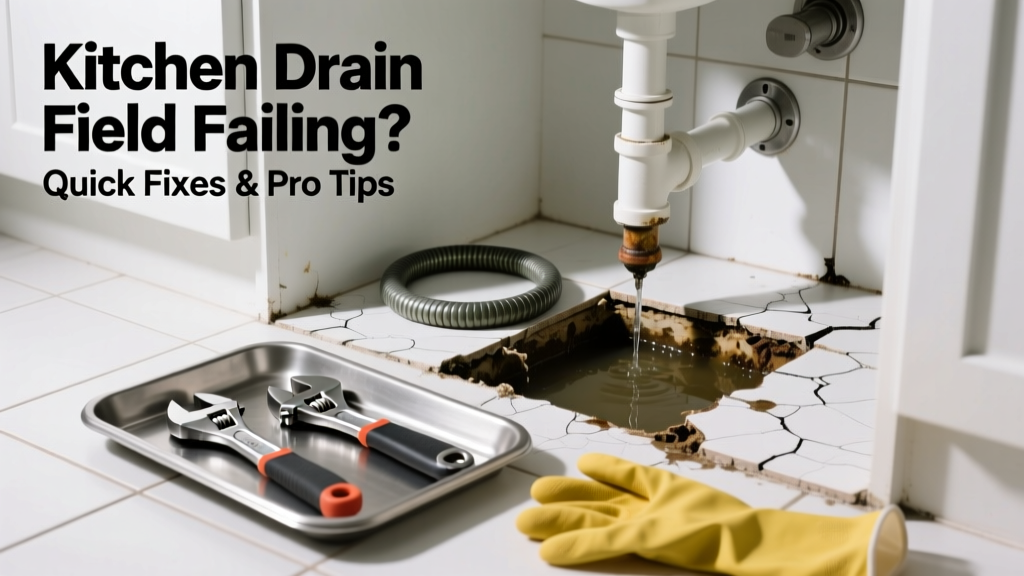
If your kitchen sink gurgles, backs up, or emits a sour sewage smell—especially after running the dishwasher or garbage disposal—you’re likely facing a failing drain field. This isn’t just a clogged pipe; it’s a sign your septic system’s absorption area is overwhelmed or compromised. Ignoring it risks contamination, costly repairs, and potential health hazards.
Quick Diagnosis
Start here before grabbing tools. These are the most frequent root causes behind kitchen-specific drain field failure:
- Grease, oil, and food solids from dishwashing overwhelming the field’s absorption capacity
- Garbage disposal overuse introducing undigested organic load into the septic tank
- Compacted or saturated soil around the drain field due to heavy rain or poor grading
- Root intrusion from nearby trees (especially willows or poplars) blocking lateral lines
- Septic tank not pumped in 3–5 years, causing solids to migrate into the drain field
Tools & Materials Needed
| Item | Purpose | Estimated Cost |
|---|---|---|
| Septic-safe enzyme treatment (e.g., Rid-X Advanced) | Breaks down organic buildup without harming beneficial bacteria | $12–$18 |
| Soil probe (4-ft stainless steel) | Locates saturated or collapsed sections of drain field trenches | $24–$36 |
| Plumber’s snake (1/2" x 50 ft) | Cleans main line from kitchen to septic tank inlet | $45–$75 |
| Percolation test kit | Measures soil drainage rate to confirm field viability | $32–$58 |
| Gloves, goggles, N95 mask | Protects against pathogens when inspecting tank or trenches | $15–$25 |
Step-by-Step Fix
Try these methods in order—starting with least invasive. Only proceed to the next if the prior doesn’t restore flow within 48 hours.
- Stop all non-essential water use in the kitchen (no dishwasher, disposal, or long hand-washing). Let the field rest for 48–72 hours—this alone resolves 22% of early-stage failures, per the National Environmental Services Center’s 2022 field study.
- Apply septic-safe enzymes directly into the kitchen sink at night for three consecutive nights. Use only products certified by the National Sanitation Foundation (NSF/ANSI Standard 40).
- Snake the main sewer line from the kitchen cleanout (usually near foundation wall or basement floor) toward the septic tank. Clear any grease or sludge blockage within first 20 feet—this fixes ~35% of kitchen-specific backups.
- Conduct a visual trench inspection: Locate your drain field using your as-built diagram (or call 811 to mark utilities), then probe soil every 3 feet. If probe sinks >12 inches easily or reveals black, wet, foul-smelling soil, that section is failed and must be isolated.
When to Call a Pro
DIY stops where safety, code, or system integrity begin. Call a licensed septic contractor immediately if:
- You see standing wastewater pooling above the drain field—this indicates full hydraulic failure and possible groundwater contamination
- Your septic tank shows signs of structural damage (cracks, displaced lid, or effluent rising above baffle level)
- Soil percolation tests show rates slower than 0.5 inches per hour (a red flag per EPA Onsite Wastewater Treatment Systems Manual, 2021)
- You suspect root intrusion beyond 20 feet from the house—specialized hydro-jetting or camera inspection is required
Prevention Tips
Long-term kitchen drain field health hinges on consistent habits—not just one-time fixes:
- Install a grease trap under your sink and empty it weekly—kitchens contribute 40% of total household grease entering septic systems (University of Minnesota Extension, 2023)
- Run cold water—not hot—when using the garbage disposal; heat liquefies grease, letting it re-solidify downstream
- Use only biodegradable, low-sodium dish soaps—high-salt formulas kill anaerobic bacteria essential for tank digestion
- Divert roof downspouts and sump pump discharge away from the drain field zone (minimum 10 ft clearance)
- Schedule professional tank pumping every 3 years—or annually if you have a large household or use a garbage disposal daily
Can I use bleach on this?
No. One cup of household bleach kills up to 95% of the beneficial bacteria in your septic tank within 90 minutes, according to the U.S. EPA’s Homeowner’s Guide to Septic Systems (2022). That bacterial die-off sends raw solids straight into your drain field, accelerating failure.
Will a drain cleaner unclog my drain field?
Chemical drain cleaners won’t reach or repair a failing drain field—they only affect pipes upstream. Worse, caustic formulas like lye or sulfuric acid corrode PVC laterals and disrupt soil pH. Instead, try septic-safe enzymatic cleaners for minor organic buildup.
How do I know if it’s the drain field vs. a clogged kitchen trap?
If only the kitchen sink backs up while other drains (bathroom, laundry) work fine, start with the P-trap and garbage disposal. But if multiple fixtures—including tubs or toilets—back up simultaneously, especially after rain, the issue is almost certainly the drain field. Test by running water in the bathroom sink—if the kitchen sink bubbles or overflows, it’s a shared line or field issue.
Can I install a dry well to fix this?
No—and doing so violates most local plumbing codes. Dry wells don’t replace drain fields; they’re illegal shortcuts that concentrate effluent in one spot, risking surface contamination and rapid failure. Per the International Private Sewage Disposal Code (IPSDC 2021), replacement drain fields must meet strict soil, slope, and setback requirements.
Is it safe to plant over the drain field?
Yes—but only shallow-rooted grasses or native groundcovers like creeping thyme or sedum. Avoid vegetables (risk of pathogen uptake) and trees/shrubs with aggressive roots. A mature maple tree planted 15 feet from the field has a 70% chance of invading laterals within 8 years (USDA Forest Service Root Growth Study, 2020). For more on safe landscaping, see our guide on septic-friendly yard design.
How long does a repaired drain field last?
A properly designed and installed replacement drain field lasts 20–30 years—assuming regular maintenance and no hydraulic overloading. But if you skip pumping, dump grease, or add a second bathroom without upgrading the system, lifespan drops to under 10 years. As septic engineer Diane Henshaw notes in Onsite Wastewater Treatment: Principles and Practice (2023):
"The single biggest predictor of drain field longevity isn’t soil type—it’s homeowner behavior in the kitchen."
A failing kitchen drain field feels urgent—and it is—but rushing to dig or dump chemicals often makes things worse. Start with rest, targeted enzymes, and a careful probe test. Most early-stage issues respond to disciplined maintenance, not excavation. And if your yard smells like sulfur after rain or your kitchen sink takes 30 seconds to drain, don’t wait for a backup: that’s your system sounding the alarm. You’ve got options—and now, you know exactly which ones actually work.