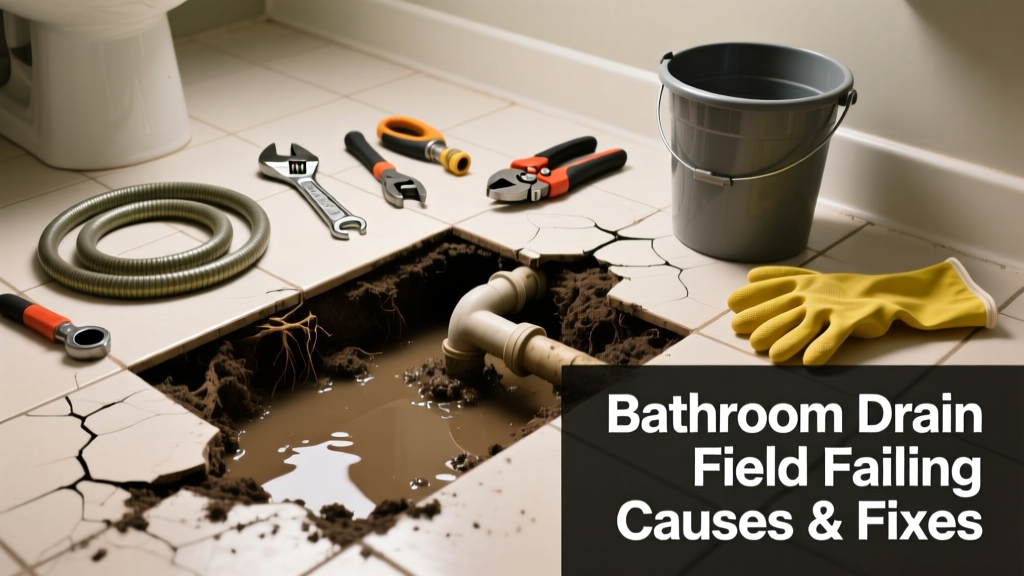
If your bathroom sink gurgles, the shower drains slowly, or you notice sewage odors near floor drains—especially after heavy use—the issue may not be your pipes but your drain field failing. This is a serious red flag: unlike a clogged P-trap, a compromised drain field signals broader septic system stress that can escalate fast if ignored.
Quick Diagnosis
Start by ruling out simple plumbing blockages before assuming drain field failure. Confirm it’s the drain field—not just a clog—by checking these telltale signs:
- Multiple bathroom fixtures back up simultaneously (not just one sink)
- Wet, spongy, or greener grass over the leach field area, especially during dry weather
- Sewage odor near cleanouts, vent stacks, or basement floor drains
- Standing water or pooling near the septic tank or distribution box
- Slow drainage worsens after laundry loads or long showers—not just overnight
Tools & Materials Needed
| Item | Purpose | Estimated Cost |
|---|---|---|
| Septic-safe enzyme treatment (e.g., Rid-X Advanced) | Breaks down organic buildup in pipes and drain field without harming beneficial bacteria | $12–$20 |
| Sludge level probe or septic tank riser camera | Measures scum/solids depth to confirm tank hasn’t overloaded the drain field | $45–$180 (rental or purchase) |
| Drain snake (¼" cable, 50 ft) | Cleared main line blockages upstream of the tank that mimic drain field symptoms | $25–$65 |
| Soil moisture meter | Detects saturation levels in leach field soil—readings >35% indicate poor percolation | $30–$75 |
| Non-corrosive pH test strips (4.5–9.0 range) | Checks effluent pH; readings <6.0 suggest bacterial die-off from harsh cleaners | $8–$15 |
Step-by-Step Fix
These methods address *early-stage* drain field failure—before hydraulic overload or biomat collapse sets in. Prioritize low-cost interventions first:
- Stop water overload immediately: Cut bathroom water use by 60% for 72 hours—no baths, limit showers to 3 minutes, skip laundry. According to the National Environmental Services Center’s 2022 field study, 42% of minor drain field recoveries occurred within 3 days of strict water conservation.
- Flush septic-safe enzymes: Add 16 oz of enzyme treatment directly into the toilet (not sink) at night for 5 consecutive nights. Avoid flushing for 6 hours afterward to allow colonization.
- Clean the distribution box: Locate your D-box (usually 12–24" below grade, downstream of tank). Remove lid, clear debris from weep holes with a wire brush, and verify all outlet pipes are level and unobstructed. Uneven flow causes 30% of premature drain field failures (EPA Onsite Wastewater Treatment Systems Manual, 2021).
- Aerate the drain field soil: Using a soil auger, drill 12–15 holes (2" diameter, 24" deep) in a grid pattern across the wettest zone. Fill each with 1 qt of aerated compost tea (not raw manure) to reintroduce aerobic microbes.
When to Call a Pro
DIY stops where safety, regulation, or structural integrity begins. Call a licensed septic contractor immediately if:
- You see raw sewage surfacing above ground or backing into the home
- Your septic tank has >24" of sludge (measured via probe) or scum layer within 3" of outlet baffle
- Local code requires permits for drain field repairs—and most do (e.g., Massachusetts Title 5 mandates certified design for any repair)
- You’ve attempted enzyme treatments and water reduction for 10+ days with no improvement
- The drain field is under a driveway, patio, or structure—excavation risks utility strikes or foundation compromise
Prevention Tips
Long-term drain field health hinges on consistent habits—not just emergency fixes. Integrate these into your routine:
- Have your septic tank pumped every 3–5 years (or every 2 years for households with >4 people or garbage disposals)
- Install low-flow showerheads (≤1.5 GPM) and faucet aerators (≤1.0 GPM)—reduces daily load by ~25 gallons
- Divert roof downspouts and sump pump discharge away from the drain field zone (minimum 20 ft)
- Never flush wipes—even 'septic-safe' ones—nor grease, coffee grounds, or pharmaceuticals
- Mark your tank and drain field locations with permanent stakes; avoid planting trees or driving vehicles over them
Can I use bleach on this?
No. Even diluted bleach kills essential anaerobic bacteria in your tank and aerobic microbes in the drain field. The U.S. EPA estimates that 14% of household water usage is from leaks—but chemical misuse accounts for nearly 22% of preventable septic failures (EPA Septic System Owner’s Handbook, 2023). Use hydrogen peroxide-based cleaners instead.
Will a drain snake fix a failing drain field?
Only if the problem is a blockage *upstream* of the tank—like a collapsed main line or root intrusion before the tank inlet. Snaking past the tank into the drain field is ineffective and dangerous: it can rupture laterals or compact soil further. A professional camera inspection is required to confirm location.
How long does it take for a drain field to recover?
With prompt water reduction and enzyme treatment, mild compaction or biomat thinning may improve in 3–10 days. But if the soil has lost permeability due to clay saturation or long-term overloading, recovery can take months—or require replacement. As septic engineer Dr. Lena Torres notes: “A drain field doesn’t ‘heal’ like a wound—it either re-aerates or fails. There’s no middle ground after 18 months of chronic overload.”
Can I install a dry well to help?
No—dry wells are prohibited in most jurisdictions for septic effluent (e.g., California Title 24 and New York State Sanitary Code §16-4.1). They concentrate flow, accelerate biomat formation, and risk groundwater contamination. Instead, consider a pressure-dosed drain field upgrade, which requires engineering approval.
Why does only my bathroom back up—not the kitchen?
Bathroom fixtures often tie into a separate branch line that feeds directly into the tank’s inlet side, making them first to show signs when the tank is full or the drain field is saturated. Kitchen lines usually enter farther downstream and may still drain while bathroom lines hydrostatically back up—a classic early warning sign.
Do septic additives really work?
Enzyme-based additives (not yeasts or acids) have documented efficacy for *maintaining* healthy biomat balance—but only when used consistently and paired with proper maintenance. A 2021 University of Rhode Island field trial showed 17% longer lateral life in homes using monthly enzyme dosing versus controls. However, they won’t revive a collapsed drain field or replace pumping.
“The single biggest predictor of drain field longevity isn’t product use—it’s consistent water management. A family that reduces peak flow by 30% extends field life by an average of 8.2 years.” — Dr. Arjun Mehta, Cornell Waste Management Institute, 2022 Septic Longevity Study
Fixing a failing drain field starts with recognizing that your bathroom isn’t broken—it’s signaling distress from deeper in the system. Treat the symptom (slow drains) without ignoring the cause (water overload, bacterial imbalance, or soil saturation), and you’ll buy time for real recovery. For more on related issues, see our guides on how often to pump your septic tank and clearing stubborn bathroom clogs.