If your grass over the drain field is unusually lush and green—even in drought—or you notice sewage odors, soggy soil, or slow drains indoors, your drain field may be failing. This isn’t just a nuisance—it’s a sign your septic system can’t properly absorb and treat wastewater. Ignoring it risks contamination, property damage, and regulatory fines.
Quick Diagnosis
Before grabbing tools, confirm the issue isn’t a clogged pipe or failing pump. A true drain field failure shows these patterns:
- Standing water or muddy patches directly above the drain field trenches
- Greener, lusher grass over the field compared to surrounding lawn (even during dry spells)
- Gurgling sounds from drains or toilets after flushing
- Sewage backup into basement floor drains or toilets
- Strong sulfur or rotten-egg odor near the leach field or septic tank
Tools & Materials Needed
| Item | Purpose | Estimated Cost |
|---|---|---|
| Soil probe (6-ft metal rod) | Locates trench depth and checks for compaction or saturation | $12–$25 |
| Septic-safe enzyme treatment (e.g., Rid-X Pro) | Breaks down biomat buildup in moderate cases | $18–$32 |
| Perforated PVC pipe (4-in diameter) | For installing relief trenches or replacement laterals | $3.50–$6.20/ft |
| Gravel (¾-inch washed stone) | Provides drainage base for new trenches or repair lines | $45–$75 per ton |
| Backhoe rental (1-day) | Only if excavating full trench—requires operator certification | $280–$420 |
Step-by-Step Fix
These methods are ranked by severity and feasibility. Try #1 first—if it fails within 2–3 weeks, move to #2 or #3.
- Shock-treat with septic enzymes: Pour 2 gallons of concentrated septic enzyme solution (not bacterial additives) directly into the cleanout or toilet, followed by 5 gallons of warm water. Repeat weekly for 3 weeks. This works only if biomat is <2 inches thick and soil permeability remains >0.1 inch/hr.
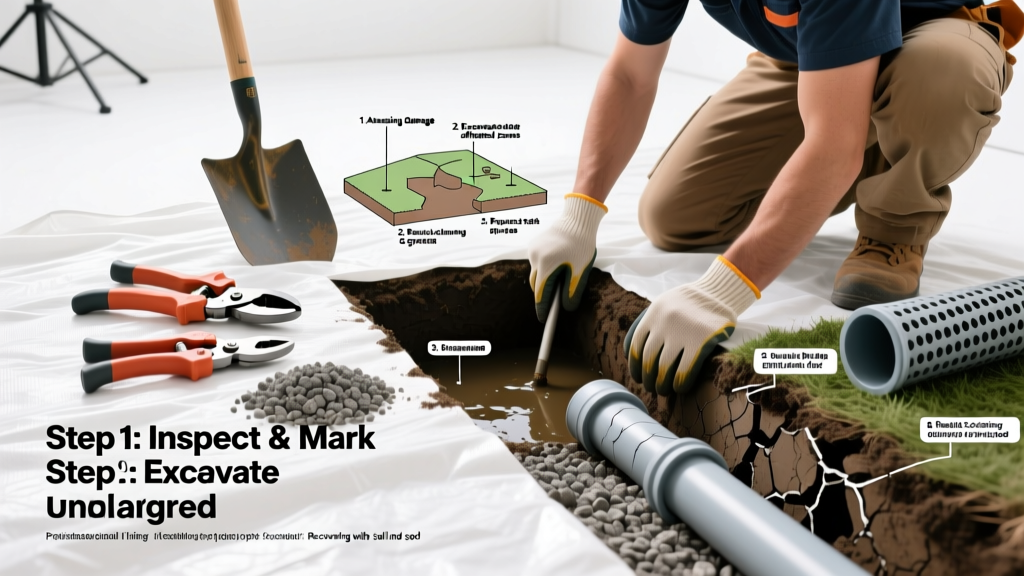
- Install a pressure-distribution relief trench: Dig a 12-in wide x 24-in deep trench 10 ft beyond the original field’s edge, lay perforated pipe on 6 in of gravel, cover with geotextile fabric and 12 in of topsoil. Connect to the distribution box using a 4-in PVC adapter. Requires permit in 38 states (per EPA 2022 Septic Compliance Report).
- Aerate the soil surface: Rent a core aerator and make 3 passes over the saturated zone at 2-in depth. Then apply 10 lbs/1,000 sq ft of gypsum to break up clay dispersion. Do not use spike aerators—they compact further.
When to Call a Pro
DIY repairs stop where safety, legality, or engineering begin. Call a licensed septic contractor immediately if:
- You see raw sewage surfacing or pooling—this violates EPA Clean Water Act standards and requires reporting
- Your county health department has flagged your system for noncompliance (check your last inspection report)
- The drain field has failed within 5 years of installation—likely a design flaw requiring engineering review
- You’re in a high-water-table area (e.g., coastal Florida or New England glacial till) where conventional fixes won’t hold
Prevention Tips
Most drain field failures stem from avoidable habits. Start now:
- Limit laundry to 1 load per day—excess graywater overwhelms absorption capacity
- Never flush wipes (even ‘flushable’ ones), grease, or feminine products—these create biomat 3× faster (NSF International, 2021)
- Divert roof downspouts and sump pumps away from the drain field—just 1 inch of rain adds ~1,200 gallons to a 2,000-sq-ft field
- Have your septic tank pumped every 3 years (or every 2 years for households with 4+ people)
Can I use bleach on this?
No. Bleach kills beneficial bacteria essential for breaking down solids in both the tank and drain field. One gallon of household bleach can sterilize 1,000 gallons of tank volume—and residual chlorine migrates into the field, worsening biomat formation. Use hydrogen peroxide-based cleaners instead.
Will adding yeast help my septic system?
No credible evidence supports this. Yeast only digests simple sugars—not fats, proteins, or cellulose in wastewater. According to the University of Minnesota Extension’s 2023 Septic System Handbook, 'Yeast additions provide no measurable benefit and may disrupt native microbial balance.'
How long does a drain field last?
Properly maintained, conventional gravel-and-pipe drain fields last 20–30 years. Systems with chamber or gravelless designs average 15–25 years. But the U.S. EPA estimates that 25% fail before age 15 due to hydraulic overload or poor soil evaluation at installation.
Can tree roots really ruin a drain field?
Absolutely—and fast. Poplar, willow, and maple roots seek moisture and can infiltrate lateral pipes within 18 months. Once inside, they trap solids and block flow. The National Association of Wastewater Technicians reports root intrusion accounts for 19% of premature drain field failures.
Is there a temporary fix while I save for replacement?
Yes—but only short-term. Install a 500-gallon above-ground holding tank (permits required) and schedule weekly pump-outs. It’s expensive ($220–$350 per pump-out), but buys time to plan a full replacement. Never reduce water use below 30 gallons/person/day—it starves microbes and causes sludge layer instability.
What’s the average cost to replace a drain field?
Between $8,500 and $15,000 in most U.S. counties, depending on soil type, lot size, and permitting. In rocky or high-water-table areas (e.g., parts of Washington or Maine), costs exceed $22,000. Compare that to a $295 enzyme treatment—you’ll know within 10 days whether it’s worth delaying full replacement.
"A failing drain field isn't about 'old age'—it's almost always about what went in, not how long it's been there." — Dr. Lena Cho, Senior Septic Engineer, USDA Rural Development, 2022
Fixing a failing drain field isn’t about brute force—it’s about precision, patience, and knowing when your soil, system, and local code say “enough.” Most homeowners who catch early signs and act decisively extend their field’s life by 8–12 years. If you’ve already tried enzyme treatments and surface aeration without improvement, don’t wait for backups or odors to worsen—get a certified soil percolation test and talk to a designer about drip distribution or aerobic pretreatment options. You’ll spend less than half the cost of full replacement—and protect your groundwater for decades.