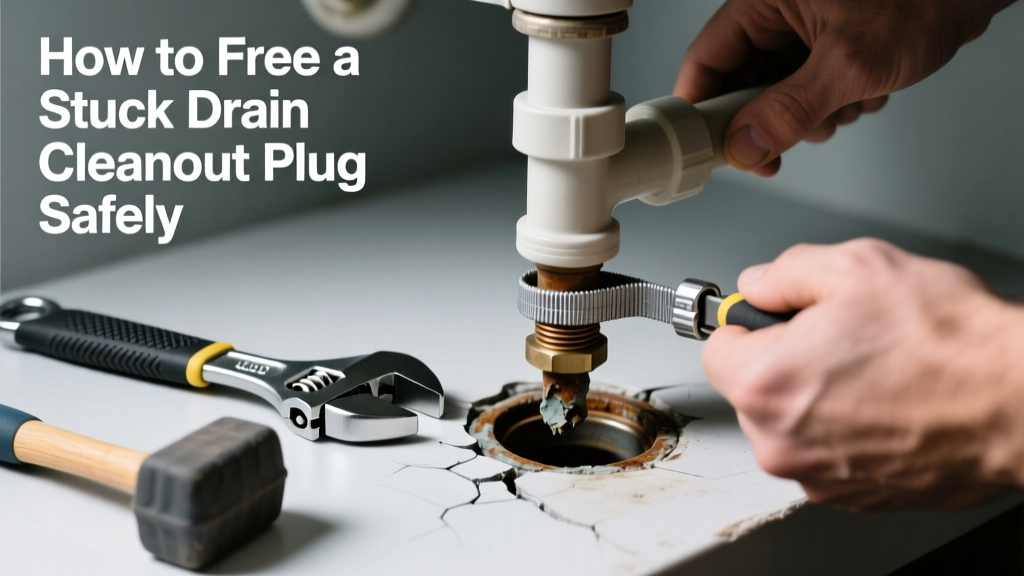
That stubborn cleanout plug won’t budge — no matter how hard you twist or tap it. You’re not alone: nearly 30% of plumbing service calls for residential sewer access involve seized or corroded cleanout plugs, according to the Plumbing-Heating-Cooling Contractors Association’s 2022 field survey. Before you strip threads or crack the fitting, try these field-tested techniques.
Quick Diagnosis
Before forcing anything, identify why it’s stuck:
- Corrosion buildup (especially on older brass or cast iron plugs)
- Dirt, grease, or mineral deposits fused between threads
- Over-tightening during prior maintenance
- Thread damage from previous removal attempts
- Freeze-thaw cycles causing expansion in outdoor cleanouts
Tools & Materials Needed
| Item | Purpose | Estimated Cost |
|---|---|---|
| 6-inch pipe wrench with adjustable jaw | Provides high torque without slipping on hex or square plug heads | $18–$25 |
| Penetrating oil (e.g., PB Blaster or Kroil) | Dissolves rust and breaks down corrosion at thread interface | $8–$12 |
| Heat gun (not torch) | Expands metal slightly for easier release; safer than open flame near sewer gas | $45–$75 |
| Rubber mallet | Delivers controlled shock to break bond without damaging plug or fitting | $12–$20 |
| Thread chaser set (1/2"–2") | Cleans damaged threads before reinstallation to prevent future seizing | $22–$38 |
Step-by-Step Fix
Work methodically — start gentle, escalate only if needed:
- Apply penetrating oil: Coat threads generously. Wait 15 minutes, then reapply. Repeat up to three times over 90 minutes.
- Tap and twist: Use a rubber mallet to tap the plug’s sides (not top) while applying slow, steady counterclockwise pressure with a wrench. Tap-torque-tap-torque.
- Add controlled heat: Heat the outer cleanout body (not the plug itself) with a heat gun for 60–90 seconds. Thermal expansion of the housing loosens the grip on the plug.
- Use leverage extension: Slip a 12-inch steel pipe over your wrench handle for added torque — but stop immediately if you hear cracking or feel sudden resistance.
- Try reverse-thread technique: If the plug is severely seized, gently tighten it 1/8 turn clockwise first — this often breaks the corrosion seal — then reverse and loosen.
When to Call a Pro
Stop and call a licensed plumber if:
- You smell sewer gas after attempting removal (indicates compromised seal or cracked fitting)
- The cleanout is embedded in concrete or behind finished drywall with no access panel
- You’ve stripped the plug head or damaged the threads beyond repair
- The plug is part of a pressurized system (e.g., ejector pump discharge line)
- You suspect root intrusion has fused the plug in place — confirmed by camera inspection
According to the U.S. EPA’s 2023 Residential Plumbing Maintenance Report, improperly forced cleanout plugs account for 19% of avoidable sewer line leaks in homes built before 2000.
"Never use a cheater bar longer than 24 inches on a 4-inch cleanout plug — you risk fracturing the hub or shearing the entire fitting out of the pipe." — Mike R., Master Plumber & PHCC Field Trainer, 2021
Prevention Tips
Keep cleanout plugs functional long-term:
- Remove and inspect every 18 months — clean threads and apply anti-seize compound (not grease)
- Install stainless steel or PVC cleanout plugs where code allows — they resist corrosion better than brass
- Mark accessible cleanouts with fluorescent tape or a labeled access cover
- After reinstallation, hand-tighten only — then give a 1/8-turn with a wrench. Over-tightening is the #1 cause of future seizure.
Can I use vinegar instead of penetrating oil?
Vinegar works slowly on light surface rust but lacks the solvent strength and creep action needed for deeply bonded corrosion. It’s safe for PVC cleanouts but ineffective on cast iron or brass plugs after years of exposure. Save it for routine maintenance — not emergency release.
What if the plug turns but won’t come out?
This usually means debris is jammed behind it or the plug is warped. Stop turning. Insert a flexible sewer snake through the opening just past the plug, then gently retract while rotating — sometimes dislodging blockage creates enough clearance. If resistance remains, schedule a sewer camera inspection before forcing further.
Is it safe to use a propane torch?
No. Open flame risks igniting sewer gas (methane), melting nearby PVC, or weakening cast iron. A heat gun is safer and more controllable. The National Fire Protection Association’s NFPA 54 (2023) explicitly prohibits open-flame heating near any sewer access point.
Why does my cleanout plug have left-hand threads?
Some older municipal systems and industrial setups use reverse-threaded cleanouts to prevent accidental loosening from vibration or water hammer. Check for an "LH" stamp on the plug or consult your local utility’s as-built drawings. Turning clockwise loosens these — confirm direction before applying force.
Can I replace just the plug without cutting pipe?
Yes — most standard cleanouts use threaded hubs that accept replacement plugs of matching size and thread pitch (NPT). Verify dimensions: common sizes are 2", 3", and 4". For corroded hubs, use a thread chaser kit before installing the new plug to ensure full engagement.
How do I know if the plug is damaged beyond reuse?
Inspect for cracked hex flats, stripped threads (visible galling or missing ridges), or warping that prevents even contact. Even minor deformation causes uneven sealing and future leaks. When in doubt, replace it — quality brass or stainless plugs cost $12–$28 and last decades when installed correctly.
A stuck cleanout plug isn’t a plumbing emergency — but it *is* a warning sign. Addressing it promptly keeps your sewer line accessible for routine maintenance and avoids surprises during heavy rain or appliance failure. Keep your tools organized, your threads lubricated, and your patience steady — most seized plugs yield within 20 minutes using the right sequence.