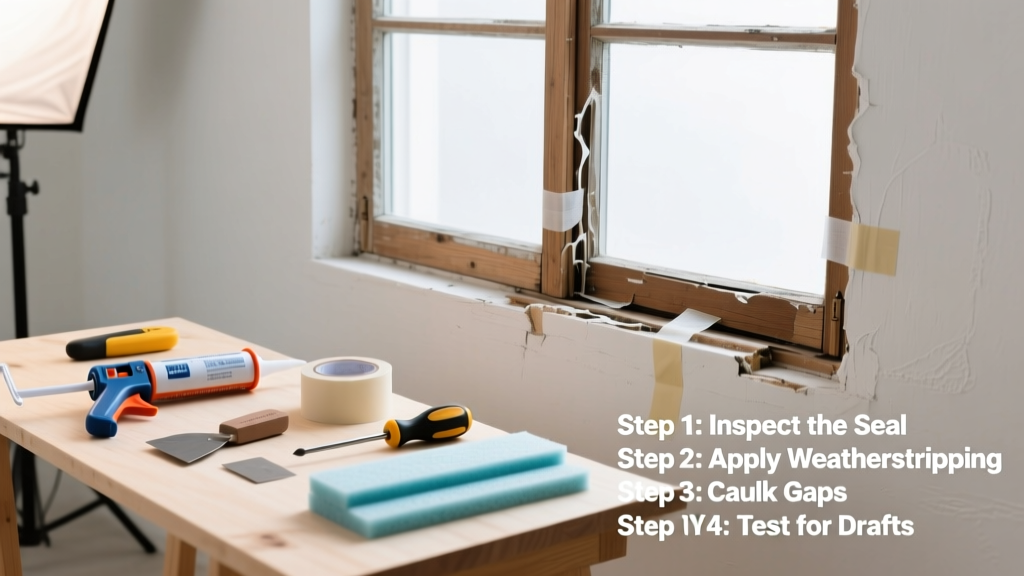
That whisper of cold air sneaking in around your window isn’t just annoying—it’s costing you money. The U.S. EPA estimates that air leaks around windows and doors account for up to 25% of residential heating and cooling loss. A drafty window is almost always fixable without replacing the entire unit—especially if the frame is sound and the glass intact.
Quick Diagnosis
Before grabbing tools, pinpoint the source. Drafts rarely come from one spot alone. Check these common culprits:
- Gaps between the window sash and frame (most frequent)
- Cracked or missing weatherstripping on movable parts
- Decayed or warped wood in older frames
- Failed caulk or sealant at the exterior perimeter
- Loose or misaligned hardware causing poor closure
Tools & Materials Needed
| Item | Purpose | Estimated Cost |
|---|---|---|
| 3M Foam Tape (1/4" x 60') or V-Seal Weatherstrip | Creates an airtight seal along sash edges | $8–$12 |
| High-quality acrylic-latex caulk (e.g., DAP Alex Plus) | Seals exterior gaps where frame meets siding | $4–$7 |
| Caulk gun & utility knife | Applies and trims caulk cleanly | $10–$15 |
| Putty knife & sandpaper (120-grit) | Removes old caulk; preps wood surfaces | $5–$9 |
| Window lock tightening kit or screwdriver set | Adjusts tension on friction hinges or latches | $0–$6 |
Step-by-Step Fix
Use this sequence based on severity and location of the draft:
- Test and tighten hardware: Close the window fully and check if the latch engages snugly. Tighten hinge screws and adjust lock cams using a 2.5mm hex key—many vinyl and aluminum windows have adjustable locking points.
- Replace weatherstripping: Peel off brittle foam or vinyl strips. Clean the channel with rubbing alcohol, then press in new V-strip or bulb seal—cut ends at 45° angles for seamless corners.
- Caulk the exterior perimeter: Remove cracked or shrunk caulk with a putty knife. Prime bare wood if needed, then apply a continuous 1/4" bead of paintable acrylic-latex caulk along the gap between window frame and siding.
- Install interior rope caulk (temporary fix): For renters or quick winter relief, roll soft rope caulk into thin snakes and press into gaps along the sash edge. It’s removable and leaves no residue.
When to Call a Pro
DIY has limits—and safety or structural integrity shouldn’t be compromised. Call a licensed window contractor if:
- The window sash won’t stay closed or drops when opened (failed balance mechanism)
- You see condensation *between* double-pane glass layers (seal failure)
- There’s rot deeper than 1/4" in wood frames, especially at bottom rails or jambs
- Brickmold or header flashing is damaged or missing—this risks water intrusion behind walls
According to the Insurance Institute for Business & Home Safety's 2023 report, improperly sealed replacement windows are responsible for 68% of post-installation moisture damage claims—so professional installation matters when full replacement is needed.
Prevention Tips
Maintain your windows year-round to avoid repeat drafts:
- Inspect weatherstripping every fall and replace it before first frost
- Re-caulk exterior joints every 3–5 years—acrylic latex lasts longer than silicone near wood
- Wipe down tracks quarterly and vacuum debris that prevents full closure
- Open and close each window fully once per season to redistribute lubricant in mechanisms
Can I use expanding foam around my window frame?
No—never use spray foam inside the operational gap between sash and frame. It expands unpredictably and can warp moving parts or prevent full closure. Use it only in non-moving cavities behind the rough opening during new construction or full replacement, not as a draft fix.
Will plastic window film really help with drafts?
Yes—but only as a temporary thermal barrier, not an air-seal solution. Shrink film reduces convective heat loss by creating a dead-air space, but it does nothing to stop air infiltration at the sash. Pair it with proper weatherstripping for best results.
How do I know if my window is beyond repair?
If the frame is soft to the touch, crumbles under light pressure, or shows mold staining deep in grain, it’s likely structurally compromised. Also, if multiple panes are fogged and seals failed within 5 years, manufacturing defects may indicate broader quality issues—consider window replacement cost analysis.
Is duct tape okay for sealing a draft temporarily?
Avoid duct tape entirely. Its adhesive dries out quickly in sunlight and temperature swings, leaving sticky residue that’s hard to remove and damages paint or vinyl. Use painter’s tape for short-term marking only—or better yet, rope caulk for clean, removable sealing.
Do storm windows help with drafts on old single-pane units?
Absolutely—they’re one of the most cost-effective upgrades for pre-1970s homes. A well-fitted interior or exterior storm window adds R-value and creates a buffer zone that cuts air infiltration by up to 45%, according to the U.S. Department of Energy’s 2022 Residential Energy Efficiency Guide.
Why does my window draft more in winter than summer?
Colder air is denser and contracts materials slightly—wood shrinks, vinyl stiffens, and gaskets lose elasticity. That tiny 1/16" gap becomes a real pathway. Seasonal expansion/contraction also loosens fasteners over time, making winter the perfect time to re-tighten and re-seal.
Fixing a drafty window doesn’t require a contractor’s license—just patience, the right materials, and knowing when to stop and call for backup. Most drafts vanish after tightening hardware and refreshing weatherstripping, returning comfort and cutting your energy bills. If you’ve tackled one window, try the next—your home will feel warmer, quieter, and more efficient all winter long. For deeper issues like rotted frames or failed glazing, explore our guide on wood window repair or double-pane window repair.