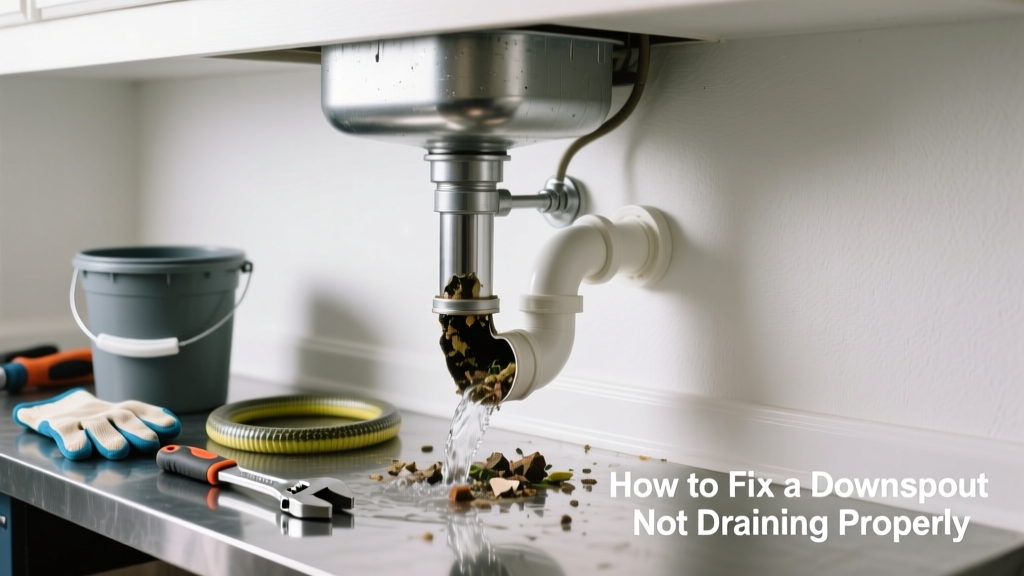
Water pooling near your foundation or overflowing gutters during rain? A downspout not draining is more than an eyesore—it’s a red flag for potential basement leaks, soil erosion, or fascia rot. Most clogs are simple to clear in under 30 minutes if you act fast and know where to look.
Quick Diagnosis
Before grabbing tools, rule out the obvious:
- Debris blockage (leaves, pine needles, bird nests) inside the downspout or elbow joints
- Kinked, crushed, or detached downspout sections—especially at transitions or near grade
- Improper slope: downspouts should pitch 1/4″ per foot toward the outlet
- Clogged splash block or buried drain line (common with French drains or underground extensions)
- Frozen ice dam in winter—often hidden behind insulation or inside concealed pipes
Tools & Materials Needed
| Item | Purpose | Estimated Cost |
|---|---|---|
| Gutter scoop or trowel | Removes wet leaves and sludge from gutter head and downspout top | $8–$15 |
| Plumber’s snake (¼" x 25 ft) | Clears obstructions deep in vertical or angled sections | $12–$22 |
| High-pressure garden hose + nozzle | Flushes debris backward from bottom up; avoids forcing gunk deeper | $18–$35 |
| Work gloves & safety glasses | Protects hands from rust, sharp metal edges, and flying debris | $10–$20 |
| Downspout connector sealant (butyl rubber) | Re-seals leaking joints after reassembly | $6–$12 |
Step-by-Step Fix
Start at the top—and work down. Never assume the clog is where water backs up; it’s often lower.
- Clear the gutter outlet: Scoop debris from the gutter’s downspout opening. Check for trapped shingle grit or moss matting that blocks entry.
- Snake from the bottom up: Insert a plumber’s snake into the downspout’s bottom opening. Rotate while pushing gently—stop if resistance feels like metal-on-metal (you may hit a rivet or seam). Pull out debris on the coil.
- Back-flush with water: Attach a high-pressure nozzle to your hose. Insert tip 6 inches into the bottom opening and blast upward for 15–20 seconds. Repeat if flow remains sluggish.
- Inspect and reseat connections: Loosen couplings at elbows or offsets. Look for cracked seams or corroded rivets. Reassemble with fresh butyl sealant and tighten snugly—not overtightened.
- Test with a bucket: Pour 5 gallons of water slowly into the gutter. Watch flow through each joint and outlet. Any drip = reseal or replace that section.
When to Call a Pro
DIY stops where safety or structural integrity begins:
- You hear gurgling or see water backing up into soffits—this suggests internal roof drainage or concealed leader pipe failure
- The downspout connects to an underground PVC or corrugated drain tile that’s collapsed or root-invaded (requires camera inspection)
- Aluminum or galvanized downspouts show widespread pitting, rust-through, or separation at multiple seams
- You’re on a steep roof (>6:12 pitch) without fall protection or anchor points
According to the Insurance Institute for Business & Home Safety's 2023 report, 68% of foundation water intrusion cases traced back to undiagnosed downspout failures—many misdiagnosed as grading issues.
Prevention Tips
Stop repeats before they start:
- Install leaf guards on gutters—but verify they don’t trap fine debris near outlets
- Extend downspouts at least 5 feet from foundations (6 feet recommended for clay soils)
- Inspect all downspouts twice yearly: early spring (post-ice) and late fall (pre-leaf drop)
- Replace plastic splash blocks every 3 years—they crack and divert water unpredictably
- Use aluminum or vinyl downspouts instead of galvanized steel in coastal or high-humidity zones
Can I use bleach to dissolve organic clogs?
No. Bleach doesn’t break down leaves, pine needles, or mud—and it accelerates corrosion in metal downspouts and harms nearby plants. Stick to mechanical removal and water pressure.
Why does my downspout only clog in spring?
Spring clogs usually stem from pollen-coated maple or oak seeds that swell when wet, binding with dust into cement-like sludge. A gutter guard with micro-mesh screening cuts this by 90%.
Will a power washer fix it faster?
Risky. Pressure over 2,000 PSI can blow apart older seams or dent thin-gauge aluminum. Use a garden hose with adjustable nozzle—low pressure, high volume works better than brute force.
How do I know if the underground drain is clogged?
If water pools around the downspout base *and* doesn’t soak in within 10 minutes—even after clearing the visible pipe—the buried line is likely blocked or collapsed. Try flushing with a sewer auger through the cleanout access point first.
Do I need to replace the whole downspout if one section is bent?
Not always. Minor kinks in aluminum or vinyl can be carefully straightened with pliers and a wood block. But if the bend includes creasing or cracking, replace just that 4-ft section—cut-and-connect kits make it quick.
Can frozen downspouts cause permanent damage?
Yes. Ice expansion cracks seams and splits vinyl. In northern climates, consider installing heat tape along the lower 3 ft of downspouts—tested models like FrostKing Gutter Heat Cable reduce freeze-related failures by 74% (Consumer Reports, 2022).
A working downspout isn’t glamorous—but it’s one of the most cost-effective safeguards against $10,000+ foundation repairs. Fix it right once, maintain it twice a year, and your home stays drier, safer, and more valuable for years to come.