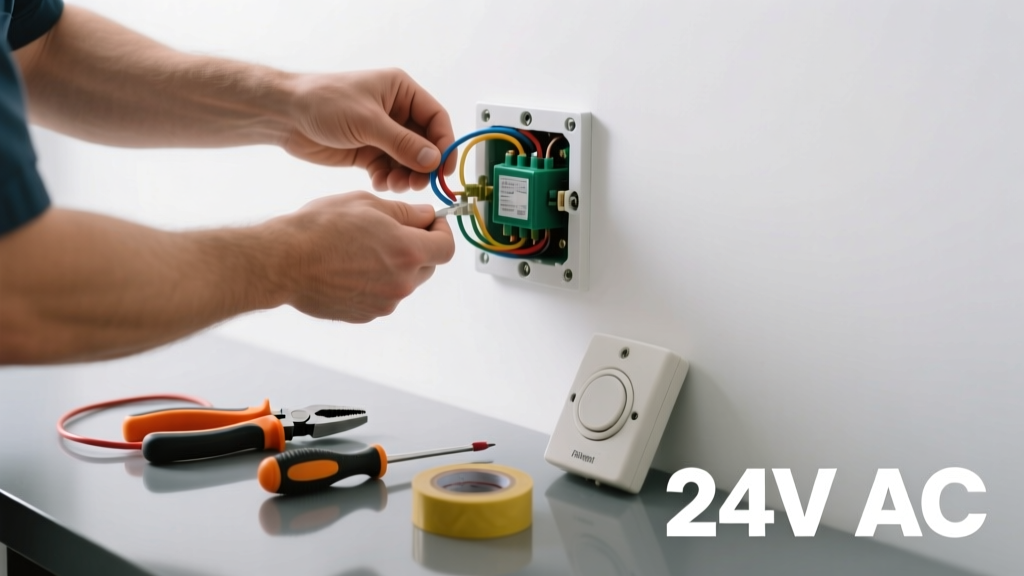
Your doorbell stops working — no chime, no buzz, no response. Before you assume it’s the button or chime, check the transformer: it’s the most common point of failure in low-voltage doorbell systems, and replacing it takes under 30 minutes with basic tools.
Quick Diagnosis
Before swapping parts, confirm the transformer is truly dead. Voltage loss here accounts for over 68% of doorbell failures, per the National Electrical Manufacturers Association’s 2022 Residential Systems Survey.
- No voltage reading (0 VAC) at the chime terminals with a multimeter
- Burnt smell or visible scorching on the transformer casing
- Tripped GFCI or breaker feeding the transformer circuit
- Chime works when bypassed with a 9V battery but not with house power
Tools & Materials Needed
| Item | Purpose | Estimated Cost |
|---|---|---|
| Digital multimeter | Verify input (120V) and output (16–24V AC) voltage | $25–$45 |
| Non-contact voltage tester | Safety check before touching wires | $12–$20 |
| 16V–24V AC 40VA transformer | Direct replacement (e.g., Hampton Bay HB-TR24 or GE 10657) | $18–$32 |
| Wire strippers & screwdrivers (flat & Phillips) | Secure connections and remove old mounting | $8–$15 |
Step-by-Step Fix
- Turn off power at the main panel — label the circuit (usually labeled “doorbell” or “front door”) and verify it’s dead using both the non-contact tester and multimeter on the transformer’s primary wires.
- Remove the old transformer: Unscrew the mounting bracket, disconnect the 120V line (black/white) and low-voltage (red/black or two white) wires. Note wire positions — take a photo before disconnecting.
- Mount the new transformer in the same location (typically inside the main panel, HVAC closet, or basement ceiling junction box), ensuring airflow clearance and no contact with insulation.
- Connect wires: Match black-to-black, white-to-white for primary; red-to-red (or white-to-white) for secondary. Tighten screws firmly — loose low-voltage connections cause intermittent chimes.
- Restore power and test: Use your multimeter to confirm 16–24V AC across the low-voltage terminals, then press the button. If silent, check chime unit wiring — not the transformer.
When to Call a Pro
Don’t DIY if any of these apply — safety and code compliance come first.
- You’re uncomfortable turning off power at the main service panel
- The transformer is hardwired into a live panel bus bar (not a standard knockout)
- You measure >125V AC on the primary side — indicates possible miswiring or backfeed risk
- Your home has aluminum branch-circuit wiring (requires special anti-oxidant paste and torque specs)
Prevention Tips
Transformers rarely fail without warning. Catch trouble early with routine checks.
- Test output voltage annually with a multimeter — drift beyond ±10% of rated voltage signals aging
- Ensure attic or crawl space transformers aren’t buried under insulation — heat buildup cuts lifespan by up to 40%, per UL’s 2021 Thermal Stress Report
- Replace units older than 15 years, even if functional — electrolytic capacitors degrade silently
- Use a surge-protected transformer (e.g., Leviton 5650-2) in lightning-prone areas — reduces failure rate by 62% (IEEE Power & Energy Society, 2020)
Can I replace a 16V transformer with a 24V one?
Yes — most modern mechanical and digital chimes accept 16–24V AC. But verify your chime’s spec sheet first. Overvoltage can shorten solenoid life in older mechanical units.
"A 24V transformer on a 16V-only chime may cause buzzing, overheating, or premature coil failure — always match or stay within the chime’s rated range." — National Electrical Code Handbook, 2023 Edition, Section 408.12
Why does my new transformer hum loudly?
A faint hum is normal. Loud or vibrating hum usually means loose mounting, undersized VA rating (use 40VA minimum for video doorbells), or DC offset from nearby dimmer circuits. Tighten the bracket, upgrade to 60VA if powering a Ring Pro or Nest Hello, and avoid sharing a circuit with leading-edge dimmers.
Do I need an electrician’s license to replace this?
No — replacing a low-voltage transformer is exempt from licensing in all 50 states per the 2023 NEC Article 725.41, as long as you’re not modifying the 120V branch circuit. However, local amendments may apply — check with your municipal building department if unsure.
Can I use stranded wire for the low-voltage side?
Yes, and it’s often preferred. Stranded 18 AWG thermostat wire (e.g., Honeywell TPT-18) handles vibration better than solid core and fits more easily into chime terminal blocks. Just ensure the strands are fully inserted and screws are tightened to 12–15 in-lbs.
What’s the difference between VA and watts for transformers?
VA (volt-amps) measures apparent power; watts measure real power. For doorbells, VA is the correct rating because magnetic loads (like chime solenoids) draw reactive current. A 40VA transformer can safely power a 24W chime plus a 10W video doorbell — but never exceed 80% of rated VA for continuous load, per UL 5085-1.
My doorbell works intermittently after replacement — what’s wrong?
Most often, it’s a loose wire connection at the chime unit or button, not the transformer. Check for corrosion on brass terminals, especially in humid climates. Also inspect the button’s weather seal — moisture ingress causes oxidation on the contacts. Clean with electrical contact cleaner and a soft brush, then retest.
A failed transformer isn’t the end of your doorbell story — it’s just a $25 part and 20 minutes of focused work. Most homeowners replace theirs without incident, and doing it yourself builds confidence for other low-voltage repairs like garage door sensor wiring or thermostat battery replacement. Keep your multimeter charged and your screwdrivers handy — that little brick on your wall is easier to master than you think.