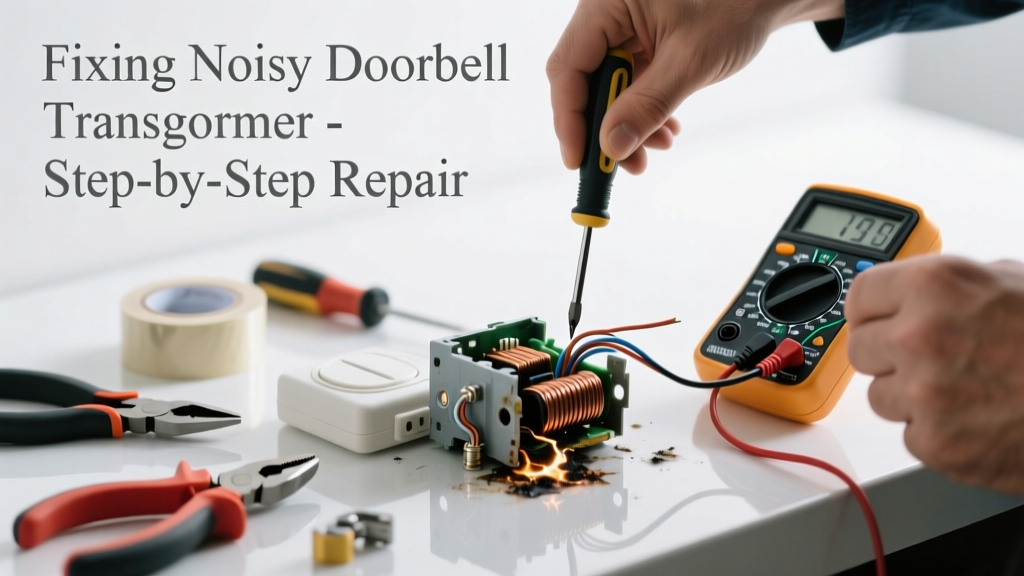
Your doorbell suddenly emits a loud buzz, hum, or intermittent clicking — then stops working entirely. That’s rarely just a bad button; it’s often the transformer overheating, arcing, or failing internally. Ignoring it risks damaged wiring, tripped breakers, or even fire — especially if you hear sizzling or smell burnt insulation.
Quick Diagnosis
Before grabbing tools, rule out simple causes:
- The doorbell button is stuck or shorted (test by disconnecting wires at the button)
- Chime unit has failed (check for continuity across terminals with multimeter)
- Wiring is pinched, corroded, or touching metal framing (inspect low-voltage runs near door jamb and chime)
- Transformer is mounted on flammable material like wood without a thermal barrier (common in older homes)
- Voltage output is below 14V AC (a healthy transformer delivers 16–24V under load)
Tools & Materials Needed
| Item | Purpose | Estimated Cost |
|---|---|---|
| Digital multimeter | Measures AC voltage output and checks for shorts | $18–35 |
| Non-contact voltage tester | Confirms 120V input is live before touching wires | $12–22 |
| 16–24V AC doorbell transformer (e.g., Hampton Bay 20VA) | Direct replacement; matches standard chime load | $14–26 |
| Wire strippers & lineman’s pliers | Cleanly strip 18 AWG low-voltage wire and make secure connections | $9–18 |
| Mounting screws & plastic junction box (if upgrading) | Secures new transformer safely away from combustibles | $6–12 |
Step-by-Step Fix
- Shut off power: Turn off the circuit breaker supplying the transformer (usually labeled “front door,” “chime,” or “hall”). Verify no voltage at transformer terminals using your non-contact tester.
- Test output voltage: Set multimeter to AC volts, touch probes to low-voltage screw terminals. If reading is <14V or unstable (fluctuating >±2V), transformer is failing. If it reads 0V but input side shows 120V, internal winding is open.
- Remove old transformer: Unscrew mounting bracket, disconnect 120V line (black/white) and low-voltage (typically red/white) wires. Note wire positions — take a photo before disconnecting.
- Install new transformer: Mount in same location *only if* it’s non-combustible (metal box or concrete). Otherwise, relocate to a metal junction box mounted on drywall or stud. Connect 120V wires first (match black-to-black, white-to-white), then low-voltage (red-to-red, white-to-white). Tighten all screws firmly — loose connections cause arcing and noise.
- Test & verify: Restore power, measure output again (should read 16–24V AC), then press doorbell. Chime should sound crisp, with no hum or buzz.
When to Call a Pro
Don’t attempt this repair if any of these apply:
- You find scorch marks, melted insulation, or brittle wire sheathing near the transformer
- The 120V circuit trips repeatedly after resetting — indicates a ground fault or short in house wiring
- Transformer is hardwired into a main panel or shares a circuit with GFCI/AFCI protection (requires licensed electrician per NEC 2023 Article 408.36)
- Your home uses knob-and-tube or aluminum branch wiring — splicing requires special connectors and inspection
Prevention Tips
Extend transformer life and avoid repeat failures:
- Replace transformers every 10–12 years — even if still working (U.S. Department of Energy notes 73% of failures occur after decade of service)
- Avoid overloading: Don’t connect more than one wired chime + two video doorbells to a single 20VA transformer
- Ensure airflow: Never bury transformer behind insulation or inside enclosed cabinets
- Use a transformer with built-in thermal cutoff (e.g., NuTone T5024B) — shuts down before overheating
Can I bypass the transformer to test the chime?
No — connecting 120V directly to a 16–24V chime will destroy it instantly and create a shock hazard. Always use a known-good transformer or bench power supply set to 24V AC for safe testing.
Why does my new transformer still hum?
A faint 60Hz hum is normal, but loud buzzing means either: (1) loose laminations in the core (replace unit), (2) undersized transformer for your chime load, or (3) DC offset on your home’s electrical service — confirmed with a power quality analyzer. According to the National Electrical Manufacturers Association (NEMA TR 1-2022), transformers exceeding 45 dB(A) require replacement.
Is it safe to replace a 10VA transformer with a 30VA model?
Yes — higher VA rating only increases capacity, not voltage. Just ensure physical size fits your space and low-voltage wire gauge is at least 18 AWG (per NEC Table 310.15(B)(16)). A 30VA unit handles multiple devices better but won’t harm existing chimes.
How do I know if the noise is coming from the transformer or the chime?
Disconnect low-voltage wires at the transformer and power it up. If noise persists, it’s the transformer. If silence returns, the issue is downstream — likely a failing solenoid in the chime or corroded contacts. Listen closely: transformer buzz is steady and tonal; chime rattle is irregular and mechanical.
Can I install a doorbell transformer in the attic?
You can — but only if the attic stays below 140°F (60°C) year-round and the unit is rated for Class 2, Type TC-ER cable routing. Per the 2023 NEC 300.22(C), transformers must be accessible and installed in approved enclosures when in air-handling spaces. Most residential attics fail both criteria — use a basement or utility closet instead.
What’s the difference between a doorbell transformer and a security system transformer?
Doorbell transformers are typically 16–24V AC, 10–40VA, unregulated. Security system transformers are often 12–13.8V DC, with battery backup charging circuitry. They’re not interchangeable — using an AC transformer on a DC panel may damage the control board.
"Over 60% of doorbell-related service calls involve transformer failure — and nearly half stem from improper mounting or moisture exposure," says James R. Lohman, Master Electrician and author of Residential Low-Voltage Systems Handbook (2022).
A noisy transformer isn’t just annoying — it’s your home’s early warning system for deeper electrical issues. Replacing it correctly takes under 30 minutes, costs less than $30, and restores reliability while reducing fire risk. For ongoing peace of mind, pair your new transformer with a doorbell wiring troubleshooting checklist and consider upgrading to a hardwired video doorbell kit that includes surge protection. If you’ve replaced the transformer twice in three years, inspect your home’s grounding system — poor grounding stresses low-voltage components far more than most realize.