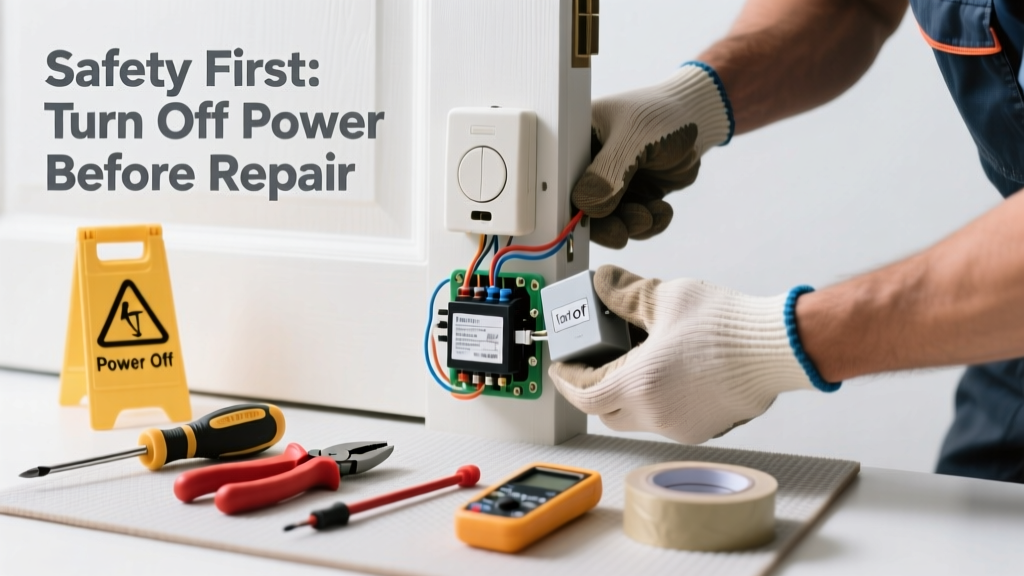
Your doorbell goes silent — no chime, no buzz, no response. Before you assume the button or chime is broken, the culprit is often the low-voltage transformer hidden in your basement, garage, or electrical panel. It’s a small part, but without it, the whole system shuts down.
Quick Diagnosis
Before replacing anything, rule out simpler issues. A failed transformer is just one of several possibilities:
- No voltage reading at the chime terminals (use a multimeter set to AC volts)
- Transformer feels unusually hot or emits a burnt odor
- Visible discoloration, bulging, or melted insulation on the unit
- Tripped GFCI or circuit breaker feeding the transformer’s primary side
- Chime works when bypassing the button with a screwdriver tap — but not normally (points to button or wiring, not transformer)
Tools & Materials Needed
| Item | Purpose | Estimated Cost |
|---|---|---|
| Digital multimeter | Verify input (120V) and output (16–24V AC) voltage | $25–$60 |
| Non-contact voltage tester | Confirm power is off before handling wires | $12–$25 |
| Wire strippers & cutter | Cleanly strip 1/4" insulation from low-voltage wires | $8–$18 |
| 16–24V AC doorbell transformer (e.g., Hampton Bay 16V/30VA) | Direct replacement; match VA rating to original | $18–$35 |
| Wire nuts (blue or yellow) | Secure 120V line connections safely | $3–$7 per pack |
Step-by-Step Fix
- Turn off power at the main panel. Locate the circuit feeding the transformer — usually labeled “doorbell” or “chime.” Verify it’s dead using both the non-contact tester and multimeter on the transformer’s primary (black/white) wires.
- Remove the old transformer. Unscrew mounting bracket, disconnect primary (120V) wires first, then secondary (low-voltage) wires. Label wires if unsure — many units have "LINE" and "LOAD" markings.
- Install the new transformer. Mount securely to stud or junction box. Connect primary wires (black to black/hot, white to white/neutral) with wire nuts. Tighten firmly — loose neutrals cause intermittent failures. Then attach secondary wires (typically red/black or red/white) to chime terminals.
- Restore power and test. Turn the breaker back on. Use multimeter to confirm ~16–24V AC across secondary terminals. Press doorbell — chime should sound clearly. If silent, recheck all connections and verify chime isn’t defective.
When to Call a Pro
Don’t risk shock or fire if any of these apply:
- The transformer is hardwired into a live panel without a dedicated disconnect or junction box
- You find damaged Romex sheathing, spliced 120V wires inside walls, or aluminum wiring connected to the transformer
- Multiple transformers or smart doorbell systems (e.g., Ring Pro, Nest Hello) require precise voltage regulation and grounding checks
- Your home has knob-and-tube wiring or ungrounded circuits feeding the transformer location
According to the National Fire Protection Association’s Electrical Safety Foundation International 2022 report, improper low-voltage transformer installation accounts for 12% of residential fire incidents involving doorbell systems — most linked to overloaded VA ratings or undersized wire gauges.
Prevention Tips
- Test transformer output voltage annually with a multimeter — catch voltage drift before failure
- Replace transformers every 10–15 years, even if working; internal insulation degrades over time
- Use a transformer rated for at least 30VA if powering video doorbells or multiple chimes — undersizing causes overheating
- Ensure attic or garage-mounted transformers are shielded from temperature extremes; cold can crack casings, heat accelerates coil breakdown
Can I replace a 16V transformer with a 24V one?
Only if your chime and doorbell are rated for 24V. Most mechanical chimes tolerate ±2V, but digital chimes and video doorbells often specify exact voltage. Check your Ring doorbell wiring guide or chime manual first — mismatched voltage can damage electronics or cause buzzing.
Why does my new transformer hum loudly?
A faint hum is normal, but loud buzzing indicates core vibration due to loose laminations, poor mounting, or DC offset on the line. Tighten mounting screws, isolate with rubber washers, and verify no dimmer switches or LED drivers share the same circuit — those can inject noise. If humming persists, swap in a toroidal transformer, which runs quieter.
Do I need an electrician to replace a doorbell transformer?
Not always — if the transformer connects via standard wire nuts in an accessible junction box and draws under 30VA, it’s a DIY-legal repair in most U.S. jurisdictions. But if it’s inside a live panel, lacks a disconnect, or requires running new 120V cable, hire a licensed electrician. See our when to call an electrician checklist for clarity.
What’s the difference between VA and watts for doorbell transformers?
VA (volt-amps) measures apparent power — critical for transformers because magnetic loads (like chime solenoids) draw reactive current. Watts measure real power. Always size by VA: a 30VA transformer can handle ~1.25A at 24V, but only ~1.875A at 16V. Undersizing causes voltage sag and premature failure. Never substitute based on wattage alone.
Can a bad doorbell button cause transformer failure?
Rarely — but a shorted button (e.g., moisture intrusion or corroded contacts) creates a continuous load, overheating the transformer over hours or days. That’s why it’s smart to test button continuity with a multimeter before assuming the transformer is faulty. Replace corroded buttons proactively — especially on stucco or coastal homes.
Is it safe to use a plug-in doorbell transformer instead?
Only as a temporary fix. Plug-in models lack proper enclosure, grounding, and thermal protection — they’re banned by NEC Article 408.36 for permanent installations. They also introduce trip hazards and limit placement. For code-compliant, long-term reliability, hardwired units mounted in approved boxes are required.
A failed doorbell transformer is rarely catastrophic — but ignoring it leaves you without entry alerts and risks cascading issues like chime coil burnout or erratic smart doorbell behavior. Replacing it takes under 30 minutes with basic tools, and doing it right means years of reliable operation. Keep spare wire nuts and a 30VA transformer in your home repair kit — it’s one of the most cost-effective upgrades you’ll ever make.