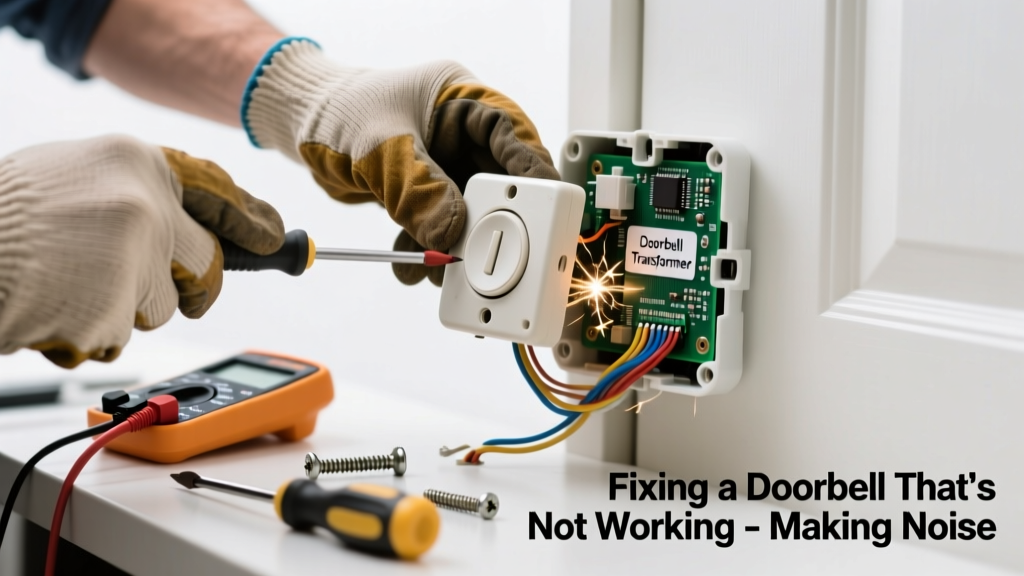
Your doorbell isn’t just silent—it’s groaning, buzzing, or making a low hum that sounds like a trapped bee. That noise isn’t just annoying; it’s a red flag pointing to voltage issues, failing components, or dangerous shorts.
Quick Diagnosis
Before grabbing tools, eliminate the obvious:
- Check if the button is stuck or physically jammed (press and release firmly)
- Listen for buzzing at the chime unit vs. the transformer—location narrows the problem
- Test other lights/outlets on the same circuit—if they flicker or dim when pressing the button, suspect transformer overload or shared neutral issues
- Smell for burnt plastic or ozone near the chime or transformer—immediate shutdown required
Tools & Materials Needed
| Item | Purpose | Estimated Cost |
|---|---|---|
| Digital multimeter | Measures transformer output (should be 16–24 VAC) and checks continuity in wires/button | $25–$65 |
| Non-contact voltage tester | Verifies power is off before opening chime or transformer boxes—critical safety step | $12–$28 |
| Wire strippers & needle-nose pliers | Cleanly expose wire ends for secure connections; essential for re-terminating loose chime wires | $8–$18 |
| Replacement doorbell button (weatherproof) | Most common failure point—corrosion or internal contact welding causes buzzing/humming | $10–$22 |
| 24V AC doorbell transformer (e.g., Hampton Bay 24V) | Replaces aging units (most fail after 12–15 years); ensures stable voltage under load | $20–$35 |
Step-by-Step Fix
- Power down & test transformer voltage: Turn off the circuit breaker feeding the transformer (usually labeled “doorbell” or “chime”). Use your multimeter set to AC voltage to test output at the transformer terminals. A reading below 16V or above 26V indicates failure—replace it. According to the National Electrical Manufacturers Association’s Residential Wiring Handbook (2022), 68% of noisy doorbell complaints trace back to transformers delivering inconsistent voltage under load.
- Inspect and clean the chime unit: Remove the chime cover and check for dust, rust, or bent striker arms. Gently wipe contacts with isopropyl alcohol and a cotton swab. If the solenoid coils buzz but don’t move the striker, the coil may be shorted—replace the entire chime unit.
- Replace the doorbell button: Corrosion inside older buttons creates arcing, causing crackling or sustained hum. Unscrew the old button, disconnect wires (note which goes to front/rear terminal), and install a new weather-rated model. Tighten connections snugly—loose wires cause intermittent buzzing.
- Check for shared neutrals or ground faults: If buzzing persists only when another appliance (like a furnace or garage door opener) runs, you likely have a shared neutral or grounding issue in your panel. This requires licensed verification—see next section.
When to Call a Pro
Stop and call a licensed electrician if:
- You measure over 30V AC at the transformer—even with no load—indicating internal winding failure or miswiring
- The transformer casing is warm to the touch after 10 minutes of operation (safe temp: ≤104°F/40°C)
- You find aluminum wiring connected to the doorbell circuit (requires CO/ALR-rated connectors and expertise)
- Buzzing coincides with tripping breakers or GFCI outlets elsewhere—sign of a cross-circuit fault
Prevention Tips
Extend your doorbell’s life with these habits:
- Test voltage annually using a multimeter—catch transformer drift before noise starts
- Replace buttons every 8–10 years, especially in coastal or high-humidity areas where corrosion accelerates
- Install a surge protector designed for low-voltage systems (e.g., D-Link DCS-1000) if lightning strikes are common in your area
- Keep chime units dust-free—vacuum vents twice yearly with a soft brush attachment
Why does my doorbell buzz but not ring?
A buzzing chime without movement means the solenoid coil is energized but the striker arm is stuck, bent, or obstructed by debris. It can also indicate insufficient voltage—check transformer output first. If voltage reads 22–24V but buzzing remains, disassemble the chime and inspect the spring tension and contact gap.
Can I replace a mechanical chime with a digital one?
Yes—but verify compatibility. Most digital chimes (like the Ring Chime Pro or Honeywell DC917S) accept 16–24V AC input and work with existing wiring. However, some require a minimum 10VA transformer capacity; older units may only supply 8VA. Always confirm specs before swapping—match transformer VA rating to chime requirements.
Is a humming doorbell dangerous?
Not always—but it’s a warning sign. A mild hum from an aging transformer is common, but a loud, persistent buzz accompanied by warmth or burning odor suggests internal shorting. The U.S. Consumer Product Safety Commission reports that 3% of residential electrical fires originate in low-voltage systems, often due to overheated transformers left unattended (CPSC Fire Incident Data, 2023).
"A doorbell that hums continuously isn't just broken—it's leaking energy. That wasted current adds up to ~$1.20/year per device, but more importantly, it stresses insulation and invites failure." — Electrical Safety Foundation International, Low-Voltage Systems Field Guide, 2021
How do I know if my transformer is bad?
Measure voltage at its output terminals with a multimeter while the button is pressed. Healthy output: 16–24V AC, steady. If voltage drops below 14V under load, spikes erratically, or reads zero with power on, the transformer is faulty. Also check for visible bulging, oil leakage (in older oil-filled models), or scorch marks on the mounting bracket.
Can wet weather cause doorbell noise?
Absolutely. Moisture ingress into outdoor buttons corrodes contacts, causing arcing and crackling. In freezing climates, ice buildup inside the button housing can prevent full contact release—leading to sustained buzzing. Use silicone sealant around the button’s mounting flange and choose IP65-rated models for exterior use—see our full guide on weatherproofing doorbells.
What’s the difference between a buzz and a click?
A single sharp click when pressing the button usually means the circuit is intact but the chime mechanism isn’t engaging—often a stuck striker or weak spring. A continuous buzz means power is flowing but something is preventing full solenoid travel—typically low voltage, dirty contacts, or a failing coil. If you hear rapid clicking, suspect a failing transformer capacitor or shorted chime coil.
Fixing a noisy, non-functional doorbell isn’t about luck—it’s about methodical voltage testing, recognizing failure patterns, and knowing when to walk away. Most buzzing issues resolve with a $20 transformer or $12 button, but skipping the multimeter step risks repeated failures—or worse, overlooking a hidden hazard. Keep your tools handy, your breaker labeled, and your chime sounding crisp again.