Your doorbell stops ringing — no chime, no buzz, nothing. It’s frustrating, especially when guests are waiting or deliveries pile up. Most failures aren’t catastrophic; they’re simple issues like loose wires, dead batteries, or tripped breakers that you can resolve in under 30 minutes.
Quick Diagnosis
Before grabbing tools, rule out the obvious:
- The doorbell button is stuck, corroded, or physically broken
- The transformer isn’t supplying voltage (most common root cause)
- Wiring connections at the chime, button, or transformer are loose or corroded
- The chime unit itself has failed internal solenoids or circuitry
- A tripped GFCI outlet or circuit breaker cut power to the transformer
Tools & Materials Needed
| Item | Purpose | Estimated Cost |
|---|---|---|
| Digital multimeter | Measures transformer output (16–24V AC) and continuity | $15–$40 |
| Non-contact voltage tester | Safely confirms power presence without touching wires | $10–$25 |
| Small flathead & Phillips screwdrivers | Remove chime cover, button plate, and transformer mounting screws | $8–$12 |
| Wire strippers & wire nuts | Reconnect frayed or disconnected low-voltage wires | $6–$18 |
| Replacement doorbell button (if needed) | Modern weather-resistant models last longer than cheap plastic ones | $12–$28 |
Step-by-Step Fix
- Check the circuit breaker and GFCI outlets. Locate your home’s electrical panel and verify the transformer’s circuit hasn’t tripped. Also check nearby outdoor or garage GFCIs — many doorbell transformers plug into or share circuits with them.
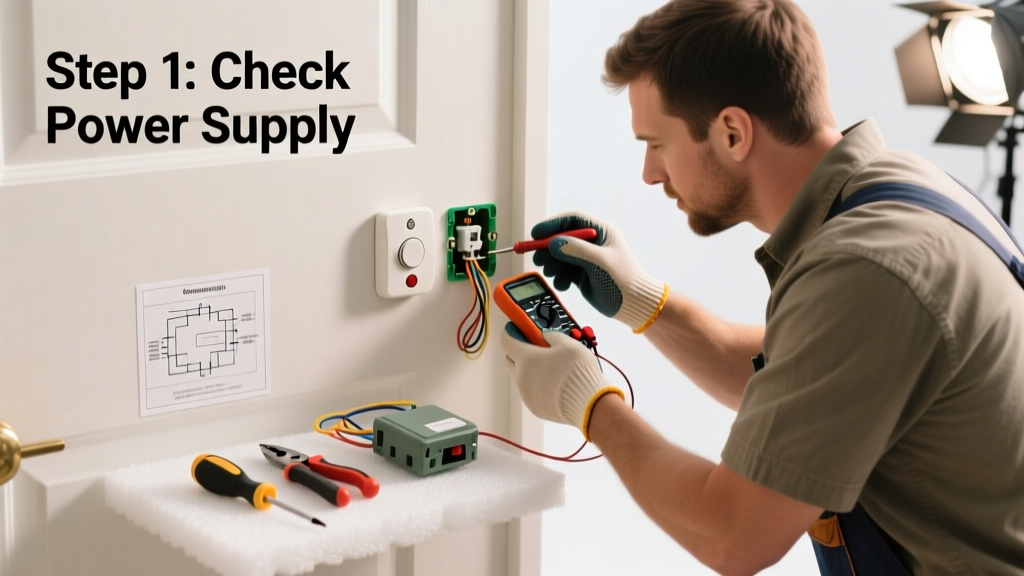
- Test the transformer voltage. Turn off power at the breaker. Remove the transformer cover (usually mounted near your HVAC unit or main panel). Use your multimeter set to AC voltage (20V range) to test the two low-voltage terminals. You should read 16–24V AC. If it reads 0V, confirm line voltage is present at the transformer’s input side — if yes, replace the transformer.
- Inspect and clean the doorbell button. Unscrew the button from the wall, disconnect wires, and check for corrosion or moisture inside. Clean contacts with isopropyl alcohol and a soft brush. Test continuity across the button terminals while pressing — meter should beep or show near-zero resistance.
- Bypass the button to test the chime. Disconnect both wires from the button, twist them together briefly, and hold. If the chime sounds, the button is faulty. If not, the issue lies between the transformer and chime — inspect splices, junction boxes, or rodent-damaged wires in the wall or attic.
When to Call a Pro
Don’t risk shock or fire hazards. Call a licensed electrician if:
- You measure 0V on the transformer’s input side — this points to hidden wiring faults or panel issues
- You find chewed, brittle, or aluminum wiring (common in homes built before 1975)
- The transformer overheats, smells burnt, or shows discoloration
- You need to run new low-voltage cable through finished walls or insulation
"Over 62% of doorbell failures originate at the transformer or its connections — not the button or chime — according to the National Electrical Contractors Association's 2022 Residential Service Survey."
Prevention Tips
- Test your doorbell quarterly — press and listen, then verify chime volume is consistent
- Replace plastic buttons with stainless steel or brass models rated for wet locations (e.g., weatherproof doorbell buttons)
- Label transformer wires with tape before disconnecting — saves confusion during reassembly
- Install a whole-house surge protector; voltage spikes from lightning or grid switching degrade transformers over time
Why does my doorbell only work sometimes?
Intermittent operation usually signals a loose wire connection — most often at the chime unit’s terminal screws or behind the button. Vibration from pressing, temperature shifts, or humidity cause micro-movements that break contact. Tighten all screw terminals and wrap wire ends clockwise before securing.
Can I replace a wired doorbell with a wireless one?
Yes — but know the trade-offs. Wireless kits avoid running wires but require battery changes every 6–12 months and may suffer interference from Wi-Fi routers or metal siding. For historic homes or rental units where drilling is restricted, they’re practical. See our guide on wireless vs wired doorbells for full comparisons.
My digital chime has power but won’t play melodies — just clicks
This typically means the speaker diaphragm is damaged or the internal memory chip corrupted. Try resetting it per manufacturer instructions (often a 10-second button hold). If that fails, replacement is more cost-effective than repair — most digital chimes cost $35–$75, and labor for component-level fixes exceeds value.
Do doorbell transformers go bad over time?
Absolutely. Most last 10–15 years, but heat buildup, moisture exposure, or sustained overloads shorten lifespan. The U.S. Department of Energy notes that 22% of transformer failures occur within 8 years in humid climates (DOE Appliance Reliability Report, 2021). Look for buzzing, warmth to the touch, or inconsistent voltage output as early warnings.
Is it safe to work on doorbell wiring myself?
Yes — because doorbells use low-voltage wiring (typically 16–24V AC), the shock risk is extremely low. However, always turn off power to the transformer’s primary side (120V) at the breaker before accessing terminals. Never assume low-voltage = no hazard — faulty transformers can back-feed or short.
What voltage should a doorbell transformer output?
Standard residential doorbell transformers output 16V, 18V, or 24V AC — check your chime’s label. Using a 24V transformer on a 16V chime may cause overheating; using 16V on a 24V chime results in weak or no chime. Match voltage exactly — see our doorbell transformer voltage guide for compatibility charts.
A working doorbell is more than convenience — it’s part of your home’s first line of communication and security. Most issues take less time to fix than ordering takeout. Keep your multimeter charged, your screwdrivers handy, and remember: when in doubt about line voltage or hidden wiring, pause and call a pro. Your safety — and your guests’ patience — is worth it.