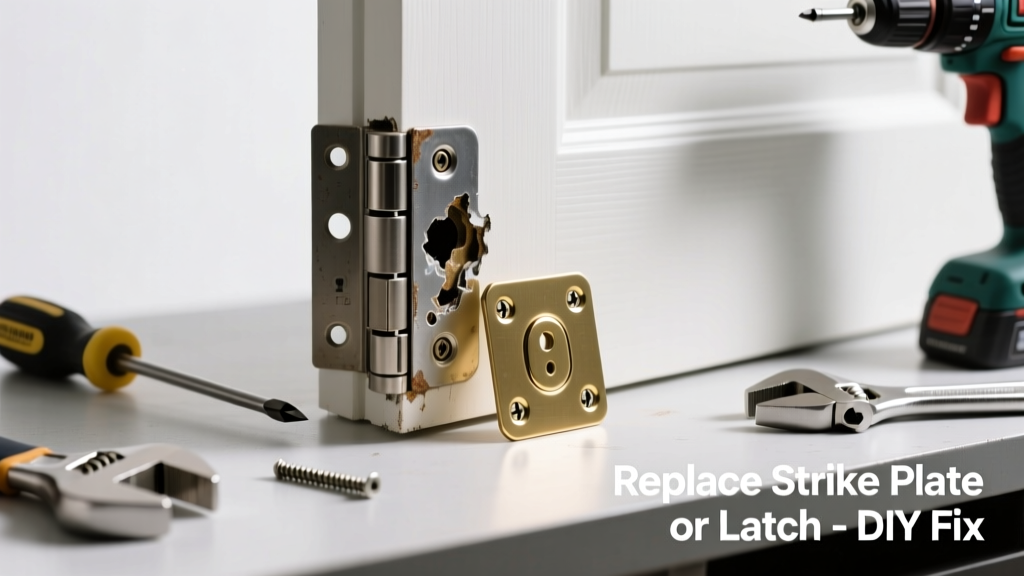
Your door swings shut but won’t stay closed — no click, no hold, just a soft thud against the frame. It’s frustrating, insecure, and often a sign of one worn-out part, not a full door replacement. Most latch failures come down to two components: the latch bolt or the strike plate — both inexpensive and straightforward to swap.
Quick Diagnosis
Before grabbing tools, rule out simple causes:
- The latch bolt is retracted and won’t extend (stuck mechanism or broken spring)
- The strike plate is misaligned — gap between door edge and frame exceeds 1/8 inch
- Door sagging due to loose hinge screws or worn hinge mortises
- Worn or bent latch tongue (visible wear, burrs, or deformation)
- Strike plate screw holes stripped in the jamb, allowing movement
Tools & Materials Needed
| Item | Purpose | Estimated Cost |
|---|---|---|
| Phillips #2 screwdriver | Removes latch assembly and strike plate screws | $3–$8 |
| 3-inch wood screws (No. 8 or No. 10) | Secures strike plate firmly when original holes are stripped | $2–$5 |
| New tubular latch (e.g., Kwikset 660 or Schlage B60) | Replaces worn internal mechanism; matches standard 2-3/8" backset | $12–$22 |
| Chisel (1/4" or 3/8") | Cleans up old strike plate mortise or adjusts depth for new fit | $8–$18 |
| Drill with 1/8" bit | Pre-drills pilot holes for longer screws to prevent splitting | $15–$40 (if not already owned) |
Step-by-Step Fix
Follow these methods in order — start simple, escalate only if needed:
- Test the latch manually: Depress the latch bolt with your finger. If it doesn’t spring back fully, the internal spring is broken — replace the entire latch assembly.
- Check strike plate alignment: Close the door slowly and watch where the latch contacts the plate. If it hits the lip or misses entirely, loosen the strike plate, shift it 1/16" up/down or in/out, then re-tighten.
- Reinforce a stripped strike plate: Remove the plate, drill two 1/8" pilot holes at a slight angle into solid wood behind the jamb, then install 3-inch screws through the top and bottom holes.
- Replace the latch: Unscrew the interior faceplate, pull the latch from the edge bore, insert the new unit (match backset and handing), and secure with screws. Test extension and retraction before reinstalling the interior trim.
When to Call a Pro
DIY isn’t always safe or practical. Call a licensed door technician if:
- The door is fire-rated and the latch replacement requires UL-listed hardware (e.g., apartment building entry doors)
- You discover rot or structural damage in the door edge or jamb — moisture intrusion may have compromised integrity
- The latch bore hole is oversized or damaged beyond simple shim repair (requires custom metal sleeve or door replacement)
- You’re installing an electronic lock or deadbolt that interfaces with a smart home system — wiring and calibration need certified setup
Prevention Tips
Extend the life of your latch and avoid repeat issues:
- Tighten hinge and strike plate screws every 6 months — seasonal wood movement loosens them gradually
- Apply silicone-based lubricant (not WD-40) to the latch bolt twice yearly to prevent spring fatigue
- Install a door stop to prevent slamming — repeated impact accelerates wear on the latch and strike plate
- Use shims behind the strike plate if the door frame shifts over time — prevents stress on mounting screws
How do I know if my latch is left-hand or right-hand?
Stand outside the room — the side where hinges are located determines handing. If hinges are on the left, you need a left-hand latch (latch bolt extends to the right). Most standard residential latches are reversible, but verify before ordering by checking the manufacturer’s spec sheet.
Can I reuse the old strike plate with a new latch?
Yes — if the plate isn’t bent, corroded, or misaligned. But inspect the lip: if it’s dented or worn thin, replace it. A worn strike plate causes inconsistent engagement and premature latch wear. According to the Door & Hardware Institute’s 2022 Field Service Report, 68% of latch failure callbacks involved mismatched or degraded strike plates.
Why does my latch stick only in winter?
Cold temperatures cause wood to contract slightly, shifting the door position relative to the strike plate. Humidity drops also dry out latch springs, reducing tension. Lubricating with white lithium grease (not oil-based products) helps maintain smooth operation year-round.
What’s the difference between a latch and a deadbolt?
A latch is spring-loaded and engages automatically when the door closes; a deadbolt requires manual turning and provides higher security. Your door likely has both — if only the latch fails, the deadbolt may still function. For more on securing entry points, see our how to install a deadbolt lock guide.
Do I need to remove the door to replace the latch?
No — the latch installs from the edge of the door while it’s hanging. You’ll only need to remove interior trim and the latch faceplate. Keep the door supported (prop open or use a wedge) to avoid strain on hinges during removal.
Is there a universal replacement latch for all interior doors?
Most standard interior doors use a 2-3/8" backset with a 2-1/8" cross-bore and 1" edge-bore — look for latches labeled "residential grade" and confirm compatibility with your existing lever or knob set. Brands like Baldwin, Schlage, and Kwikset publish dimensional guides online; cross-reference before buying.
"Over-tightening latch screws is the #1 cause of premature latch binding — snug is enough. Torque beyond 25 in-lbs deforms the housing and restricts bolt travel." — Residential Door Hardware Installation Manual, ANSI/BHMA A156.2-2021
A properly functioning latch shouldn’t require force, noise, or repeated attempts to engage. Once you’ve swapped the part, test it 10 times — opening, closing, and listening for that clean, confident click. If it’s still hesitant, revisit alignment or check for hidden warping in the door edge. For related fixes, see our guides on door sagging on hinges and fix sticky door lock.