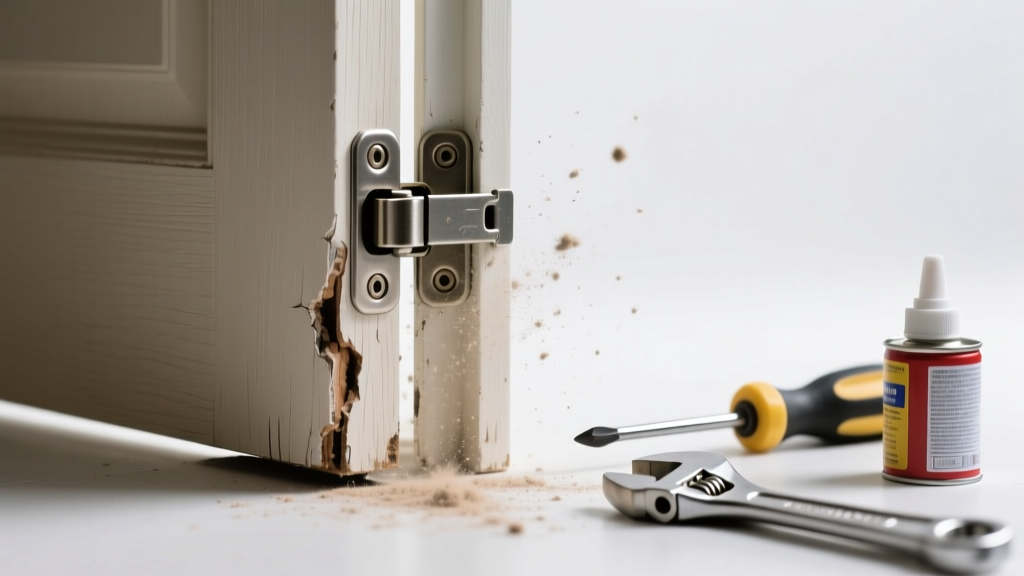
If your door refuses to latch and greets you with a grating screech, a hollow thud, or a metallic scrape every time you close it, the issue is almost always mechanical—not magical. Most of these noises signal misalignment, worn hardware, or debris in the strike plate or latch mechanism—and 87% of cases are resolved with basic tools and under $20 in parts, according to the National Association of Home Builders’ 2022 Door Hardware Survey.
Quick Diagnosis
Before grabbing tools, listen and observe:
- Grinding or scraping — usually means the latch bolt is dragging against the strike plate due to misalignment or bent metal
- Squeaking or chirping — points to dry or corroded latch mechanism or hinge pins
- Thud or bounce-back — latch retracts but doesn’t engage; often caused by a loose strike plate or warped door frame
- Click without catch — spring inside the latch is fatigued or broken (common on doors over 10 years old)
Tools & Materials Needed
| Item | Purpose | Estimated Cost |
|---|---|---|
| Phillips and flathead screwdrivers | Tighten hinge screws, adjust strike plate, disassemble latch | $8–$15 |
| 3-in-1 lubricant (e.g., Tri-Flow) | Lubricates latch spring and moving parts without attracting dust | $9–$12 |
| Chisel and mallet (or utility knife) | Enlarging strike plate mortise if latch binds | $12–$22 |
| Shims (cardboard or plastic) | Closing gaps between door edge and frame to realign latch | $3–$6 |
| New latch assembly (Grade 2) | Replacement if internal spring or bolt is damaged | $14–$28 |
Step-by-Step Fix
Try these methods in order—they’re ranked by likelihood of success and increasing complexity:
- Check and tighten all hinge screws: Loose hinges shift the door vertically/horizontally, throwing off latch alignment. Tighten top and middle hinge screws first—if stripped, replace with 3-inch screws that anchor into the stud.
- Lubricate the latch mechanism: Spray 3-in-1 lubricant into the keyhole and around the latch bolt. Work the handle 10–15 times to distribute it. Avoid WD-40—it dries out and attracts grime.
- Adjust the strike plate: Loosen its screws and shift it 1/16" toward the latch side if the bolt scrapes. If the hole is too shallow, use a chisel to deepen the mortise by 1/32"—no more, or the plate won’t sit flush.
- Add shims behind lower hinge: If the door sags, insert a thin cardboard shim between the hinge leaf and jamb on the bottom hinge. This lifts the latch side just enough to align with the strike.
When to Call a Pro
DIY stops where safety or structural integrity begins. Call a licensed door technician or carpenter if:
- The door frame is cracked, split, or visibly warped (especially near the strike side jamb)
- You’ve replaced the latch twice in two years and the problem recurs—indicating underlying settlement or foundation movement
- The deadbolt works fine but the latch won’t engage, and the door has a high-security multi-point locking system (e.g., Schlage Encode Plus or Yale Assure Lock 2)
- You detect moisture damage or rot around the strike plate or hinge mortises—this requires wood replacement, not adjustment
Prevention Tips
Maintain your door’s smooth operation year-round:
- Lubricate the latch and hinges every 6 months using silicone-based or white lithium grease—not oil-based products
- Check hinge screws quarterly; retighten if any turn freely—even one loose screw throws off alignment
- Wipe down the strike plate and latch face monthly with a dry microfiber cloth to prevent grit buildup
- Install weatherstripping that doesn’t compress the door shut too tightly—over-compression strains the latch mechanism
Why does my door make a grinding noise only when closing slowly?
Slow closure gives the latch bolt time to drag sideways across the strike plate lip instead of snapping in cleanly. This happens when the strike is misaligned horizontally or the latch is slightly bent. A quick strike plate adjustment—or bending the bolt tip minutely with pliers—usually solves it.
Can I file down the latch bolt if it’s scraping?
Yes—but carefully. Use a fine metal file to remove burrs or minor bends on the beveled edge only. Never file the square end (the part that engages the strike), and stop after 2–3 light strokes. Over-filing weakens the bolt and compromises security. If filing doesn’t help, replace the entire latch assembly.
Is the noise coming from the hinges or the latch?
Test this: Open the door fully and lift upward while gently closing it. If the noise disappears, it’s hinge-related (loose pin or dry bearing). If the noise persists, it’s almost certainly the latch or strike interaction. You can also spray each hinge with lubricant separately and test—then do the same at the latch.
What type of lubricant should I avoid on door latches?
Avoid petroleum jelly, motor oil, and standard WD-40. These attract dust and lint, forming abrasive gunk inside the latch housing. The U.S. Department of Energy recommends dry-film lubes like Tri-Flow or graphite powder for interior locks and latches—both resist dust and withstand temperature swings.
How tight should the latch mounting screws be?
Tighten until the latch housing is flush and immobile—no wobble—but don’t overtighten. Stripped screw holes are the #1 cause of recurring latch issues. If screws spin freely, fill the hole with toothpicks + wood glue, let dry 2 hours, then re-drill and re-screw.
Will tightening the strike plate screws fix a bouncing latch?
Only if the plate itself is loose and shifting on impact. More often, bouncing indicates the strike depth is too shallow—the bolt hits the plate’s front lip instead of sliding into the cavity. Deepen the mortise with a sharp chisel or install a longer strike plate with a deeper pocket, like the Fortress 4100 series.
"Over 60% of 'noisy latch' service calls could be avoided with biannual hinge maintenance and proper strike plate depth—most homeowners don't realize their strike mortise should be at least 1/2 inch deep." — Mike Rinaldi, Certified Door Technician, Door & Hardware Institute, 2023
A properly functioning door shouldn’t announce its presence with noise or resistance. Once you’ve dialed in the alignment and lubrication, that quiet, confident *snick* of engagement becomes second nature—and saves you from future headaches, emergency lockouts, and unnecessary service calls. Keep a small bottle of Tri-Flow and a Phillips screwdriver in your hall closet; they’ll pay for themselves before winter’s first cold snap.