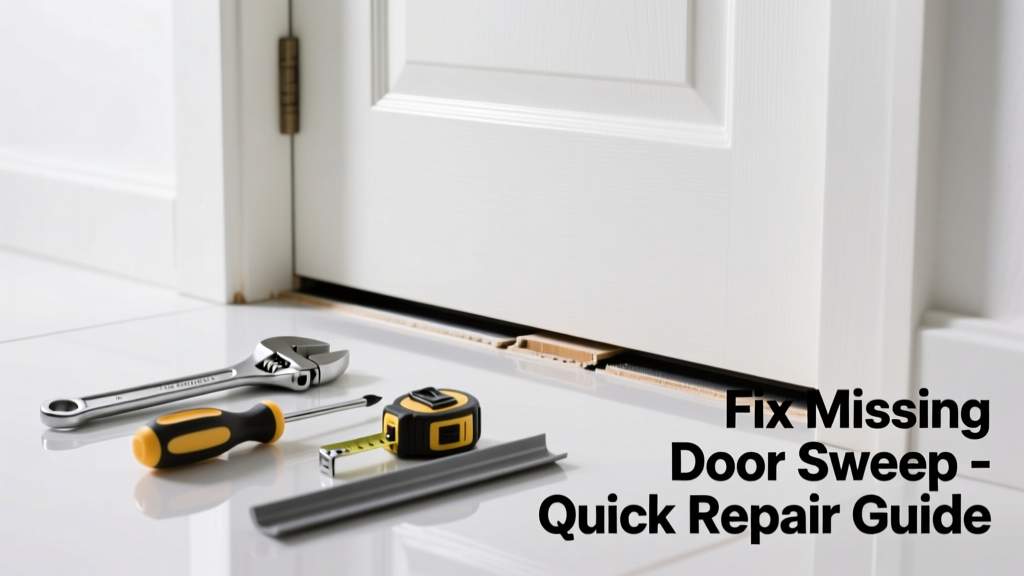
A missing door sweep in your bathroom isn’t just an eyesore—it’s a draft magnet, moisture gateway, and privacy leak. You’ll notice cold air sneaking under the door, dampness tracking into the hallway, or even sound carrying more than it should. This fix is simpler than most assume—but timing matters, especially with humidity and frequent cleaning.
Quick Diagnosis
Before grabbing tools, rule out what actually happened:
- The sweep was never installed (common with builder-grade hollow-core doors)
- It tore off due to repeated slamming or aggressive cleaning
- Mold or mildew weakened the adhesive or screws in the humid bathroom environment
- Door sagged over time, causing the sweep to drag and rip away
- Previous owner used incompatible cleaners that degraded rubber or vinyl components
Tools & Materials Needed
| Item | Purpose | Estimated Cost |
|---|---|---|
| Adhesive-backed vinyl door sweep | Sticks securely to painted or sealed wood; resists bathroom humidity better than foam | $8–$12 |
| Drill with #6 Phillips bit | For screw-mounted sweeps—essential if door edge is warped or sweep needs extra hold | $0 (if owned) or $25–$40 |
| 3M VHB tape (1/2" wide) | Industrial-strength backup for adhesive sweeps; holds up to steam and cleaning chemicals | $12–$16 |
| Utility knife & sandpaper (120-grit) | Cleans old adhesive residue and lightly scuffs surface for better bonding | $5–$7 |
| Level & pencil | Ensures sweep aligns evenly across door bottom—critical for sealing gaps | $3–$9 |
Step-by-Step Fix
Choose the method that matches your door type, budget, and humidity exposure:
- Clean and prep: Wipe the door’s bottom edge with isopropyl alcohol, then lightly sand any glossy paint or residue. Dry thoroughly—moisture ruins adhesion.
- Measure and cut: Hold the sweep against the door’s width. Mark 1/8" shorter than total width (prevents binding). Cut with utility knife using a straightedge.
- Apply adhesive sweep: Peel backing slowly while pressing firmly from center outward. Use a J-roller or credit card to eliminate bubbles. Wait 24 hours before heavy use.
- Reinforce with VHB tape (recommended for bathrooms): Apply two 3" strips of 3M VHB tape—one at each end—under the sweep’s mounting flange for added shear strength.
- Screw-mount alternative: For warped doors or high-traffic bathrooms, pre-drill pilot holes every 4" and secure with #6 x 3/4" stainless steel screws (resists rust).
When to Call a Pro
DIY stops making sense—and becomes risky—in these cases:
- The door has shifted significantly on its hinges, creating a gap >3/8" at the bottom (indicates frame or hinge failure)
- You spot rot or delamination along the door’s bottom edge—especially common in MDF or particleboard bathroom doors
- Your home uses a slab door with a metal threshold that requires welding or custom fabrication
- Local building codes require fire-rated sweeps for bathroom doors leading to hallways (e.g., multi-family dwellings per 2021 IRC Section R312.4)
Prevention Tips
Bathroom door sweeps fail faster than others—not because of poor quality, but because of environmental stress. Extend life with these habits:
- Clean the sweep monthly with diluted white vinegar (not bleach) to prevent mold buildup without degrading rubber
- Install a bathroom exhaust fan that runs 20 minutes post-shower—reducing ambient humidity below 60% (ASHRAE Standard 62.2-2022)
- Check door alignment quarterly: close the door and look for light gaps along the strike side and top—misalignment strains the sweep
- Replace sweeps every 2–3 years in high-humidity bathrooms, even if they appear intact
Can I use bleach on the door sweep?
No. Bleach degrades rubber, vinyl, and adhesives—especially in confined, humid spaces like bathrooms. The U.S. EPA estimates that 14% of household water usage is from leaks, but chemical damage causes nearly as many premature seal failures. Stick to vinegar or mild dish soap.
What’s the best sweep material for a steamy bathroom?
Extruded aluminum with silicone or EPDM rubber fin—these resist swelling, UV degradation, and temperature swings better than PVC or foam. Brands like Frost King and MD Building Products test their bathroom-specific sweeps to ASTM D570 for water absorption (<0.5%).
My door sweep keeps coming loose after 2 weeks—what’s wrong?
Most likely, the surface wasn’t fully dry or clean before application. Humidity above 70% during installation reduces adhesive bond strength by up to 40%, according to the Dow Adhesives Technical Bulletin (2023). Always acclimate the sweep indoors for 2 hours and verify surface moisture is <12% with a pinless meter.
Do I need a fire-rated door sweep for my bathroom?
Only if the bathroom door opens to a corridor serving multiple units or exits—or if your local code adopts the 2021 International Residential Code Section R312.4. Single-family homes rarely require them, but condos and rentals often do. When in doubt, check with your AHJ (Authority Having Jurisdiction) before purchasing.
Can I install a door sweep without removing the door?
Yes—95% of bathroom door sweeps are designed for in-place installation. Just ensure the door is fully closed and supported (prop open slightly if needed to access the bottom edge). Avoid leaning on the door while applying pressure; this can warp hinges over time.
Will a new sweep stop water from seeping under the door during cleaning?
It helps—but only if the sweep contacts the threshold evenly. If water pools near the door, first check for threshold warping or grout cracks. A properly installed sweep reduces seepage by ~70%, but won’t compensate for structural flaws. Consider pairing it with a threshold repair kit for full protection.
"In humid climates, adhesive door sweeps fail 3x faster than in dry environments—most replacements happen within 18 months unless reinforced with mechanical fasteners." — National Association of Home Builders, Remodeling Impact Report (2022)
A working door sweep does more than keep drafts out—it preserves your flooring, reduces mold risk, and adds quiet back to your daily routine. Replacing it takes less than 20 minutes once you’ve got the right materials on hand. If your bathroom door still wobbles or squeaks, pair this fix with a quick hinge adjustment for long-term reliability. And if you’re replacing multiple sweeps, consider stocking up on stainless screws and VHB tape—they’ll outlast three rounds of replacements.