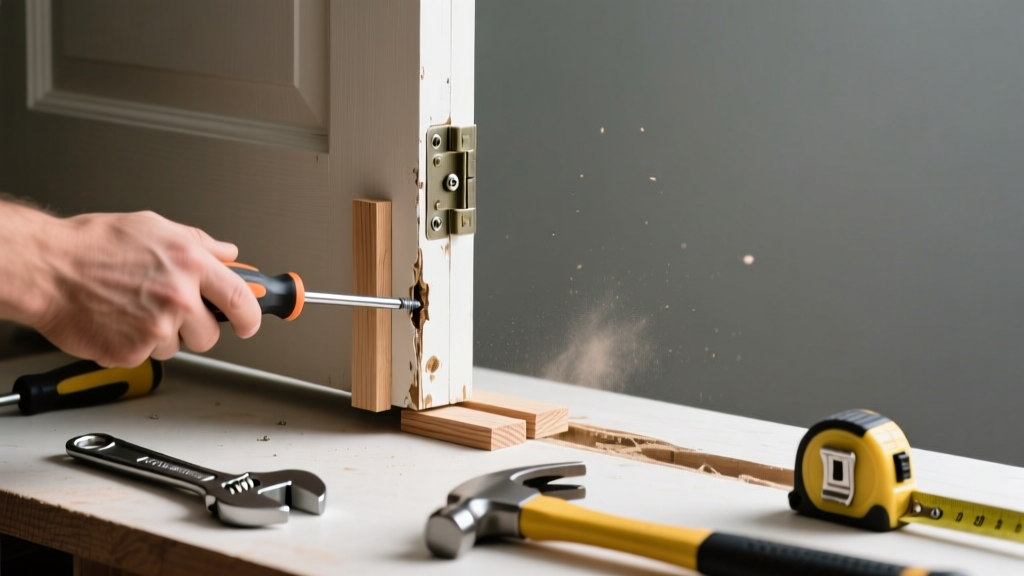
A door that sticks is more than just annoying—it’s a sign something’s off with your home’s structure, humidity levels, or hardware. It might catch halfway shut, scrape the frame, or refuse to latch without a shove. Most sticking doors can be fixed in under an hour with basic tools and a methodical approach.
Quick Diagnosis
Before grabbing tools, identify where and when the sticking happens. This tells you whether the issue is seasonal, structural, or mechanical.
- Top corner binds — often due to swollen wood or hinge misalignment
- Bottom drags on threshold — common after humidity spikes or floor settling
- Latch won’t engage — usually a misaligned strike plate or warped door edge
- Sticking only in winter/summer — points to wood expansion or contraction
- Door rubs along entire jamb — suggests sagging hinges or shifted framing
Tools & Materials Needed
| Item | Purpose | Estimated Cost |
|---|---|---|
| 3-in-1 screwdriver or Phillips + flathead set | Tightens hinges, adjusts strike plates, removes trim | $8–$15 |
| Shim pack (wood or plastic) | Realigns hinges without removing screws | $4–$9 |
| Plane or sanding block (80–120 grit) | Removes small amounts of wood from binding edges | $12–$25 |
| Feeler gauge or credit card | Measures gap consistency between door and frame | $0–$3 (credit card is free) |
| Wood filler & touch-up stain (if planing) | Repairs over-sanded areas and hides repairs | $6–$14 |
Step-by-Step Fix
Work through these methods in order—they escalate from simplest to most involved. Most doors improve after Step 1 or 2.
- Tighten all hinge screws — Use a screwdriver to snug up all hinge screws (top, middle, bottom). If screws spin freely, replace them with 3-inch #10 screws that bite into the stud behind the jamb.
- Add shims behind hinge leaves — Loosen top hinge screws slightly, insert a thin wood shim behind the hinge leaf, then retighten. This subtly pulls the door away from the jamb at the top. Test after each shim.
- Adjust the strike plate — If the latch catches but won’t fully seat, loosen the strike plate, shift it 1/16" outward or downward with a chisel or utility knife, then resecure. File the hole slightly if needed.
- Plane or sand the binding edge — Mark high spots with lipstick or chalk on the jamb, close the door gently, then inspect transfer marks. Plane or sand only those marked areas—no more than 1/32" per pass.
When to Call a Pro
Some sticking isn’t about maintenance—it’s a symptom of deeper issues. Don’t risk safety or structural integrity by forcing fixes.
- The door frame is visibly cracked, bowed, or pulling away from drywall
- Multiple doors in the same room stick simultaneously (indicates foundation movement)
- You’ve adjusted hinges and planed edges twice and the problem returns within days
- The door swings open or closed on its own (sign of significant floor slope or framing shift)
According to the Insurance Institute for Business & Home Safety's 2023 report, 68% of homes with chronic door sticking show measurable foundation settlement within 18 months—especially in clay-heavy soil regions.
Prevention Tips
Sticking doors are often preventable with smart habits and seasonal awareness.
- Maintain indoor humidity between 35–55% year-round using a hygrometer and dehumidifier/humidifier as needed
- Inspect hinge screws every 6 months—tighten before they strip
- Apply paste wax to door edges twice yearly to reduce friction and moisture absorption
- Check exterior doors for caulk gaps around the frame; reseal annually to prevent water-driven swelling
Why does my door stick only in summer?
Wood absorbs moisture from humid air, expanding across its grain—especially along the stiles and rails. Interior doors made of solid pine or poplar swell more than engineered-core or MDF doors. The U.S. EPA estimates that indoor relative humidity above 60% increases wood swelling by up to 3% in thickness.
Can I use a belt sander to fix a sticking door?
No—belt sanders remove material too aggressively and unevenly, risking irreversible damage to the door’s profile or finish. Stick to hand planes, rasp files, or fine-grit sanding blocks. For precision, use a cabinet scraper instead: it cuts cleanly without heat or dust buildup.
What if tightening the hinges makes it worse?
That usually means the hinge screws aren’t anchoring into solid wood. Remove the screws and fill the holes with wooden toothpicks dipped in wood glue. Let dry 2 hours, then re-drill pilot holes and reinstall longer screws. This restores holding power without replacing the entire hinge.
Do I need to remove the door to plane it?
Not always—but it’s safer and more accurate. Hanging doors are unstable targets for planing. Remove it using a pry bar and helper, lay it flat on sawhorses, and mark high spots first. See our guide on how to remove a door safely for step-by-step visuals.
Will shaving the door void my warranty?
Yes—if it’s a pre-hung interior door from brands like Masonite or Jeld-Wen, most warranties exclude field modifications like planing or routing. Check your manufacturer’s warranty PDF (usually online) before altering. Solid-core doors tolerate minor trimming; hollow-core ones do not.
Can weatherstripping cause sticking?
Absolutely. Over-compressed or aged foam weatherstripping bulges into the gap and creates drag. Replace with vinyl V-strip or silicone bulb seals—they compress evenly and last 7+ years. For help choosing the right type, see our best weatherstripping for interior doors comparison.
Fixing a sticking door isn’t about brute force—it’s about reading the clues the door gives you and responding with precision. A well-adjusted door should swing smoothly, close silently, and seal without gaps. When you get it right, you’ll notice it immediately: no more shoulder-shoving, no more wedging books under the door, just quiet, reliable function—exactly what a door is meant to do. And if you’re tackling other stubborn household hiccups, check out our guide on fixing a stuck window latch next.