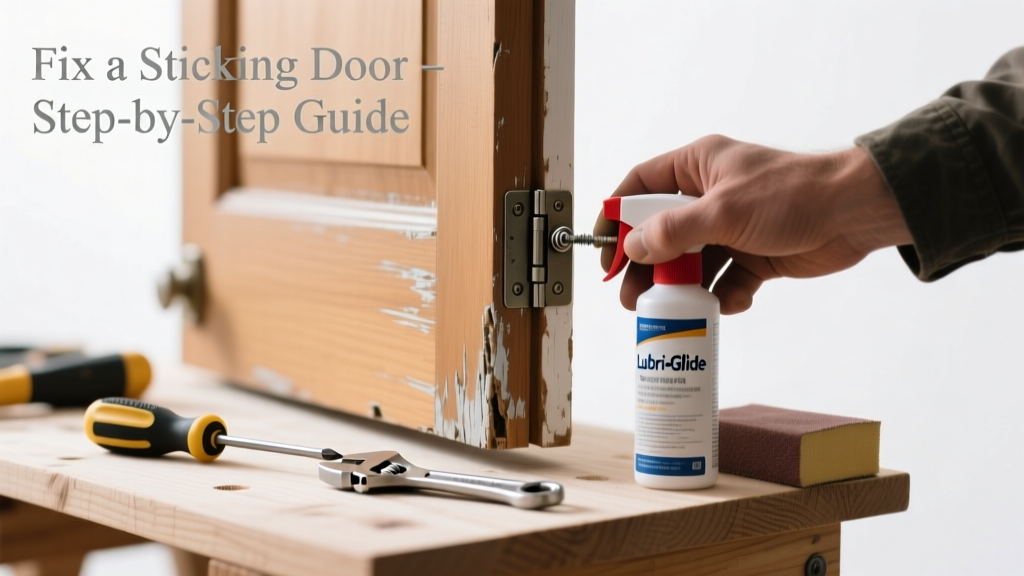
That sudden screech when you open the bedroom door—or the stubborn resistance followed by a low grind—isn’t just annoying. It’s a sign your door’s alignment, hardware, or frame has shifted, often due to seasonal wood swelling, loose hinges, or worn components. Left unaddressed, it can worsen quickly and even compromise security or energy efficiency.
Quick Diagnosis
Before grabbing tools, identify the root cause by observing when and where the noise occurs:
- Squeaking or chirping — usually dry hinge pins or corroded hinge knuckles
- Scraping or dragging sound — door rubbing against strike plate, jamb, or threshold (often top corner or bottom edge)
- Grinding or groaning — warped door slab, swollen frame, or failing hinge screws pulling out of soft wood
- Thumping or popping — loose latch mechanism, misaligned strike plate, or shifting foundation affecting the entire jamb
Tools & Materials Needed
| Item | Purpose | Estimated Cost |
|---|---|---|
| 3-in-1 screwdriver or drill/driver with #2 Phillips bit | Tightens hinge screws, adjusts strike plate, removes latch hardware | $8–$25 |
| 60-grit and 120-grit sandpaper (or sanding block) | Removes minor high spots on door edge or jamb without over-sanding | $4–$9 |
| White lithium grease or silicone-based lubricant | Lubricates hinge pins and latch mechanisms without attracting dust | $5–$12 |
| Wood shims (1/16" and 1/8") | Temporarily reposition jambs or hinge mortises for realignment testing | $3–$7 |
| Feeler gauge or business card | Measures consistent gap between door and jamb (ideal: 1/8" at top/bottom, 1/16" at latch side) | $2–$6 |
Step-by-Step Fix
Start with the simplest, lowest-risk fixes first—and test after each step:
- Lubricate hinges and latch: Remove hinge pins using a flathead screwdriver and hammer tap. Wipe off rust or grime, apply white lithium grease, and reinsert. Spray silicone lube into latch bolt cavity and operate 10 times.
- Tighten all hinge screws: Use a drill/driver to snug every hinge screw—including those in the jamb and door edge. If screws spin freely, replace with 3-inch #8 wood screws anchored into the stud behind the jamb.
- Check and adjust strike plate: Loosen strike plate screws. Slide it 1/16" deeper into the jamb if latch binds; use a chisel or Dremel to enlarge mortise if needed. Reattach with longer screws.
- Sand high-contact areas: Close door and mark rubbing spots with pencil. Sand only the marked area with 120-grit paper—never more than 1/32" off the edge. Wipe dust and retest.
When to Call a Pro
DIY stops being safe or effective when structural issues are involved:
- The door drags along the floor across its full width—even after threshold adjustment
- You see visible gaps >1/4" between door and jamb at top or sides, especially with diagonal cracking in nearby drywall
- Hinge screws won’t hold in the jamb, and the jamb itself shifts or bows when pressure is applied
- The sticking coincides with recent foundation work, basement flooding, or severe seasonal cracking in plaster or flooring
According to the National Association of Home Builders’ 2022 Residential Construction Defect Report, 27% of post-construction door alignment complaints stem from undetected framing movement—not hinge wear—making early professional assessment critical.
Prevention Tips
Keep doors operating smoothly year-round with these habits:
- Re-lubricate hinges every 6 months—especially before winter heating season begins
- Check hinge screws quarterly; tighten any that feel loose (don’t overtighten—strip-out risk is high in pine jambs)
- Run a dehumidifier in basements and crawlspaces during humid months—wood moisture content above 12% causes swelling
- Install adjustable threshold seals on exterior doors to compensate for seasonal expansion
Why does my door stick only in summer but not winter?
Wood absorbs moisture from humid air, expanding across its grain—especially in solid-core interior doors and older pine jambs. A typical 30"-wide solid pine door can swell up to 1/8" in high-humidity conditions. This is normal, but persistent sticking indicates inadequate clearance or poor ventilation in the room.
Can I plane the door edge myself safely?
Yes—if you limit removal to no more than 1/32" per pass and use a sharp, fine-set hand plane (like a Stanley No. 4). Always plane with the grain and check fit frequently. Avoid power planers unless you’ve done this before—they remove material too fast and create uneven edges. For guidance, see our how to plane a door edge tutorial.
Will WD-40 fix my squeaky hinges long-term?
No—it’s a water-displacing solvent, not a lubricant. WD-40 evaporates quickly and leaves little protective film. It may quiet hinges for a day or two, then attract dust and gum up the pin. White lithium grease or silicone spray lasts 6–12 months and resists washout from humidity. See our best lubricants for door hinges comparison.
What if the latch won’t retract fully when the door closes?
This usually points to strike plate misalignment or a bent latch tongue. First, check if the door closes flush—if not, fix sticking first. Then inspect the latch: depress it manually with a screwdriver while door is open. If it sticks, clean and lubricate the internal spring. If it retracts smoothly but still binds when closing, shim the strike plate outward with thin brass washers behind its screws.
How do I know if my door is warped instead of just sticking?
Closed and latched, slide a credit card around the perimeter. If it catches consistently on one vertical edge (e.g., top 6 inches of latch side), that’s likely warping. Lay a 4-foot level across the door face horizontally and vertically—any gap >1/16" between level and surface confirms warp. Warped doors rarely recover; replacement is often more reliable than shaving. Learn more in our signs you need a new interior door guide.
Is it safe to sand the door’s top edge if it scrapes the header?
Yes—but only if the gap at the top is ≥1/8" when closed. Measure with a feeler gauge first. Sand no more than 1/32" at a time, then recheck operation. Over-sanding reduces head clearance and compromises fire-rated door integrity (if applicable). Never sand fire-rated doors without manufacturer approval—look for the UL label near the hinge edge.
A well-maintained door should swing silently and latch cleanly—not groan, scrape, or require shoulder pressure. Most sticking-and-noise issues resolve in under an hour with basic tools and methodical testing. If the problem returns within weeks, revisit your humidity control strategy or inspect for hidden framing movement—because sometimes the door isn’t the problem at all. It’s just the first thing to talk back.