Your bathroom door scrapes the jamb every time you open it — especially after a hot shower. That sticky, resistant drag isn’t just annoying; it’s a red flag for moisture damage, hinge wear, or swelling wood. Ignoring it risks worsening warping or damaging the latch mechanism.
Quick Diagnosis
Bathroom doors stick for different reasons than doors elsewhere in the house. Humidity is the biggest culprit — but it’s rarely the only one. Start here:
- Swelling of the door edge (especially the top or latch-side) due to repeated exposure to steam and moisture
- Hinge screws loosened or stripped from repeated use on a heavy, moisture-laden door
- Paint buildup along the strike side or top edge creating friction
- Foundation shift or floor cupping causing the threshold to rise slightly beneath the door
- Warped door slab — often visible as a gap at one corner when the door is closed
Tools & Materials Needed
| Item | Purpose | Estimated Cost |
|---|---|---|
| 3-in-1 screwdriver or cordless drill with Phillips bit | Tightens hinge screws and adjusts hardware without stripping heads | $8–$25 |
| 120-grit sandpaper (or sanding sponge) | Removes minor swelling or paint ridges without over-sanding | $3–$6 |
| Wood shims (thin cardboard or plastic) | Temporarily test hinge adjustment before committing to shimming | $2–$4 |
| Moisture meter (optional but recommended) | Measures wood moisture content — above 12% indicates active swelling risk | $45–$90 |
| Wax-based door lubricant (e.g., paste wax or paraffin) | Reduces friction without attracting dust like silicone sprays | $5–$12 |
Step-by-Step Fix
Try these methods in order — most sticking issues resolve with the first two steps.
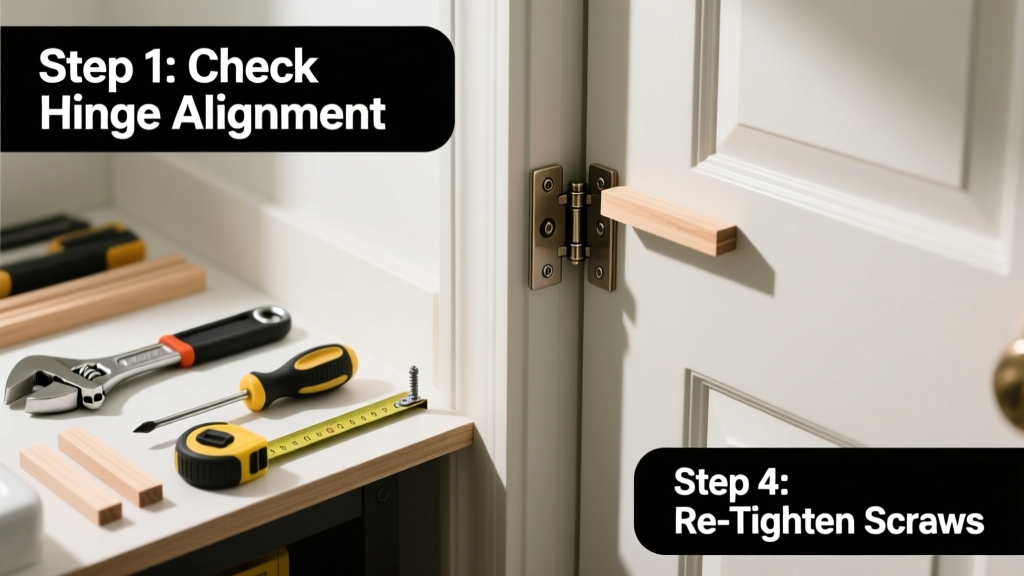
- Tighten all hinge screws. Use a drill or screwdriver to snug each screw — especially the top hinge. If screws spin freely, remove them and fill holes with wooden toothpicks + wood glue, then reinsert screws after 30 minutes.
- Sand the sticking area lightly. Identify where the door rubs (often top corner or latch-side edge). Sand with 120-grit in the direction of the grain, removing only 1/32" of material. Wipe away dust and test.
- Add shims behind the bottom hinge leaf. If the door binds at the top corner, loosen the bottom hinge screws slightly, insert a thin cardboard shim behind the hinge leaf, then retighten. This tilts the door inward, increasing clearance at the top.
- Apply wax lubricant to the strike-side edge and top rail. Rub paste wax or a candle along contact points — not spray lubricants, which attract grime and degrade finishes over time.
When to Call a Pro
Some sticking signs mean deeper structural or moisture issues that DIY can’t safely address:
- The door frame itself is visibly bowed or separating from drywall — suggests chronic water intrusion behind tile or around the tub/shower
- Moisture meter readings exceed 18% in the door or jamb — indicates possible rot requiring replacement
- You’ve sanded more than 1/16" off the door edge and it still drags — the door may be too warped for correction
- The bathroom floor feels spongy or slopes toward the door — could indicate subfloor decay needing full replacement
According to the Insurance Institute for Business & Home Safety's 2023 report, 68% of bathroom door sticking cases linked to unaddressed moisture led to hidden mold growth within 18 months if not investigated.
Prevention Tips
Stop the cycle before it starts — especially in high-humidity zones:
- Run the bathroom exhaust fan for at least 20 minutes after every shower (not just during) — install one if you don’t have it
- Seal all edges of the door with semi-gloss or polyurethane — especially the top, bottom, and latch-side edge where moisture wicks in
- Check hinge screws quarterly — bathroom doors see more cycles per day than any other interior door
- Keep the door slightly ajar after showers to promote airflow — avoid propping it fully open against trim, which stresses hinges
Can I plane the door myself?
Yes — but only if swelling is uniform and minimal. Use a hand plane set for a very light cut (no more than 0.005" per pass), and always plane with the grain. Stop if you hit bare wood or see tear-out. For hollow-core doors, planing is unsafe — sanding only.
Why does my door stick only in winter?
Low indoor humidity dries out wood, causing shrinkage — but if your door sticks *more* in winter, it’s likely because your heating system dries the air so much that the door warps asymmetrically, or your home’s foundation shifts slightly with seasonal soil moisture changes. Check for gaps around the frame — they’ll widen in cold months and alter alignment.
Will weatherstripping help with sticking?
No — weatherstripping adds thickness and increases friction. It’s designed for exterior doors to block drafts, not interior bathroom doors. In fact, adding it to a sticking interior door often worsens binding. Focus on hinge alignment and moisture control instead.
How do I know if the door is warped or just swollen?
Closed, measure the gap between door and jamb at three points: top, middle, and bottom. If gaps vary by more than 1/8", it’s likely warped. If gaps are consistent but the door drags only after showers, swelling is the issue. A straightedge laid flat across the door surface will reveal bowing — look for light gaps underneath.
Can I use a dehumidifier to stop sticking?
A portable dehumidifier helps — but only if placed inside the bathroom with the door closed during and after showers. The U.S. EPA estimates that 14% of household water usage is from leaks and evaporation, much of it concentrated in bathrooms. A unit pulling 20+ pints/day cuts relative humidity below 50%, slowing wood expansion significantly.
Should I replace the door if it sticks repeatedly?
Not immediately — but consider it if you’ve sanded more than 1/8" off the edge, the core feels soft near the bottom, or you detect musty odors behind the casing. Solid-core MDF or composite doors resist moisture better than solid pine or poplar. Compare moisture-resistant options here.
Sticking bathroom doors are rarely about the door itself — they’re early warnings from your home’s moisture management system. Fix the symptom with sanding or shimming, but protect the long term by controlling humidity, sealing wood, and checking hinges regularly. A well-maintained bathroom door should swing silently, even after back-to-back showers.