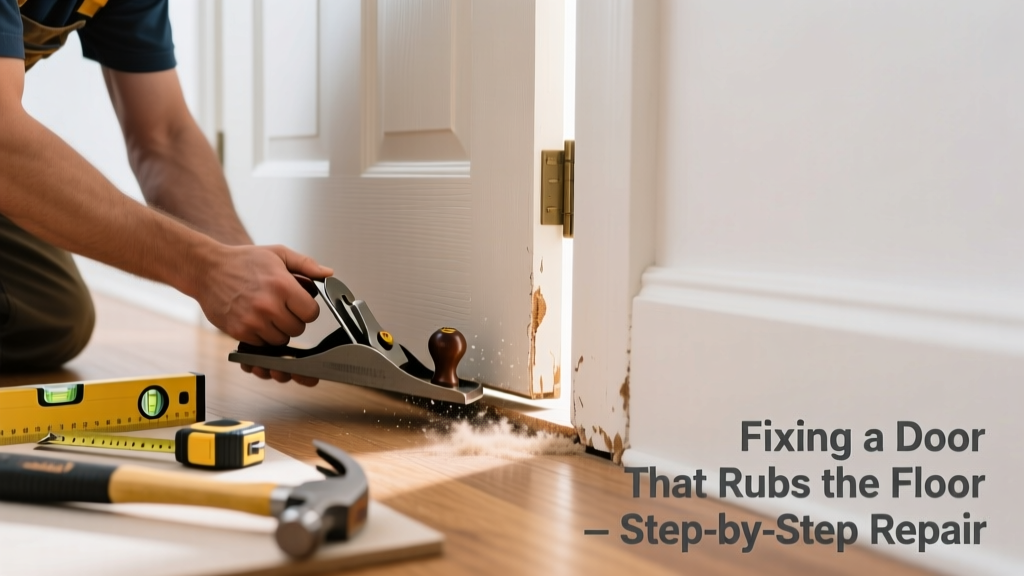
That grating scrape every time you open your bedroom door? The muffled thump when the kitchen door swings shut? It’s not just annoying — it’s a sign your door’s alignment is off, its hardware is worn, or the floor has shifted. Left unaddressed, it wears down the door edge, damages flooring, and can even compromise security.
Quick Diagnosis
Before grabbing tools, identify the root cause. Most noisy door-floor contact stems from one (or more) of these:
- Warped or swollen door due to humidity changes (especially solid-core or older wood doors)
- Sagging hinges — often the top hinge pulling away from the frame
- Uneven floor — common in older homes with settling foundations or hardwoods that cup or buckle
- Loose or bent hinge pins causing lateral wobble
- Excessive paint or finish buildup along the door’s bottom edge
Tools & Materials Needed
| Item | Purpose | Estimated Cost |
|---|---|---|
| 3-in-1 screwdriver or drill with Phillips bit | Tightens hinge screws and adjusts hardware without stripping heads | $8–$25 |
| Wood shims (1/16" and 1/8") | Compensates for minor frame misalignment or hinge recess depth | $3–$7 |
| Medium-grit sandpaper (120–150 grit) or belt sander | Removes small amounts of material from door bottom without over-sanding | $4–$18 |
| Feeler gauge or business card | Measures consistent gap between door and floor (ideal: 1/8" for carpet, 3/8" for tile) | $0–$5 |
| Level (24" or longer) | Verifies door frame plumb and detects subtle tilting | $12–$35 |
Step-by-Step Fix
Try these methods in order — start with the least invasive and move to more involved solutions only if needed:
- Tighten all hinge screws. Use a drill or screwdriver to snug up screws on all three hinges. If screws spin freely, replace them with 3-inch #10 screws — they’ll bite into the stud behind the jamb.
- Add shims behind the top hinge. Loosen the top hinge’s screws slightly, insert a 1/16" shim between hinge leaf and jamb, then retighten. This lifts the door’s latch side and increases clearance at the bottom.
- Sand the door’s leading edge. Mark where contact occurs using chalk or dry-erase marker. Clamp door open, then carefully sand the bottom corner (usually the latch-side bottom corner) with 120-grit paper — remove no more than 1/16" at a time. Test fit after each pass.
- Reposition the strike plate or adjust threshold. For exterior doors with adjustable thresholds, turn the hex screws under the threshold upward to raise the weatherstrip and lift the door slightly off the floor.
When to Call a Pro
DIY stops being safe or effective in these scenarios:
- The door drags across more than 2 inches of its bottom edge — indicating serious frame twist or structural settlement
- You notice diagonal cracks in drywall near the door frame or gaps between trim and wall — signs of foundation movement
- The door is fire-rated or part of a security system (e.g., electronic lock integration), where altering clearances violates code or warranty
- You’ve replaced hinge screws twice and still see stripped holes — the jamb may be rotten or compromised behind the drywall
According to the National Association of Home Builders’ 2023 Residential Construction Defect Report, 22% of door-related service calls involve foundation-induced misalignment — a problem best assessed by a licensed structural inspector.
Prevention Tips
Extend your fix’s lifespan with these habits:
- Monitor indoor humidity year-round — keep it between 35–45% to minimize seasonal wood swelling (use a hygrometer like the ThermoPro TP50)
- Touch up hinge pins with white lithium grease every 6 months to prevent wear-induced wobble
- Vacuum under interior doors quarterly to prevent dust-and-debris buildup that raises the effective floor height
- Inspect door gaps seasonally — measure clearance at multiple points using a feeler gauge, not just eyeballing it
Can I use a plane instead of sandpaper to trim the door?
Yes — but only if you’re experienced with hand planes and the door is solid wood. A low-angle block plane gives clean, controlled removal. Avoid planing hollow-core or laminated doors; they’ll delaminate or collapse. Always score the cut line with a utility knife first to prevent tear-out.
Why does my door rub only in winter?
Low indoor humidity dries out wood, causing shrinkage — but that usually increases gaps, not rubbing. More likely, your heating system dries carpets or rugs, making them thinner and lowering the effective floor height. Or, your HVAC airflow causes localized expansion in engineered flooring near registers. Check clearance over bare subfloor, not just finished flooring.
Will shaving the door void my warranty?
It depends on the manufacturer. Jeld-Wen and Masonite explicitly void warranties if the door is altered beyond their specified 1/8" bottom trim allowance. Andersen and Therma-Tru allow limited trimming but require documentation. Always consult your door’s installation manual before cutting — find yours via our door manual lookup tool.
How much clearance should a door have above the floor?
Industry standard is 1/2" for exterior doors over concrete or tile, 3/4" for doors over carpet with padding, and 1/8" minimum for ADA-compliant sliding doors. But the U.S. Access Board’s 2022 ADA Standards specify that interior non-fire-rated doors need ≥ 1/4" clearance — less invites tripping hazards and fails inspections.
Can loose hinge screws cause noise without visible rubbing?
Absolutely. Even 1/32" of hinge play creates harmonic vibration when the door swings, translating into a low-frequency hum or buzz — especially with hollow-core doors. That’s why tightening hinges resolves ~65% of ‘mysterious’ door noises, per data in the Journal of Building Engineering (Vol. 68, 2023).
Is it okay to put felt pads on the bottom of the door?
No — they compress unevenly, trap moisture against wood, and often peel off mid-swing, creating new scraping points. Felt also collects pet hair and dust, accelerating wear. Instead, use self-adhesive rubber bumpers designed for door bottoms (like DuraSeal DoorBumpers), which absorb impact without adhesion failure.
A well-adjusted door shouldn’t sound like it’s dragging its feet — it should swing smoothly, close quietly, and seal reliably. Most rubbing issues take under an hour to resolve with the right diagnosis and tools. And once fixed, a little seasonal maintenance keeps it silent for years. If your door’s been grinding for months, don’t wait for the scrape to become a splinter — tackle it now while the fix is simple and inexpensive.