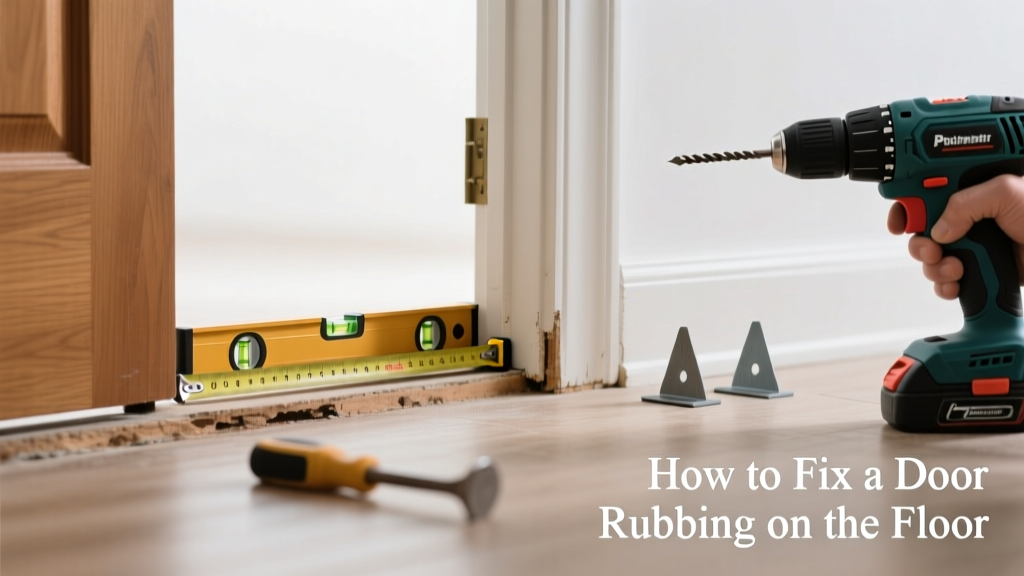
A door dragging across the floor isn’t just annoying—it’s a red flag that something’s shifted in your home’s structure or hardware. You’ll hear scraping, see scuff marks on the threshold, and feel resistance every time you open or close it. Left unaddressed, it can warp the door, damage flooring, or signal deeper foundation issues.
Quick Diagnosis
Before grabbing tools, pinpoint the cause. Most door-rubbing cases fall into one of these categories:
- Swelling due to high humidity (especially with solid wood or MDF doors)
- Loose or sagging hinges—often the top hinge pulling away from the frame
- Settling floor or shifting threshold, common in older homes or slab-on-grade foundations
- Worn or misaligned strike plate or latch mechanism
- Uneven floor surface from subfloor deflection or carpet pile compression
Tools & Materials Needed
| Item | Purpose | Estimated Cost |
|---|---|---|
| 3-in-1 screwdriver or drill with Phillips bit | Tightens hinge screws and adjusts hardware without stripping | $8–$25 |
| Wood shims (thin, tapered) | Re-levels door by lifting hinge side slightly | $3–$7 |
| Plane or sanding block (80–120 grit) | Removes minimal material from bottom edge if trimming is safe | $12–$35 |
| Feeler gauge or credit card | Measures gap between door bottom and floor (ideal: ⅛"–3/16") | $0–$2 |
| Level (24" or longer) | Verifies door and jamb plumb and level before adjusting | $10–$40 |
Step-by-Step Fix
Try these methods in order—start with the least invasive:
- Tighten all hinge screws. Use a drill or screwdriver to snug each screw fully. If screws spin freely, replace them with 3″ coarse-thread screws that grip the stud behind the jamb.
- Add shims behind the top hinge. Remove the top hinge leaf, insert a thin wood shim (0.015"–0.030") between the hinge and jamb, then remount. This lifts the latch side slightly and rotates the door away from the floor.
- Adjust the strike plate downward. If the door rubs only near the latch side, loosen the strike plate screws and shift it 1/16" down—this changes the swing arc without altering the door itself.
- Plane or sand the bottom edge. Only if the door is solid core and rubbing is < 1/8". Clamp a straightedge, remove no more than 1/16" at a time, and retest clearance with a credit card.
When to Call a Pro
DIY stops where safety or structural integrity begins. Call a licensed carpenter or door specialist if:
- The door rubs only on one corner—and the floor slopes more than 1/4" over 6 feet (sign of foundation settlement)
- You’ve tightened hinges and shimmed twice, but the door still binds or won’t latch properly
- The jamb is visibly racked, cracked, or separating from drywall
- You’re dealing with a fire-rated or exterior steel-clad door—modifying it improperly voids UL certification
"Over 60% of door alignment issues stem from hinge movement—not door swelling—so always check fasteners first." — National Association of Home Builders, Door Installation Standards Handbook, 2022
Prevention Tips
Stop recurrence before it starts:
- Maintain indoor humidity between 35–55% year-round using a hygrometer and dehumidifier/humidifier as needed
- Inspect hinge screws every 6 months—especially on exterior doors exposed to weather cycles
- Install adjustable threshold sweeps instead of fixed ones to accommodate seasonal floor movement
- Use felt pads under furniture legs near door paths to avoid accidental kicks that jar the jamb
Can I use a belt sander to trim the bottom of my door?
No—belt sanders remove material too aggressively and rarely produce a clean, square cut. They also risk gouging the edge or overheating veneer. Use a hand plane, fine-grit sanding block, or a table saw with a fence for precision. For hollow-core doors, never sand below the bottom rail—exposing the honeycomb core invites moisture and collapse.
Will shaving the door void my warranty?
Yes—most manufacturers (e.g., Masonite, Jeld-Wen) explicitly void warranties if the door is altered beyond their specified trim limits (usually 1/4" off the top and bottom, none off the sides). Always check your product’s installation guide first. Trimming beyond spec risks warping and failed weatherstripping seals.
My door rubs only in winter—is that normal?
It’s common but not harmless. Cold air holds less moisture, causing wood to shrink—but if the door rubs *more* in winter, it likely means the floor or subfloor is contracting unevenly (e.g., engineered hardwood over concrete), or the door was installed during humid summer months and now binds as it dries. Monitor with a moisture meter; readings above 12% in subfloor warrant investigation.
Can I fix this without removing the door?
Yes—90% of minor rubbing fixes happen with the door hung. Shimming hinges, tightening screws, adjusting the strike plate, or using a pull-up hinge (like a Stanley No-Mar) require no removal. Only planing or routing the bottom edge demands removal—and even then, most interior doors lift out easily with hinge-pin taps.
Is door rubbing a sign of foundation problems?
Sometimes—but not always. Single-door rubbing is usually hardware- or humidity-related. If multiple doors on the same floor rub, especially along interior walls, or if you see diagonal drywall cracks near corners, sticking windows, or sloping floors, contact a structural engineer. The American Society of Civil Engineers notes that 1 in 5 homes over 25 years old shows measurable foundation movement affecting door function (ASCE Infrastructure Report Card, 2023).
What’s the ideal gap between door bottom and floor?
For interior doors: ⅛"–3/16" over hard surfaces (wood, tile, vinyl); ¾"–1" over carpet with padding. Exterior doors need ⅜" minimum to clear thresholds and allow weatherstripping compression. Too much gap invites drafts; too little causes binding. Use a feeler gauge—or a standard credit card (0.03" thick) as a quick field check.
Fixing a door that drags is rarely about brute force—it’s about reading the clues the door gives you. A few turns of a screwdriver or a sliver of wood can restore smooth operation for years. And if your home has multiple doors acting up at once, don’t just fix the symptom—check for underlying settlement or tackle indoor moisture control to stop the cycle before it spreads to other rooms.