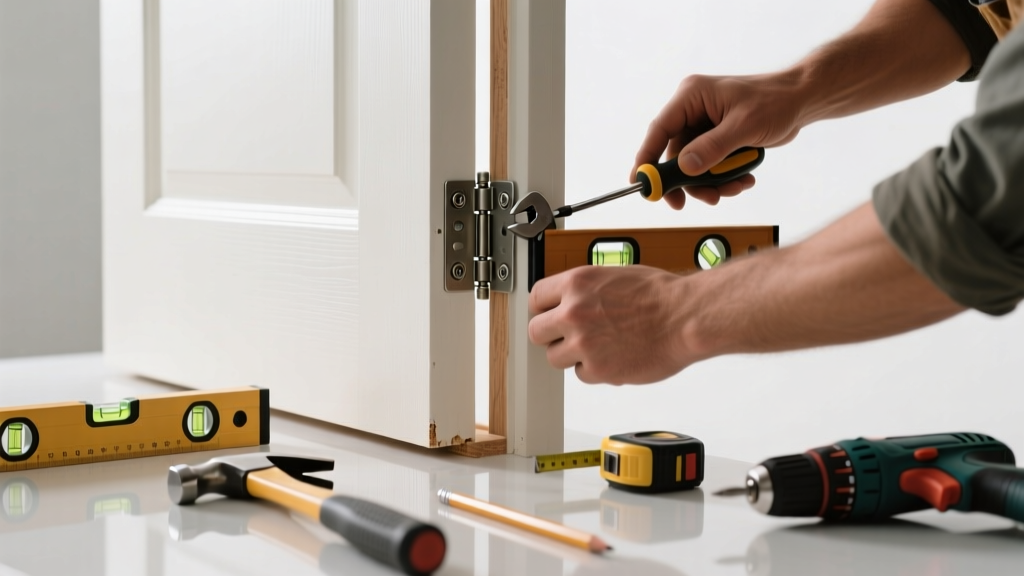
If your door swings open on its own, drags on the floor, or leaves a wedge-shaped gap at the top or bottom, it’s likely not square — meaning the frame or door itself has shifted out of true 90° alignment. This isn’t just an annoyance; it compromises security, energy efficiency, and long-term hardware function. Most cases stem from simple settling or hinge wear — and can be fixed in under two hours with basic tools.
Quick Diagnosis
Before grabbing tools, rule out the obvious:
- Hinge screws pulled loose or stripped in the jamb or stud framing
- Door sagging on the latch side (gap widens at top, narrows at bottom)
- Warped door slab — especially common with solid-core pine or older hollow-core doors exposed to humidity
- Frame twisted due to foundation settlement or improper shimming during installation
- Threshold or floor heaved or sunk beneath the door’s swing path
Tools & Materials Needed
| Item | Purpose | Estimated Cost |
|---|---|---|
| 3-in-1 screwdriver or cordless drill with clutch | Drives and tightens hinge screws without stripping heads | $12–$45 |
| Shim pack (plastic or cedar) | Fills gaps behind hinge leaves to reposition door vertically/horizontally | $4–$8 |
| 4-ft level (preferably with vial for both horizontal and vertical) | Verifies plumb of jamb and level of header — critical for diagnosing squareness | $18–$32 |
| Wood filler & touch-up stain | Repairs old screw holes when relocating hinges | $6–$10 |
| 16d finish nails or 3" deck screws | Re-secures jamb to framing if anchor points are compromised | $3–$7 |
Step-by-Step Fix
Start with the least invasive method and escalate only if needed:
- Tighten all hinge screws — Use a drill/driver on low torque. If screws spin freely, remove them and fill holes with wooden toothpicks + wood glue; let dry 30 minutes before reinserting.
- Add shims behind the top hinge — If the door rubs at the top latch corner, insert a thin cedar shim behind the top hinge leaf (between leaf and jamb). Re-tighten screws and test swing. Repeat in 1/16" increments until gap evens out.
- Reposition the middle hinge — On three-hinge doors, loosen the middle hinge screws and shift the leaf 1/32" toward the latch side to pull the door tighter against the stop. Secure with new screws if original holes are stripped.
- Check and adjust strike plate depth — A misaligned strike plate often mimics squareness issues. File or bend the lip slightly if the latch binds, or relocate the plate using a chisel and pilot holes.
When to Call a Pro
DIY stops where structural integrity begins. Call a licensed carpenter or door specialist if:
- The door frame is visibly racked — i.e., one corner of the jamb is pushed inward while the opposite bows outward
- You find >1/4" gap between jamb and rough opening, indicating missing or failed shims behind the frame
- Foundation cracks appear near the doorway or adjacent walls show diagonal stress fractures
- The door is part of a fire-rated assembly (e.g., garage entry or basement egress) — altering alignment may void UL certification
According to the National Association of Home Builders’ 2022 Residential Construction Performance Guidelines, door frames must remain plumb within 1/8" over 6 feet — exceeding that tolerance risks long-term binding and weatherstripping failure.
Prevention Tips
Square doors stay square longer with proactive care:
- Tighten hinge screws every 6 months — especially on exterior doors subject to wind load and thermal expansion
- Install adjustable hinge pins on interior doors to fine-tune alignment without removing hardware
- Use moisture meters to keep indoor RH between 35–55% — wood doors swell significantly above 60% RH (U.S. Forest Service, 2021)
- Replace hollow-core doors older than 12 years — their internal cardboard honeycomb degrades and sags under repeated use
Why does my door only stick in winter but not summer?
Seasonal sticking points to humidity-driven wood swelling. Interior doors expand across the grain — especially at the top and latch-side stile — when ambient moisture rises. The U.S. EPA estimates indoor RH routinely hits 60–70% in heated homes during cold months, enough to swell a pine door up to 1/16". Run a dehumidifier near the door or sand the binding edge with 120-grit paper — but only after confirming the frame is still plumb.
Can I plane the door edge without making it worse?
Yes — but only as a last resort and only on the latch side or top edge, never the hinge side. Remove no more than 1/32" per pass with a hand plane or belt sander, then retest. Over-planing creates light gaps and weakens the stile’s structural integrity. Always check for frame squareness first — planing a door that’s already true only compounds misalignment.
How do I know if the problem is the frame or the door?
Remove the door from hinges and lay it flat on sawhorses. Place a straightedge along each edge — look for gaps >1/32". If the door is warped, you’ll see consistent bowing. If it’s flat, the issue is almost certainly the frame. Then check jamb plumb with a level at both sides and head — if either shows >1/8" deviation over 6 ft, the frame is out of square.
Will tightening hinge screws fix a door that won’t latch?
Sometimes — but only if the latch misalignment is minor (<1/16"). Most latch failures stem from strike plate position, not hinge slop. Try this test: close the door slowly and watch where the latch tongue contacts the strike. If it hits the outer lip or misses entirely, shift the strike plate 1/32" deeper or laterally using a chisel and pilot drill — not hinge adjustment.
Do I need to replace the entire door if it’s warped?
Not always. Minor warp (<1/16" over 36") can be corrected temporarily with strategic clamping and moisture control. But if the door shows cupping (edges higher than center) or twist (diagonal warp), replacement is safer and more cost-effective than repair. Solid wood doors rarely recover fully; engineered stave-core or MDF-core doors hold shape better long-term.
What’s the fastest way to test if my door frame is square?
Measure diagonally from top-left to bottom-right corner of the rough opening, then top-right to bottom-left. If measurements differ by more than 1/8", the frame is racked. For finished jambs, measure inside the reveal — top left to bottom right vs. top right to bottom left — same tolerance applies. This ‘3-4-5 triangle’ verification is used by framers on every job site.
A door that’s not square doesn’t have to mean a full replacement — most issues resolve with precise hinge tweaks and frame verification. Keep your level and shims handy, and revisit hinge maintenance twice a year. For persistent problems, explore our guide on how to rehang a door or door sticking in humidity. Consistent alignment protects your home’s comfort, safety, and resale value far beyond just smooth operation.