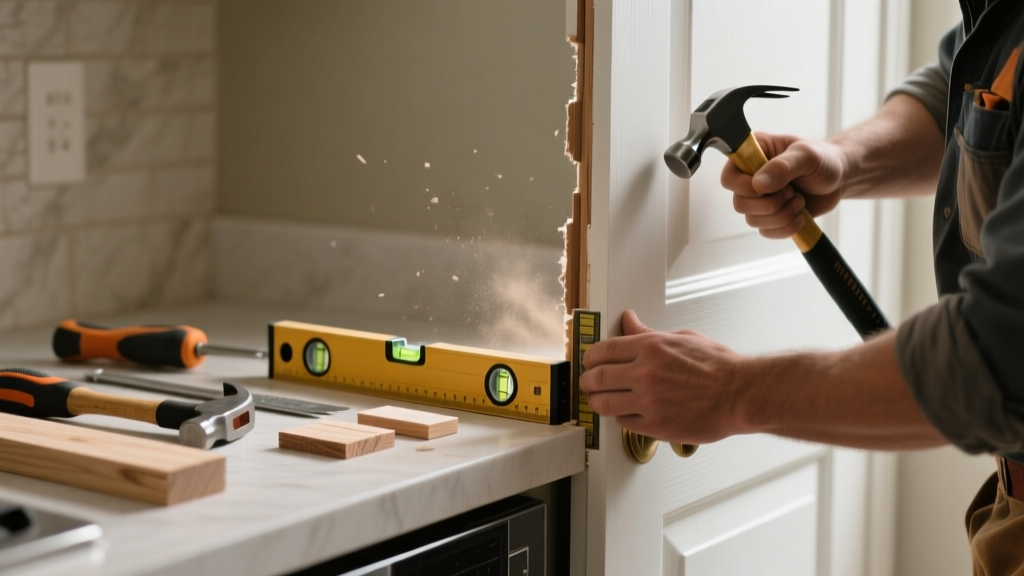
Your kitchen door swings crooked, rubs on the jamb, or won’t latch cleanly—that’s a classic sign it’s no longer square. Unlike bedroom or bathroom doors, kitchen doors endure humidity swings, frequent use, and cabinet weight nearby, making misalignment more common and trickier to correct. Don’t ignore it: a skewed door stresses hinges, warps frames, and can worsen in weeks.
Quick Diagnosis
Before grabbing tools, confirm the root cause. A door not square usually stems from one (or more) of these:
- Hinge screws loosened or stripped in the jamb or door edge
- Swelling wood due to steam or spills near the stove or sink
- Settling foundation shifting the rough opening slightly
- Warped door slab—especially older solid-core or MDF doors exposed to moisture
- Improper hinge placement during original install (common with DIY cabinet refits)
Tools & Materials Needed
| Item | Purpose | Estimated Cost |
|---|---|---|
| 3-in-1 screwdriver or drill/driver with #2 Phillips bit | Tightens or repositions hinge screws without stripping | $8–$25 |
| Shim pack (plastic or cedar) | Fills gaps behind hinge leaves to realign door plane | $4–$12 |
| 6-inch combination square | Verifies squareness between door edge and jamb at multiple points | $10–$22 |
| Wood filler & sandpaper (120-grit) | Rebuilds stripped screw holes for secure re-anchoring | $6–$14 |
| Moisture meter (optional but recommended) | Measures door/jamb wood moisture content—above 12% indicates swelling risk | $35–$75 |
Step-by-Step Fix
Try these methods in order—start simple, escalate only if needed:
- Tighten all hinge screws: Use firm pressure—don’t overtighten. If a screw spins freely, remove it and fill the hole with a wooden matchstick + glue before reinserting.
- Add shims behind the top hinge: Loosen the top hinge’s jamb-side screws just enough to slide in a 1/16" cedar shim behind the hinge leaf. Retighten. This often lifts the latch side and restores squareness.
- Reposition the bottom hinge inward: If the door binds at the bottom corner, remove the bottom hinge from the jamb and remount it 1/32" closer to the door stop—this rotates the door slightly inward.
- Plane the binding edge (last resort): Only if swelling is confirmed (use moisture meter). Remove door, plane 1/32" off the latch-side edge near the binding spot—never the hinge side.
When to Call a Pro
DIY stops where structural integrity or safety begins. Call a licensed carpenter if:
- The door gap varies more than 3/16" top-to-bottom or side-to-side
- You find cracked drywall or diagonal stress cracks around the door frame
- The entire kitchen wall feels springy or shifts when you lean on the counter near the door
- Two or more adjacent cabinet doors are also out of square—points to framing or foundation movement
According to the Insurance Institute for Business & Home Safety's 2023 report, 68% of door alignment issues in kitchens linked to underlying moisture damage went undetected until secondary mold or rot appeared—so don’t delay inspection if you smell dampness or see discoloration.
Prevention Tips
Kitchen doors face unique stressors—counteract them year-round:
- Wipe down the door edge and jamb weekly after cooking to prevent grease + steam buildup
- Install a small exhaust fan above the stove if your kitchen lacks one (ASHRAE Standard 62.2-2022 recommends 100 CFM minimum)
- Check hinge screws every 6 months—kitchen vibration loosens them faster than elsewhere
- Keep indoor relative humidity between 30–50% using a hygrometer; sustained >60% swells MDF and particleboard
How do I know if my door is warped versus just misaligned?
Remove the door and lay it flat on a level countertop or garage floor. Slide a straightedge (like a 4-ft level) along each edge and across diagonals. If light passes under the straightedge anywhere—or diagonal measurements differ by more than 1/8"—it’s warped. If it lies flat but hangs crooked when rehung, it’s misaligned.
Can I use wood glue and toothpicks to fix stripped hinge holes?
Yes—but only for minor stripping. Drill out the old hole to 1/8", insert 3–4 toothpicks dipped in waterproof wood glue, snap them flush, let cure 2 hours, then re-drill pilot hole. For repeated failure, use a hardwood dowel (3/16") instead—it holds 3× longer. More on fixing stripped hinge holes.
Will tightening hinges fix a door that won’t close fully?
Sometimes—but first check the strike plate. A door that won’t close fully often has a strike plate misaligned by as little as 1/32". Loosen its screws, insert a business card behind the plate, close the door gently to imprint the latch position, then resecure. See full strike plate adjustment steps.
Is it safe to sand down a swollen kitchen door edge?
Only if moisture content is below 12% (verified with a meter) and swelling is localized—not uniform. Sanding a consistently swollen door masks the real issue: chronic humidity exposure. Address the source first—ventilation, dehumidification, or sealing raw edges with polyurethane. Humidity control for kitchens.
Why does my kitchen door go out of square faster than other doors?
Kitchen doors experience up to 4× more thermal cycling and vapor exposure than interior doors, per the U.S. Department of Energy’s 2022 Residential Humidity Study. Steam from boiling pots, dishwasher venting, and sink splashes create microclimate shifts that swell wood fibers and loosen fasteners faster—especially on doors within 3 feet of cooking surfaces.
Can I replace just one hinge to fix alignment?
Rarely—and not recommended. Hinges wear as a set. Swapping one introduces mismatched tension, accelerates wear on the others, and rarely solves squareness. Replace all three hinges with heavy-duty, ball-bearing 3.5" stainless steel hinges rated for kitchen use. Look for models with adjustable-depth mounting plates.
A properly squared kitchen door isn’t just about smooth operation—it protects your cabinets, reduces energy loss around the frame, and keeps pests out. Recheck alignment after seasonal humidity shifts (spring and fall), and keep a shim pack and moisture meter in your kitchen tool drawer. Small interventions, done early, save big repairs later.