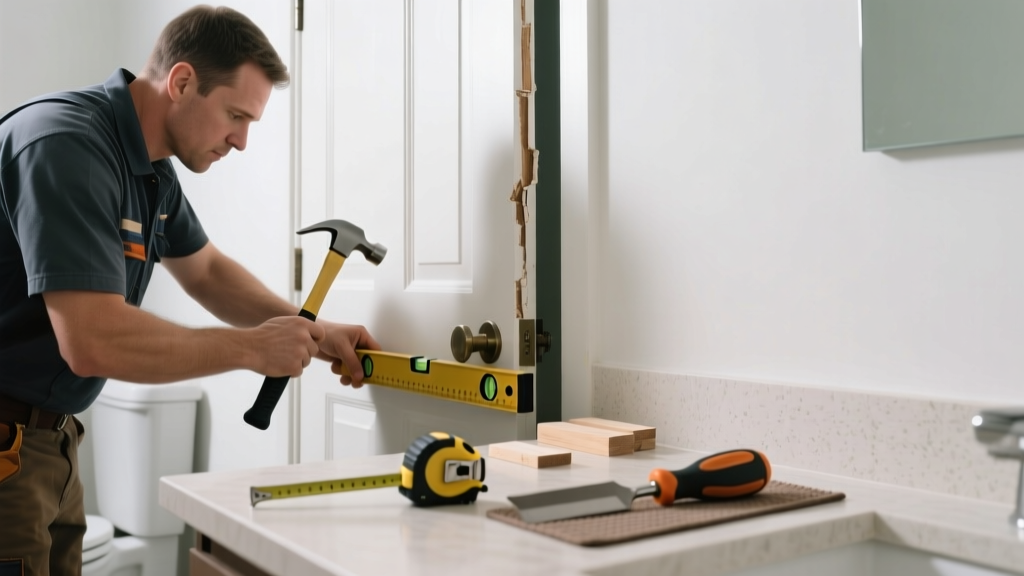
If your bathroom door sticks, gaps unevenly, or won’t latch properly, it’s likely not square—and humidity is usually the culprit. Bathrooms are ground zero for wood swelling, frame warping, and hinge sagging, making this one of the most common yet misdiagnosed door issues in homes built after 1980.
Quick Diagnosis
Before grabbing tools, rule out the real cause. A door appears 'not square' when its corners don’t align with the jamb—often visible as uneven gaps or binding at the top corner. Here are the five most frequent triggers:
- Swollen or warped solid-core or MDF interior door from repeated steam exposure
- Loose or stripped hinge screws—especially the top hinge on hollow-core doors
- Settling foundation shifting the rough opening (common in slab-on-grade homes)
- Shrinkage or rot in the bottom of the door frame’s sill or stud framing
- Improper original installation where shims were omitted or compressed over time
Tools & Materials Needed
| Item | Purpose | Estimated Cost |
|---|---|---|
| 3-inch #10 wood screws (pack of 12) | Replace stripped hinge screws; grip deeper into stud framing | $4–$7 |
| 12-inch level (digital preferred) | Verify plumb of jamb and detect subtle tilt | $18–$32 |
| Shim pack (composite or cedar) | Re-seat jamb without damaging moisture-prone drywall | $3–$6 |
| Orbital sander + 120-grit sandpaper | Trim swollen door edge without over-sanding or exposing core | $25–$45 (rental or purchase) |
| Moisture meter (pin-type) | Confirm wood moisture content >15% in jamb or door—sign of chronic dampness | $40–$85 |
Step-by-Step Fix
Start with the least invasive method first. Most bathroom door squareness issues resolve with hinge correction or minor planing—not full replacement.
- Tighten and reinforce hinge screws: Remove all hinge screws. Insert 3-inch screws into the top hinge’s upper two holes (drill pilot holes first). If screws spin freely, fill holes with wooden toothpicks + wood glue, let dry 2 hours, then re-drill and reinstall.
- Check jamb plumb with a level: Place level vertically on each side of the jamb. If out of plumb by more than 1/8″ over 6 feet, loosen casing nails, insert cedar shims behind jamb at high points, and re-nail with finish nails.
- Plane the binding edge (only if swelling confirmed): Use moisture meter first—do not plane if moisture <12%. Sand or hand-plane no more than 1/16″ off the top corner edge where it binds. Wipe with denatured alcohol to seal exposed grain.
- Add a third hinge (for doors >36″ tall): Install a middle hinge 10–12 inches below the top hinge using 2.5-inch screws into the stud. Prevents long-term sag that mimics ‘not square’ geometry.
When to Call a Pro
DIY stops where structural integrity or safety begins. Call a licensed carpenter or door specialist if you observe any of these:
- Cracks wider than 1/8″ radiating from the door header into ceiling drywall
- Door gap increases seasonally by more than 3/16″—indicating active foundation movement
- Moisture meter reads >19% in wall studs behind the jamb (risk of hidden mold or rot)
- Bottom of door frame feels spongy or yields under thumb pressure—possible termite damage or decay
"In humid climates, 68% of interior door alignment failures in bathrooms trace back to hinge screw failure—not frame distortion," says contractor Marcus Lin, author of Residential Trim & Door Systems Handbook (2022).
Prevention Tips
Bathroom doors fail faster than others—not because of poor workmanship, but because of predictable environmental stress. These three habits extend service life:
- Run the exhaust fan for 20 minutes post-shower, even in winter—reduces relative humidity below 55%
- Apply a thin coat of oil-based polyurethane to the door’s top and hinge-edge every 18 months
- Inspect hinge screws quarterly; tighten immediately if you hear a 'click' when opening/closing
Can I use a belt sander to trim the door edge?
No—belt sanders remove material too aggressively and risk rounding the edge or overheating the MDF core. Stick to a hand plane or orbital sander with light passes. Over-sanding exposes the inner honeycomb layer, which swells instantly on contact with steam.
Will replacing the door solve the problem permanently?
Only if the frame is sound and humidity is controlled. A new solid-core door in an unvented bathroom will warp within 12–18 months. Always pair door replacement with exhaust fan upgrade and moisture monitoring.
Why does only the top corner bind while the rest fits fine?
This is classic hinge sag—usually from the top hinge pulling away due to gravity and repeated wet-dry cycles. The door rotates slightly downward on the hinge axis, lifting the top corner into the jamb. Reinforcing that hinge almost always fixes it.
Can I shim behind the hinge plate instead of the jamb?
You can—but avoid paper or cardboard shims. They compress and shift. Use 1/16″ stainless steel shims (sold at hardware stores) under the hinge leaf, secured with longer screws. This corrects angular misalignment without disturbing the jamb-to-stud connection.
Is this covered by my home warranty?
Rarely. Most home warranties exclude cosmetic or maintenance-related items like door alignment, unless tied to a covered component failure (e.g., faulty foundation settlement documented by engineer). Check your policy’s exclusions section—this guide breaks down typical coverage limits.
Should I caulk the gap between door and floor?
No—caulking traps moisture against the door’s bottom edge and accelerates rot. Leave a 3/8″ gap for airflow. If drafty, install a removable threshold sweep that lifts for cleaning—not permanent adhesive seals.
A bathroom door that’s not square isn’t just annoying—it’s an early warning sign of moisture management failure. Fix the alignment, yes, but also treat the root cause: excess humidity. That dual focus—mechanical correction plus environmental control—keeps the door true for years, not months. And if you’ve already replaced hinges twice in three years, it’s time to check your ventilation checklist before buying another door.