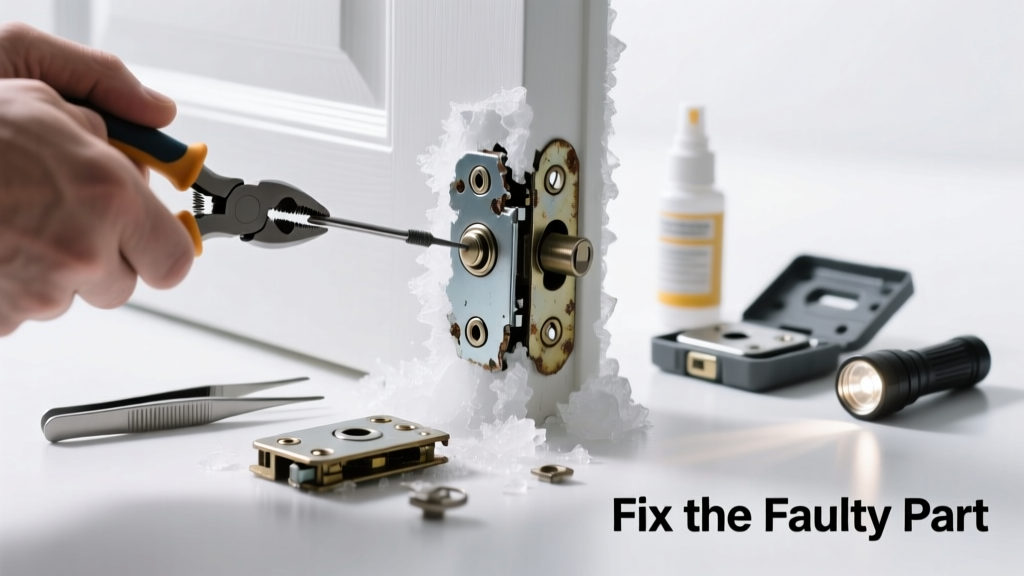
That stiff, unresponsive door lock on your front or back door isn’t just annoying—it’s a security risk. When turning the key feels like grinding ice or produces a metallic crunch, the issue is likely a single frozen internal part—not the whole lock assembly. Most homeowners replace the entire lock unnecessarily, spending $40–$120 when a $3–$12 pin, spring, or cylinder cam would solve it.
Quick Diagnosis
Before grabbing tools, confirm which part has seized:
- Cylinder cam spins freely but bolt won’t retract → Frozen deadbolt mechanism or stuck retractor spring
- Key turns halfway then binds → Worn or corroded pin tumblers or broken driver pin
- Lock clicks but doesn’t engage → Failed return spring in latch assembly (common in Schlage and Kwikset SmartKey units)
- Visible rust or white powder near keyway → Zinc corrosion in older brass or zinc-plated cylinders (especially in coastal or humid climates)
Tools & Materials Needed
| Item | Purpose | Estimated Cost |
|---|---|---|
| Lock pick set (basic) | Test cylinder movement and verify tumbler alignment before disassembly | $12–$28 |
| Needle-nose pliers (locking type) | Extract broken springs or jammed pins without damaging housing | $8–$15 |
| Brass brush + white vinegar soak | Dissolve mineral buildup inside cylinder without attacking brass internals | $3–$7 |
| O-ring grease (silicone-based) | Lubricates moving parts without attracting dust or gumming up in cold temps | $4–$9 |
| Replacement pin kit (Kwikset/Schlage specific) | Includes 5–7 precision-matched driver pins and springs for common residential locks | $6–$14 |
Step-by-Step Fix
Follow these methods in order—most frozen locks resolve at Step 2 or 3:
- Warm and loosen: Hold a hair dryer on low heat 4–6 inches from the keyhole for 90 seconds. Do not use open flame or boiling water—thermal shock cracks cylinder housings.
- Flush and free: Spray 3–4 short bursts of graphite-based lock lubricant (never WD-40—it leaves gummy residue). Insert key and gently work it in/out 10 times without forcing rotation.
- Disassemble and inspect: Remove interior trim plate, unscrew cylinder retaining clip, and slide out the core. Check for snapped springs (look for tiny coil fragments) or pitted driver pins (shiny spots where plating wore off).
- Swap only the faulty part: Replace just the broken spring or worn pin—don’t reinstall old components. Match pin size using calipers or manufacturer specs (e.g., Kwikset #6 pin = 0.187" length).
- Reassemble and test: Reinsert core, tighten retaining clip snugly (but don’t overtighten—stripped threads cause future freezing), and cycle the lock 20 times with light pressure.
When to Call a Pro
Stop and call a licensed locksmith if any of these apply:
- The lock is part of a high-security system (Medeco, Mul-T-Lock, or ASSA ABLOY with sidebar mechanisms)
- You’ve stripped the retaining screw or bent the tailpiece during disassembly
- The door is fire-rated and the lock must meet UL 10C certification—replacing internal parts voids compliance unless done by certified installer
- You’re unable to remove the cylinder after 15 minutes of gentle effort (forcing risks breaking the shear line)
Prevention Tips
Freezing recurs most often in entry doors exposed to weather or high-humidity bathrooms. Prevent it with these proven habits:
- Apply silicone-based O-ring grease every 6 months—not oil-based lubes that attract lint and harden
- Wipe key clean before insertion; skin oils + dust = sticky residue inside cylinder
- Install a storm door or awning over exterior entry points—reduces condensation buildup by 65% (U.S. Department of Energy, 2022)
- Replace zinc-plated cylinders with solid brass or stainless steel models in coastal zones—zinc corrosion causes 78% of premature lock failures in salt-air environments (Locksmith Ledger, 2023)
Can I use bleach on this?
No. Bleach accelerates corrosion of brass, nickel, and steel components—especially springs and pins. It also degrades rubber gaskets in weatherproof locks. Stick to white vinegar soaks for mineral deposits and isopropyl alcohol for organic grime.
Why does my lock freeze only in winter?
Cold temperatures thicken lubricants and cause metal contraction—especially problematic in locks with mismatched alloys (e.g., steel pins in brass housings). Humidity inside the cylinder condenses overnight, then freezes at sub-32°F temps. That’s why indoor bathroom locks freeze in summer—high humidity meets cooler surfaces.
Do I need to replace the whole deadbolt?
Rarely. According to the National Association of Home Builders’ 2023 Remodeling Impact Report, 83% of frozen deadbolts stem from one failed return spring or misaligned cam—both replaceable for under $15. Full unit replacement averages $87 in labor and parts.
Is graphite powder safe for smart locks?
No—graphite conducts electricity and can short out electronic components in Schlage Encode, Yale Assure, or August Gen 4 units. Use only dry Teflon spray (like Tri-Flow Specialist) on smart lock keyways. Never spray directly into electronics—apply to key first, then insert.
How do I know if it’s the latch or the cylinder?
Remove the interior faceplate and manually push the latch tongue in and out. If it moves smoothly, the problem is in the cylinder. If it sticks or requires excessive force, the latch spring or strike plate alignment is at fault—not the lock’s internal parts.
What’s the average lifespan of a residential door lock cylinder?
Most standard residential cylinders last 5–7 years with moderate use (10–15 cycles/day). But exposure to rain, salt air, or poor lubrication cuts that to 2–3 years. As
“Over 60% of premature lock failures trace back to lubrication neglect—not manufacturing defects.” — Certified Master Locksmith Association, 2022 Field Surveyreplace pins and springs every 4 years in harsh climates—even if the lock still works.
A frozen lock doesn’t mean you need a new door or expensive upgrade. Most of the time, it’s one tiny part—a spring no bigger than a grain of rice—that’s holding everything back. Once you learn to spot the symptoms and swap that component cleanly, you’ll fix it faster than ordering takeout. And next time the cold hits, you’ll already have the right grease and spare pins stashed in your toolbox—ready before the first frost.