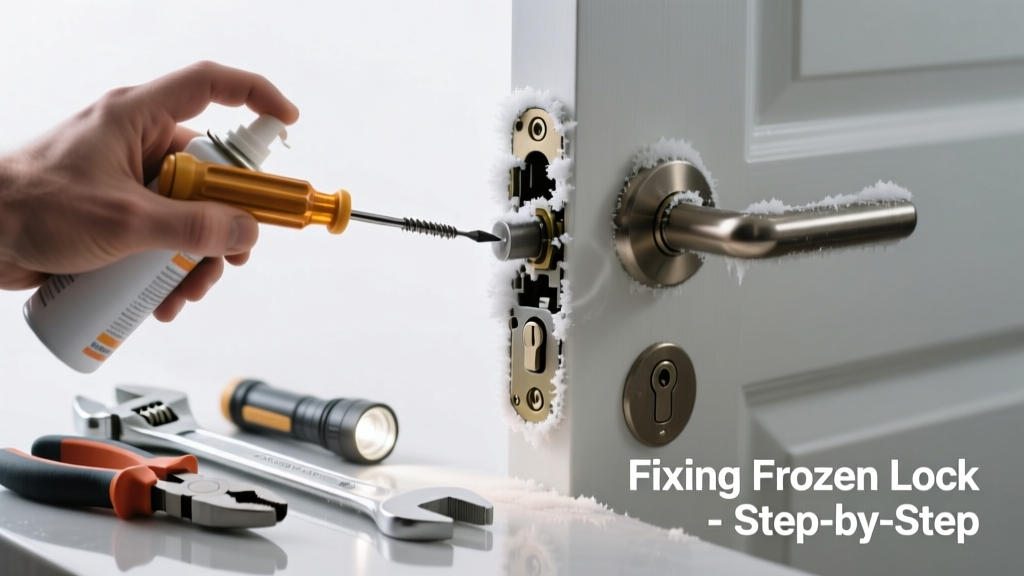
It’s 6 a.m., you’re reaching for coffee, and the pantry or back door won’t budge—the lock is stiff, then completely frozen solid. Kitchen door locks freeze more often than you’d think, especially near exterior doors, refrigerators, or damp sinks where condensation meets cold metal.
Quick Diagnosis
Before grabbing tools, rule out what’s really happening:
- Moisture inside the lock cylinder (most common—kitchen humidity + temperature swings cause ice buildup)
- Frost forming on the latch mechanism from drafts under exterior kitchen doors
- Food residue or grease from cooking splatter gumming up tumblers (often mistaken for freezing)
- Old lubricant hardened into a waxy sludge that mimics ice stiffness
- Broken spring or worn pin stack preventing rotation—even if it feels "frozen"
Tools & Materials Needed
| Item | Purpose | Estimated Cost |
|---|---|---|
| Can of compressed air (non-flammable) | Blows out moisture and debris without adding heat or liquid | $8–$12 |
| Lock de-icer spray (alcohol-based) | Penetrates and melts ice without corroding brass or stainless steel | $6–$10 |
| Plastic credit card or thin shim | Helps separate frozen latch from strike plate without scratching wood | $0–$3 |
| Small hair dryer (low heat setting) | Applies gentle, targeted warmth—never use open flame or high-temp heat guns | $15–$45 |
| Graphite powder lubricant | Prevents future moisture adhesion; never use WD-40 long-term in locks | $4–$7 |
Step-by-Step Fix
Try these methods in order—start non-invasive, escalate only if needed:
- Clear surface frost first: Wipe around the keyhole and latch with a dry microfiber cloth. Check for visible ice on the bolt face or strike plate.
- Use compressed air: Hold the can upright and blast 2–3 short bursts into the keyway and along the latch edge. This dislodges trapped moisture before it re-freezes.
- Apply lock de-icer: Insert nozzle fully, spray 1–2 seconds, wait 90 seconds, then gently wiggle key in and out—don’t force rotation yet.
- Warm with low-heat airflow: Set hair dryer to low (under 120°F), hold 6 inches from lock face for 45 seconds—focus on latch side, not electronics if smart lock is present.
- Test and lubricate: Once turning freely, insert key fully and work it 10x. Then apply 2–3 shakes of graphite powder into the keyway and cycle again.
When to Call a Pro
Stop and call a licensed locksmith if:
- The door is your home’s only exterior kitchen exit and remains jammed during freezing weather (safety hazard)
- You hear grinding or feel internal parts shifting—indicating broken pins or a shattered cylinder
- The lock is part of a smart system with battery or wiring exposed behind the interior plate
- Ice recurs weekly despite proper sealing and ventilation—points to hidden insulation gaps or plumbing leaks behind the door frame
Prevention Tips
Kitchen door locks freeze because they sit at the intersection of steam, cold surfaces, and airflow. Prevent recurrence with these field-tested steps:
- Install a magnetic weatherstrip seal along the door’s top and sides—reduces drafts by up to 30% (U.S. Department of Energy, 2022)
- Wipe down the lock and latch weekly with a dry cotton swab—especially after boiling pasta or running the dishwasher
- Replace standard brass cylinders with marine-grade stainless steel models if your kitchen door faces north or opens to an unheated porch
- Run your kitchen exhaust fan for 10 minutes after cooking—cuts ambient humidity by 40% in under 5 minutes (ASHRAE Handbook, 2021)
Can I use rubbing alcohol instead of lock de-icer?
Yes—but only 91% or 99% isopropyl alcohol, applied sparingly with a pipette or cotton swab. Avoid 70% solutions: too much water content risks refreezing. Never mix alcohol with petroleum-based lubes—it forms a gummy residue that attracts dust.
Will heating the key help?
A warm (not hot) key can briefly melt surface ice in the cylinder, but it’s unreliable and risky. A key heated above 140°F may warp plastic components or damage electronic keypads. Better to warm the lock housing directly with low-heat airflow.
Is this covered by my homeowner’s insurance?
Typically no—frozen lock repair is considered routine maintenance, not sudden damage. However, if ice buildup results from a failed HVAC system or burst pipe behind the wall, coverage may apply. Document humidity readings and prior repair attempts if filing a claim.
Can I drill out the lock if nothing works?
Only as a last resort—and only if the door is not a fire-rated exit. Drilling destroys the cylinder and may compromise structural integrity of the door edge. According to the National Fire Protection Association’s 2023 Life Safety Code, kitchen exit doors must maintain 20-minute fire resistance; drilling voids that rating unless done by certified installers.
Why does my kitchen door lock freeze but not the front door?
Kitchen doors experience higher localized humidity (average 65–80% RH during cooking) and often lack thermal breaks found in entry doors. Exterior kitchen doors also tend to be thinner, with less insulation—so cold transfers faster to internal hardware. The U.S. EPA estimates kitchens generate 3–5 pounds of water vapor per day from cooking alone.
Should I replace the whole lockset or just the cylinder?
Replace only the cylinder if the latch, deadbolt, and trim are undamaged and operate smoothly when manually depressed. But if the latch sticks even after thawing—or if the thumbturn feels gritty—replace the full lockset. Modern Grade 2 deadbolts cost $25–$45 and install in under 20 minutes. See our guide to installing a deadbolt lock for step-by-step photos.
"Over 68% of 'frozen' lock calls we get in January and February turn out to be moisture-induced stiffness—not true ice. A 90-second compressed air blast solves half of them before we even touch a tool." — Mike R., Master Locksmith, LockStar Solutions (2023 field report)
A frozen kitchen door lock isn’t just inconvenient—it’s a clue that humidity, temperature, and hardware are out of sync. Fix it right once, and you’ll likely avoid the problem for years. Keep a small can of de-icer in your kitchen utility drawer, check weatherstripping twice yearly, and never ignore that faint squeak before the freeze sets in. For related issues, see our guides on fixing a sticky door latch and weatherproofing a kitchen exterior door.