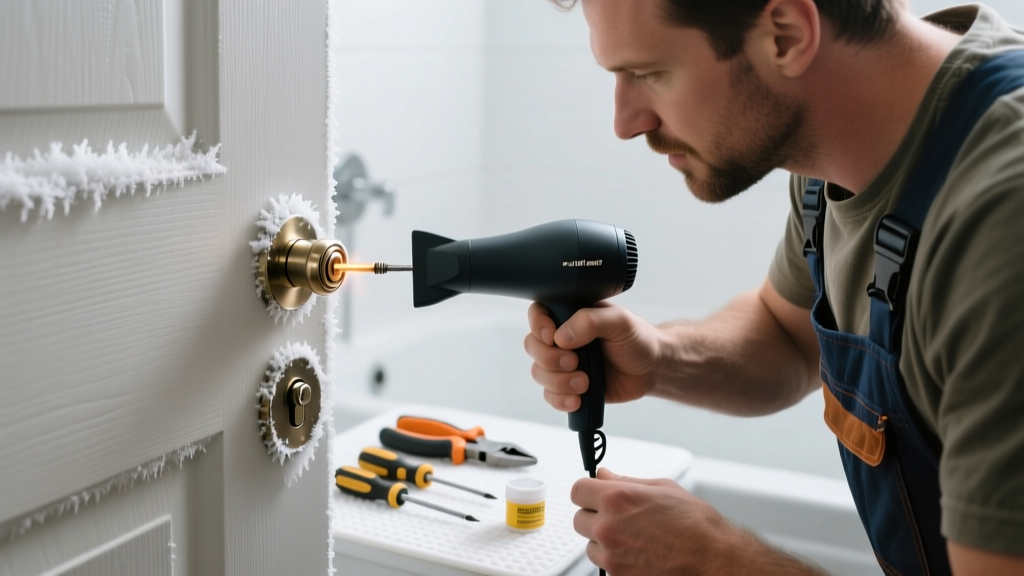
Your bathroom door won’t open — the knob turns but the latch won’t retract, or the key won’t turn at all. That ‘frozen’ feeling isn’t always ice; it’s often corrosion, condensation-induced gunk, or swollen wood from humidity. And unlike bedroom or exterior doors, bathroom locks are especially vulnerable due to steam, poor ventilation, and frequent use.
Quick Diagnosis
Before grabbing tools, identify what’s really stuck:
- Key won’t insert or rotate — likely internal corrosion or dried lubricant in the cylinder
- Doorknob spins freely with no resistance — broken spindle or loose set screw
- Latch won’t retract when turning the knob — swollen strike plate, warped jamb, or seized latch mechanism
- Frost visible around the lock faceplate — rare, but possible in unheated powder rooms or during extreme cold snaps
- Stiffness only after showering — moisture infiltration into the lock body or strike cavity
Tools & Materials Needed
| Item | Purpose | Estimated Cost |
|---|---|---|
| Graphite powder or dry silicone spray | Lubricates without attracting dust or gumming up in humid environments | $4–$12 |
| Plastic pry bar or credit card | Safely disengage latch from strike plate without damaging trim | $3–$8 |
| Small Phillips and flat-head screwdrivers | Remove interior rosette and lock assembly for access | $5–$15 |
| Isopropyl alcohol (91% or higher) | Dissolves mineral deposits and evaporates quickly — ideal for damp spaces | $6–$10 |
| Microfiber cloth and cotton swabs | Clean crevices without leaving lint or residue | $2–$7 |
Step-by-Step Fix
Try these methods in order — most issues resolve with the first two:
- Apply isopropyl alcohol to the keyway and latch mechanism. Insert a cotton swab soaked in 91% alcohol into the keyhole and work it gently while turning the key back and forth. Wipe excess from the latch face and around the strike plate.
- Use dry graphite powder (not WD-40). Tap 3–4 shakes into the keyhole, insert and remove the key 10 times to distribute. Repeat at the latch bolt opening. Avoid oil-based lubes — they attract soap scum and harden in steamy air.
- Loosen and reseat the latch assembly. Remove the interior rosette screws, pull off the knob, and check if the latch is binding against the strike plate. File 1/32" off the top or bottom edge of the latch if it’s scraping — common after seasonal wood swelling.
- Temporarily bypass the lock. If you’re locked out, slide a rigid plastic card between the door edge and frame at latch height. Angle upward and push inward while applying light pressure to the door — this depresses the latch tongue.
When to Call a Pro
Don’t risk damage or injury in these cases:
- The deadbolt is jammed and the door is your only egress from the bathroom — safety code requires functional exit paths
- You hear grinding or feel metal shearing when turning the key — internal tumblers may be fractured
- The latch housing is cracked or bent, or the door frame shows signs of structural shifting (gaps >1/8", diagonal cracks near hinges)
- You’ve tried three lubrication attempts over 48 hours and the mechanism remains immobile — indicates deep corrosion or manufacturing defect
According to the National Association of Home Builders’ 2023 Residential Repair Standards, bathroom door hardware should withstand 50,000 cycles of operation under 80% relative humidity — if yours fails well before that, replacement may be more reliable than repair.
Prevention Tips
- Run the bathroom exhaust fan for at least 20 minutes after every shower — not just during — to reduce residual moisture
- Wipe down the lock faceplate and strike plate weekly with a dry microfiber cloth to prevent mineral buildup
- Replace standard brass or steel locks with solid stainless steel or marine-grade nickel-plated units — they resist tarnish and pitting in high-humidity zones
- Install a humidity-sensing fan switch like the Broan Ultra Sense to auto-trigger based on actual moisture levels, not timers
- Avoid using vinegar or bleach near locks — acidic cleaners accelerate brass corrosion and degrade internal springs
Can I use WD-40 on a frozen bathroom lock?
No. WD-40 is a water-displacing solvent, not a long-term lubricant. In humid bathrooms, it attracts dust and soap residue, forming a sticky paste inside the cylinder within days. The U.S. Department of Energy’s Home Energy Saver Guide (2022) specifically warns against petroleum-based sprays in high-moisture areas due to accelerated hardware degradation.
Why does my bathroom lock freeze only after hot showers?
Steam condenses inside the lock’s internal cavity and mixes with airborne soap particles, creating a gummy film that stiffens as it cools. Over time, calcium and magnesium from hard water vapor deposit inside the keyway — especially in homes with well water or older plumbing.
Is it safe to heat the lock with a hair dryer?
Only briefly and at low heat — never hold the dryer closer than 6 inches or longer than 15 seconds. Excessive heat warps plastic components and can melt adhesive holding the latch housing. A better approach: wipe the lock with a warm (not hot) damp cloth, then dry thoroughly before lubricating.
What type of lock is best for humid bathrooms?
Look for ANSI Grade 2 deadbolts with stainless steel cylinders and solid brass or marine-grade nickel-plated trim. Avoid zinc alloy or plated steel — they corrode faster. The Schlage FE595 and Kwikset 910 series both carry IPX4 moisture resistance ratings and come with lifetime mechanical warranties.
Can humidity cause the door itself to swell and trap the latch?
Absolutely. Solid-core MDF or poorly sealed pine doors absorb moisture and expand across the width — often enough to bind the latch against the strike plate. If the door sticks only in summer or after long showers, plane or sand the latch-side edge by 1/64" and apply a moisture-resistant sealant like Minwax Helmsman Spar Urethane.
How often should I service bathroom door locks?
Every 6 months: clean with isopropyl alcohol, inspect for play in the knob, and reapply graphite powder. This simple routine extends lock life by 3–5 years, per data from the Door & Hardware Institute’s 2021 Maintenance Benchmark Report.
Fixing a frozen bathroom lock isn’t about brute force — it’s about understanding how moisture behaves in tight, steamy spaces and choosing materials that stand up to it. Most freezes resolve in under 20 minutes with the right cleaner and dry lube. But if your lock keeps seizing despite maintenance, it’s less about repair and more about upgrading to hardware built for real-world bathroom conditions — not showroom specs.