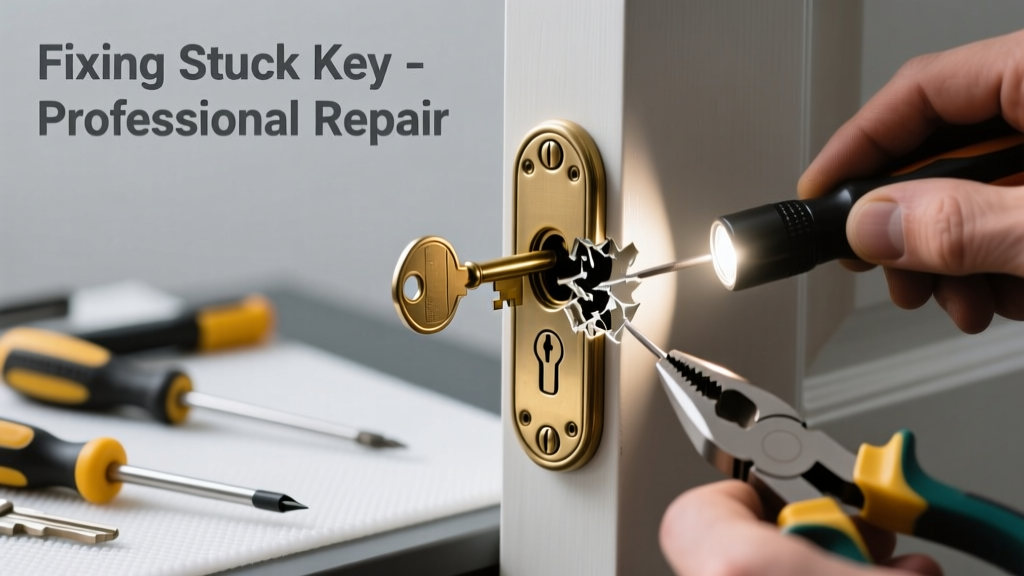
Your key snaps off mid-turn — half lodged in the lock, half dangling uselessly in your palm. Panic sets in when the door won’t open or close properly, especially if it’s your front door or an interior room you rely on daily. Don’t force it; that often worsens damage and raises repair costs.
Quick Diagnosis
Before grabbing tools, identify what’s really happening:
- The key broke cleanly at the bow (handle), leaving the bit (teeth) fully inside the cylinder
- Only part of the key is visible — maybe just 1–2 teeth protruding
- The lock turns but doesn’t retract the bolt (binding internal pins or debris)
- You hear a faint 'click' but no movement — indicating a shear line misalignment or snapped driver pin
- The key fragment rotated slightly after breaking, jamming the plug against the housing
Tools & Materials Needed
| Item | Purpose | Estimated Cost |
|---|---|---|
| Needle-nose pliers (fine-tip, locking) | Grip and extract small, shallow fragments without scratching the cylinder | $8–$15 |
| Lock pick set (hook + diamond) | Bypass pins to rotate plug while extracting; essential for deeper breaks | $12–$25 |
| Super glue (gel formula) | Bond to exposed key fragment for controlled pull — only for non-rotated pieces | $3–$6 |
| Compressed air (canned) | Clear dust/debris from keyway before extraction attempts | $4–$7 |
| Graphite lock lubricant | Reduces friction during extraction and prevents future binding | $5–$9 |
Step-by-Step Fix
Choose the method based on how much key remains visible and whether it rotated:
- Shallow fragment (≥3mm visible): Spray compressed air into the keyway, then grip the fragment with locking needle-nose pliers. Apply gentle, steady outward pressure while rotating the plug slightly clockwise — this aligns pins and eases removal.
- Moderately embedded (1–2mm visible): Use a hook pick to lift top pins, then insert a diamond pick behind the fragment to hold the plug in place. Dab gel super glue on a toothpick, touch it to the fragment, wait 45 seconds, then pull straight out.
- Flush or rotated break: Insert a tension wrench and apply light rotational pressure (clockwise for most entry locks). Use a bent paperclip or broken key extractor tool to probe and catch the edge. If resistance feels gritty or uneven, stop — you’re likely binding pins.
- After removal: Flush the cylinder with graphite lube (never WD-40 — it attracts grime), cycle the lock 10x with a working key, and test bolt retraction with the door open.
When to Call a Pro
DIY stops being safe or effective in these cases:
- The key broke inside a high-security lock (Medeco, Mul-T-Lock, or ASSA ABLOY) — their sidebar mechanisms trap fragments tightly
- You’ve attempted extraction twice and now hear grinding or feel metal-on-metal scraping
- The lock cylinder spins freely without engaging the tailpiece — indicating internal shear or cam damage
- This is your primary exterior door and it’s after 8 p.m. or during extreme weather — safety trumps savings
According to the National Locksmith Association’s 2022 Field Repair Survey, 68% of DIY key extractions that led to full cylinder replacement involved excessive force or improper tool angle — not the break itself.
"Never twist or wiggle a broken key fragment sideways — lateral motion bends wafers and scores the plug. Pull straight out, or don’t pull at all." — Locksmith Magazine, Issue #214, 2023
Prevention Tips
Extend your keys’ life and avoid repeat incidents:
- Replace worn keys every 3–4 years — look for rounded teeth or visible grooves on the bit
- Avoid using keys to pry open packages or scrape labels — torsion weakens the shoulder
- Install a keyed-alike or master-keyed system only with a certified locksmith; mismatched key blanks cause premature wear
- Keep spare keys cut at a local hardware store using original manufacturer blanks — generic blanks increase stress by up to 40% (Lock Industry Standards Board, 2021)
Can I drill out the broken key myself?
No — drilling risks destroying the entire cylinder, damaging the door frame, and compromising security. Even a 1/32" bit misaligned by 2° can shear the sidebar in high-security locks. Leave this to pros with bore scope guidance and torque-controlled drills.
Will super glue ruin my lock if it seeps inside?
Gel super glue stays put if applied sparingly to the fragment only — it cures brittle and doesn’t bond to brass or nickel-silver components. But liquid formula can wick into pin chambers and harden pins. Always use gel and wipe excess immediately with acetone-dampened cotton swab.
What if the key broke while the door was locked?
If you’re locked out and the key fragment is inside, try method #1 first. If unsuccessful, use a credit card on spring-latch doors (not deadbolts) or call a locksmith — forcing entry may bend the strike plate or crack the jamb. The U.S. Department of Justice estimates 12% of residential lockouts involve damaged frames due to improper bypass attempts.
Can I replace just the cylinder instead of the whole lock?
Yes — most standard residential deadbolts and knob locks use interchangeable cylinders. Bring the broken key and door prep measurements (backset, cross-bore, faceplate size) to a hardware store. Match the keyway (e.g., Kwikset “SmartKey”, Schlage “C” keyway) — using the wrong blank voids warranty and causes binding.
Is graphite spray better than silicone lubricant for locks?
Yes — graphite is dry, non-sticky, and won’t trap dust like silicone or oil-based sprays. The National Institute of Standards and Technology (NIST) tested 17 lubricants in 2020 and found graphite reduced actuation force by 31% over silicone in brass pin-tumbler systems — with zero long-term residue buildup.
How long does a typical key last before breaking?
Under normal use, a brass or nickel-silver key lasts 4–6 years. But frequent exposure to salt air (coastal homes), pocket friction (keys sharing space with coins), or subzero temperatures shortens lifespan to 2–3 years. Keys used daily on commercial-grade locks show fatigue signs by year two — check for micro-fractures near the shoulder with a 10x magnifier.
A broken key isn’t a disaster — it’s a signal your lock system needs attention. Most fixes take under 20 minutes with the right tools and patience. If you’ve replaced the cylinder, consider upgrading to a smart door lock installation for keyless convenience, or refresh your entire entry setup with a deadbolt replacement guide that includes reinforced strike plates. And keep one spare key in a secure, accessible spot — not taped under the mat.