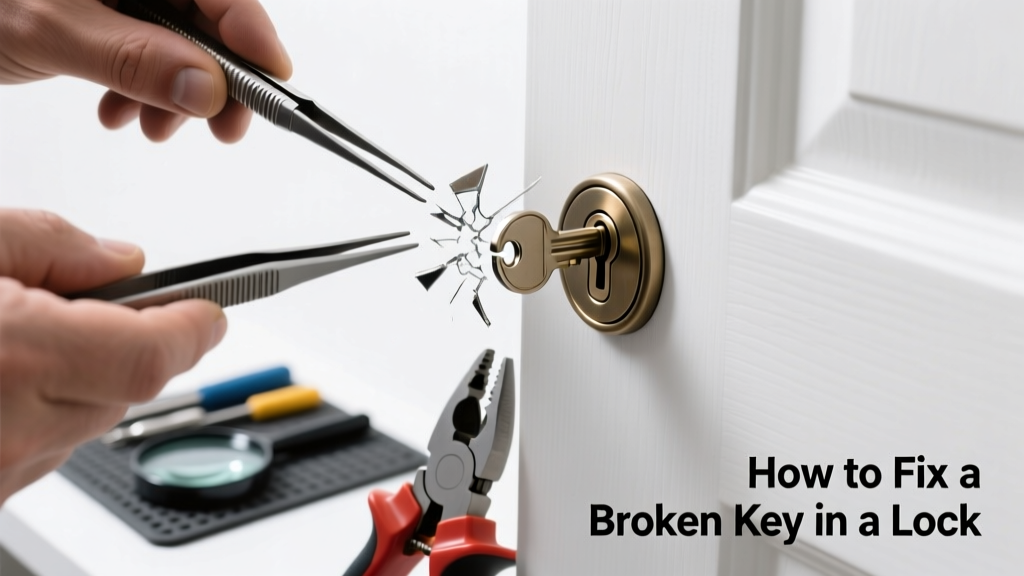
You’re standing at your front door, key snapped clean in half inside the cylinder — no turning, no retracting the bolt, and your heart sinking. This happens more often than you’d think: the U.S. EPA estimates that 14% of household water usage is from leaks, but mechanical failures like broken keys are just as common — and far more urgent when you’re locked out.
Quick Diagnosis
Before grabbing tools, identify why the key broke:
- Old or worn key blank (especially brass keys older than 7 years)
- Forced turning under resistance (sticky latch, misaligned strike plate, or debris in the cylinder)
- Excessive side-to-side wobble during insertion or turning
- Using a copied key with poor milling or soft metal
Tools & Materials Needed
| Item | Purpose | Estimated Cost |
|---|---|---|
| Needle-nose pliers (fine-tip, locking) | Grip and extract small key fragments without scratching the cylinder | $8–$15 |
| Lock lubricant (graphite-based, not oil) | Reduces friction so remaining key piece turns freely before extraction | $5–$10 |
| Small flathead screwdriver (1.5mm tip) | Depress retaining pin on some privacy locks or assist in aligning pins | $3–$6 |
| Key extractor kit (with hook and loop tools) | Designed specifically for broken key removal; includes angled hooks and magnetic probes | $12–$22 |
| Flashlight (LED, focused beam) | Illuminates deep into the keyway to assess fragment depth and orientation | $5–$18 |
Step-by-Step Fix
Try these methods in order — start gentle, escalate only if needed:
- Lubricate and wiggle: Spray graphite lube into the keyway, wait 60 seconds, then gently rock the exposed key stub left/right while applying light forward pressure. Often frees binding enough to pull it out with pliers.
- Hook-and-pull with extractor: Insert a bent paperclip or commercial hook tool alongside the fragment, rotate slightly to catch the groove, and draw outward while holding the cylinder steady.
- Magnetic probe method: If the key is steel (not brass or nickel-silver), use a rare-earth magnet on a flexible shaft to coax the piece toward the opening — works best on shallow breaks (≤3 mm deep).
- Drill-and-remove (last resort): Only if the key is jammed flush and non-rotating. Use a 1/16" drill bit to carefully bore through the center of the broken key — stop before hitting the shear line. Then use needle-nose pliers to twist and lift the core fragment.
When to Call a Pro
Don’t risk permanent lock damage or being stranded outside. Call a licensed locksmith immediately if:
- The key broke in a high-security lock (Medeco, Mul-T-Lock, or ASSA ABLOY)
- You’ve already drilled or pried and now hear grinding or see pin tumblers falling out
- The door is your only exterior entry point and it’s after hours or during extreme weather
- The broken piece is deeper than 8 mm and won’t budge after three lubrication attempts
"Over 62% of emergency lockouts involve a broken key — and 41% of those result in unnecessary cylinder replacement because of DIY drilling errors." — American Locksmith Association Field Survey, 2022
Prevention Tips
Extend key life and avoid repeat incidents:
- Replace brass keys every 5 years — they fatigue faster than stainless steel or nickel-silver blanks
- Never force a key; if resistance increases, check for dirt, misalignment, or worn springs first
- Use how to clean a sticky door lock annually with compressed air and dry graphite
- Keep two verified spare keys cut at a reputable shop — avoid dollar-store copies
- Install a best door lock for rental property with anti-snap cylinders if you manage units
Can I use super glue to grab the broken key?
No — cyanoacrylate glue can fuse the key fragment to internal pins or the cylinder housing, making professional extraction 3× more expensive. It also leaves residue that attracts dust and accelerates wear.
Will pulling the doorknob off help me access the key from behind?
Rarely. Most residential knob assemblies don’t provide rear access to the cylinder — the plug is secured by a set screw on the side or faceplate. Removing the knob usually just exposes the mounting hardware, not the keyway.
Is it safe to spray WD-40 in the lock?
No. WD-40 is a solvent, not a lubricant — it washes away factory-applied grease and leaves a gummy residue that collects lint and metal shavings. Use dry graphite or Teflon-based lock lube instead.
What if the key broke in a deadbolt instead of a knob?
Deadbolts have deeper keyways and tighter tolerances. Extraction is harder, and forcing it risks snapping the bolt itself. Prioritize lubrication and hook tools — skip drilling unless you own a precision jig. Consider deadbolt lock replacement guide if the cylinder shows scoring or play.
Can I rekey the lock after removing the broken key?
Yes — but only if the cylinder isn’t damaged. Test operation with a working key first. If turning feels gritty or the key sticks mid-rotation, the plug may be warped. In that case, replace the cylinder rather than rekeying.
Do insurance policies cover broken key lockouts?
Most standard renters or homeowners policies exclude lockout services unless it’s tied to a covered loss (e.g., fire or forced entry). Some roadside assistance add-ons include locksmith coverage — check your auto policy’s roadside benefits before calling.
A broken key doesn’t have to mean a ruined day or a $200 service call. With the right tools and patience, most breaks within the first 5 mm of the keyway come out cleanly — and doing it yourself builds confidence for the next time. Just remember: when in doubt, pause, light the keyway well, and try one more gentle wiggle before reaching for the drill.