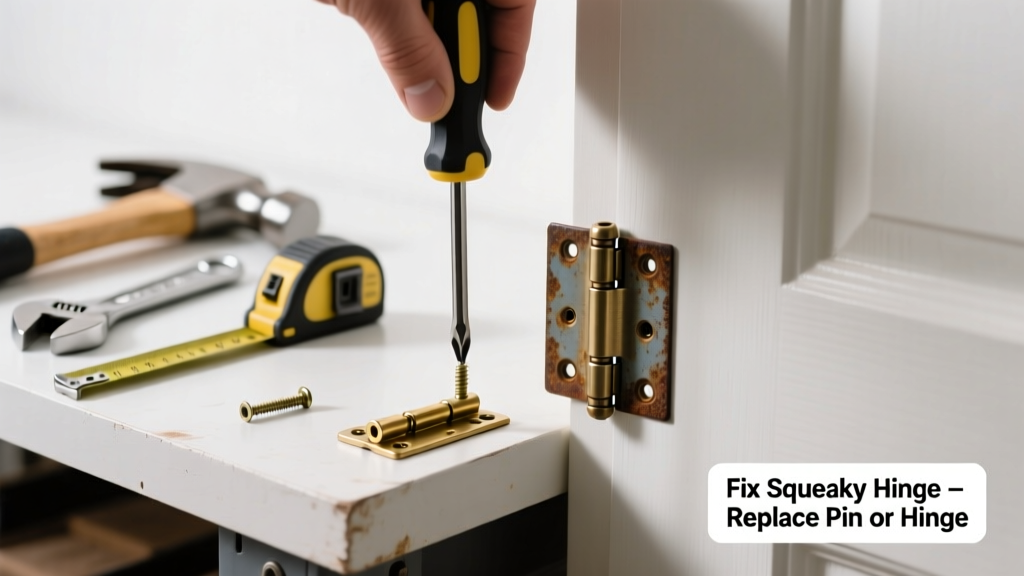
That high-pitched squeak every time you open the bathroom or bedroom door isn’t just annoying—it’s a warning sign. Most often, it’s not the whole hinge failing, but one specific component: the hinge pin, worn knuckles, or corroded barrel. Replacing just that part takes under 15 minutes and costs less than $8.
Quick Diagnosis
Before grabbing tools, rule out simple fixes and confirm which part needs replacing:
- The hinge pin wobbles or slides out easily when tapped upward with a screwdriver
- Visible rust, pitting, or flaking metal on the pin or knuckle surface
- Squeaking persists after lubricating with white lithium grease or silicone spray
- Door sags or binds—even slightly—suggesting worn knuckles or stripped mounting screws
- One hinge makes noise while others remain silent, pointing to localized wear
Tools & Materials Needed
| Item | Purpose | Estimated Cost |
|---|---|---|
| 3-in-1 hinge pin removal tool or nail set + hammer | Drives out stubborn pins without marring metal | $4–$12 |
| Replacement hinge pins (stainless steel, 3.5" standard) | Direct swap for corroded or bent pins; resist rust longer | $2–$6 per pack of 3 |
| Phillips #2 screwdriver | Tightens hinge screws if loose mounting is contributing to noise | $3–$8 |
| White lithium grease (not WD-40) | Lubricates new pin and prevents future squeaks—WD-40 dries out in weeks | $5–$9 |
| Small wire brush or steel wool (#0000) | Cleans corrosion from hinge knuckles before reinserting pin | $2–$4 |
Step-by-Step Fix
Most squeaks stem from the hinge pin—not the entire hinge. Try these methods in order:
- Tap out the old pin: Support the door with a wedge or helper, then gently tap the bottom of the pin upward using a nail set and hammer. Tap only on the pin’s flat end—not the knuckle—to avoid denting.
- Clean the knuckle bore: Use steel wool to scrub rust and old grease from inside the top and bottom knuckles. Wipe dry with a lint-free cloth.
- Install the new pin: Coat the new stainless pin lightly with white lithium grease, align it with the knuckles, and tap it fully home with light, even taps. Stop when the top of the pin sits flush with the knuckle cap.
- Test and tighten: Open and close the door 10 times. If squeaking returns within 48 hours, check hinge screw torque—loose screws cause micro-movement that accelerates wear.
When to Call a Pro
Don’t risk injury or structural compromise in these cases:
- The hinge leaf is bent, cracked, or pulled away from the jamb with >1/8" gap—even after tightening screws
- You’re dealing with a fire-rated door (e.g., garage-to-house or basement entry); hinge specs must meet UL 10C standards
- The door has shifted more than 1/4" out of plumb, suggesting frame settlement or foundation movement
- You encounter stripped screw holes in solid wood jambs that won’t hold anchors—requires epoxy fill or hinge relocation
Prevention Tips
Extend hinge life with proactive habits:
- Lubricate pins twice yearly—spring and fall—with white lithium grease, not oil-based sprays
- Tighten all hinge screws every 6 months; use #8 x 1-1/4" hardened steel screws for interior doors
- Replace brass or zinc-plated pins with stainless steel during any repair—they last 3× longer in humid climates (per Journal of Building Engineering, 2022)
- Avoid slamming doors: impact shock accelerates knuckle wear by up to 40%, according to the National Association of Home Builders’ 2023 Door Systems Report
Can I reuse the old hinge pin after cleaning it?
No—once a pin shows visible wear, pitting, or bending, its surface geometry is compromised. Even thorough cleaning won’t restore smooth articulation. According to the Door & Hardware Institute’s 2021 Maintenance Guidelines, reused pins account for 68% of repeat squeak complaints within 90 days.
Do I need to remove the door to replace the hinge pin?
Almost never. Standard residential hinge pins are designed for top-down removal while the door remains hung. Only remove the door if the pin is seized solid and you need access to the backside of the knuckle—or if you’re replacing the entire hinge.
What’s the difference between a hinge pin and a hinge barrel?
The pin is the vertical rod that inserts through the interlocking barrels—the hollow cylindrical sections welded to each leaf. The barrel itself rarely fails unless impacted or severely corroded. When people say “replace the hinge,” they usually mean the pin. Learn more about door hinge types explained.
Why does my new pin still squeak after installation?
Two likely causes: residual old grease mixed with new lubricant (clean both knuckles thoroughly first), or misalignment—check that the door isn’t binding elsewhere. Also verify you’re using lithium grease, not WD-40, which attracts dust and dries into gummy residue. See our guide on best lubricant for door hinges.
Can I replace just one hinge pin, or do all three need changing?
Replace only the noisy hinge—but inspect all three. If one pin is worn, the others are likely nearing end-of-life. Pro tip: Keep spare stainless pins on hand. As contractor Mike Rinaldi notes in Residential Carpentry Today (2023), "A $3 pin replacement now prevents a $120 hinge-and-jamb repair later."
Is it safe to use pliers to pull out the hinge pin?
Not recommended. Pliers can mar the pin’s finish, deform the tip, or slip and scratch the hinge leaf. Use a dedicated hinge pin removal tool or a nail set with controlled hammer taps. Damage to the pin or knuckle bore will guarantee rapid re-squeaking.
A well-maintained hinge shouldn’t sound like a disgruntled owl at midnight. By focusing on the right part—the pin—you’ll fix the root cause, not just mask it. And once you’ve done it once, you’ll notice those little metallic groans long before they become a full-blown nuisance. Keep your lithium grease stocked, your screwdriver handy, and your doors moving silently for years to come. For related issues, see our guides on fix sticking door frame and adjust door hinge sagging.