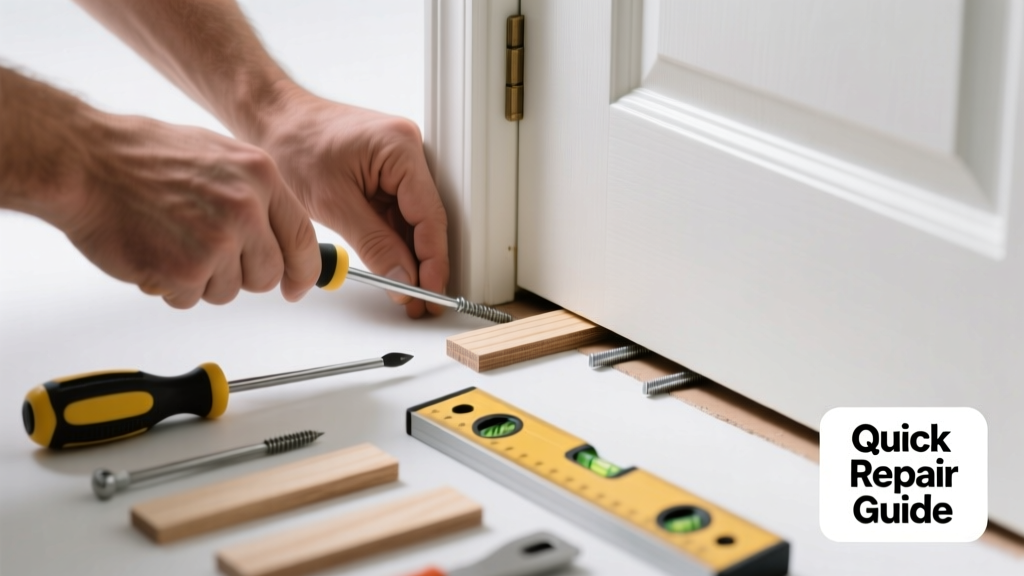
That drafty whoosh every time you close the door? The latch that just won’t catch? A door gap too large isn’t just annoying—it’s a sign of misalignment, wear, or structural shift. Left unaddressed, it wastes energy, compromises security, and accelerates weatherstripping failure.
Quick Diagnosis
Before grabbing tools, identify the root cause. Most oversized door gaps stem from one (or more) of these issues:
- Loose or stripped hinge screws—especially top hinge
- Warped door slab due to humidity or age
- Settled or shifted door frame (common in older homes with brick veneer or slab foundations)
- Worn or improperly installed weatherstripping
- Incorrect strike plate depth or latch bolt alignment
Tools & Materials Needed
| Item | Purpose | Estimated Cost |
|---|---|---|
| 3-inch wood screws (pack of 12) | Replace stripped hinge screws; pull jamb back into alignment | $4–$8 |
| Shim pack (composite or cardboard) | Fine-tune hinge or strike plate position without sanding | $3–$6 |
| Fein Multimaster or oscillating tool | Cut precise strike plate mortise or adjust latch depth | $89–$149 (rental: $25/day) |
| Door sweep with adjustable aluminum mount | Seal bottom gap up to ¾" without floor scraping | $12–$28 |
| Chalk line & 4-ft level | Verify plumb of jamb and detect subtle frame distortion | $7–$15 |
Step-by-Step Fix
Try these methods in order—from simplest to most involved:
- Tighten and reinforce hinge screws: Remove all hinge screws. Replace top hinge screws with 3-inch #10 wood screws driven into the wall stud (not just the jamb). If the screw holes are stripped, fill with wooden toothpicks + wood glue, let dry 30 minutes, then re-drill pilot holes.
- Add shims behind hinges: If the door rubs at the top corner but gaps at the bottom, insert a 1/16" cardboard shim behind the middle hinge’s jamb-side leaf. Reattach and test swing. Repeat incrementally until gap evens out.
- Adjust the strike plate: If the latch doesn’t fully engage, loosen strike plate screws and shift it 1/32" toward the door edge using a chisel or utility knife. For deeper engagement, deepen the mortise by 1/16" with a sharp chisel—never hammer directly on the plate.
- Install an adjustable door sweep: For gaps >3/8" at the threshold, use a heavy-duty aluminum-mount sweep with vertical adjustment screws. Mount flush to door bottom, then lower until it contacts the threshold with light resistance when closed.
When to Call a Pro
DIY stops where safety and structure begin. Call a licensed door technician or carpenter if:
- The door frame is visibly racked (out-of-square corners), especially if accompanied by cracked drywall or sloping floors
- You need to plane or re-hang a solid-core exterior door—the weight and precision required demand specialized clamping and alignment tools
- The gap exceeds ½" at multiple points and worsens seasonally, suggesting foundation movement (verify with a foundation inspector first)
- You’re working with historic or fire-rated doors—modifications may void certifications or violate local code
Prevention Tips
Extend your repair’s lifespan with proactive habits:
- Check hinge screws every 6 months—tighten immediately if loose
- Run a dehumidifier in basements and crawlspaces to keep indoor RH between 35–50% (ASHRAE 2022 recommends this range to minimize wood movement)
- Replace worn weatherstripping annually—especially foam tape on interior doors and kerf-mounted vinyl on exterior units
- Avoid slamming doors; install soft-close hinges on high-use entries like kitchen or garage doors
Why does my door gap get worse in winter?
Wood shrinks as indoor humidity drops below 30%. Interior doors made of solid pine or MDF can contract up to 1/16" across the width, widening side and top gaps. According to the U.S. Department of Energy, this seasonal shrinkage accounts for nearly 40% of reported door alignment complaints between November and February.
Can I shave down the door edge myself?
Yes—but only up to 1/8" per side, and only on non-fire-rated interior doors. Use a hand plane with a freshly sharpened blade, working with the grain. Clamp a straightedge guide and remove material in thin passes. Sand smooth before repainting. Never plane the hinge or lock stile—this weakens structural integrity.
Will adding weatherstripping fix a 5/8" gap?
No. Standard adhesive foam or V-strip weatherstripping compresses only 1/8"–3/16". A 5/8" gap indicates serious misalignment or frame settlement. Installing thick weatherstripping here creates binding, premature wear, and false security. Address the root cause first—then seal what remains.
How do I know if the gap is at the hinge or latch side?
Close the door and hold a credit card vertically along each side. If it slides easily at the top near the hinges but sticks at the latch side, the jamb is bowed outward at the hinges. If it slips freely at the latch side but binds near the knob, the strike jamb is pulled inward—or the door is warped. A laser level or straightedge confirms which surface is deviating.
Is a gap under the door always a problem?
Not always—but it depends on location and size. Building codes require a 3/4" minimum clearance for egress doors (IBC 2021 §1010.1.2), but energy codes penalize gaps over 1/4" on exterior doors. Interior bathroom doors often need a ½" gap for airflow, while bedroom doors should be sealed to slow smoke spread. Always match function to code and climate.
What’s the maximum acceptable gap for an exterior door?
The National Fenestration Rating Council (NFRC) and ENERGY STAR require exterior doors to maintain ≤1/8" gap at the head and jambs, and ≤3/8" at the threshold for certification. Gaps larger than this increase air infiltration by up to 22%, according to the Door Air Leakage Test Results report from Oak Ridge National Laboratory (2022).
"Over 60% of door-related energy loss stems not from the door slab itself, but from poorly aligned frames and oversized gaps—most of which can be corrected with under $20 in hardware." — Mike Latta, Certified Door Systems Technician, DHI Certification Board, 2023
A properly adjusted door shouldn’t whisper, whistle, or let light bleed through unevenly. Small gaps are normal—but consistent drafts, rattling, or difficulty latching mean something’s shifted. Fix it early, and you’ll save on heating bills, reduce wear on hardware, and keep your home quieter and safer. For persistent issues, consult our door sagging repair guide or weatherstripping installation walkthrough for next-level sealing.