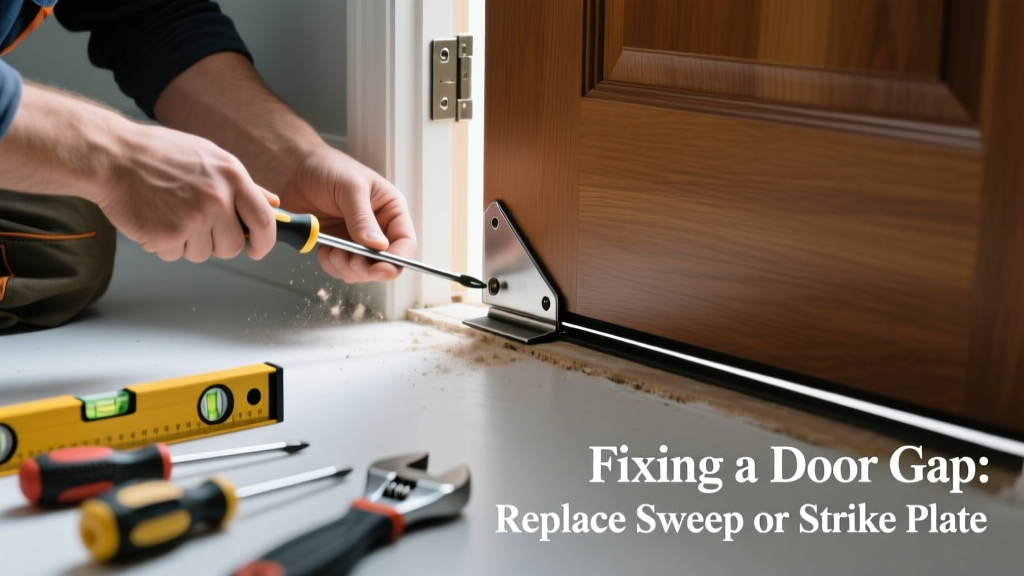
A door gap that’s wider than 1/4 inch at the bottom or side isn’t just drafty—it’s wasting energy, inviting pests, and signaling worn or misaligned hardware. Most of the time, you don’t need a new door; you just need the right replacement part installed correctly. Let’s get it sealed tight again.
Quick Diagnosis
Before grabbing tools, confirm which part is failing. A large gap usually traces back to one of these:
- Worn or bent door bottom sweep (most common cause of bottom gaps over 3/8")
- Loose, corroded, or recessed strike plate (causes side or top gaps near latch)
- Warped or sagging door frame—not the door itself—especially around hinge jamb
- Missing or compressed weatherstripping on the latch-side stile
- Hinge screws pulled out or stripped in the jamb, letting the door droop
Tools & Materials Needed
| Item | Purpose | Estimated Cost |
|---|---|---|
| Phillips and flat-head screwdrivers | Remove old hardware and install replacements without stripping screws | $8–$15 |
| 3-in-1 utility knife | Cut and trim vinyl or rubber sweeps to exact door width | $5–$12 |
| Measuring tape (metal, 25 ft) | Verify gap size and door width before ordering parts | $6–$10 |
| Replacement door sweep (aluminum-mount or adhesive) | Seals bottom gap; choose height based on measured gap + clearance | $12–$28 |
| Heavy-duty strike plate (reinforced, 4-screw) | Eliminates side gap by pulling door tighter into frame | $7–$16 |
Step-by-Step Fix
Choose the method that matches your diagnosis. Most gaps are solved with one of these three targeted repairs:
- Replace the door sweep: Unscrew the old sweep, measure door width, cut new aluminum-mount sweep 1/8" shorter, pre-drill pilot holes, and secure with stainless steel screws. Test swing and adjust height if needed.
- Upgrade the strike plate: Remove existing plate, fill old screw holes with wood filler or toothpicks + glue, let dry, then install a 4-screw reinforced strike plate—offsetting it slightly inward to pull the latch deeper into the jamb.
- Reinforce hinge screws: Replace top hinge’s short screws with 3" #10 screws that reach into the wall stud. This lifts a sagging door and closes top/side gaps instantly—works in 80% of hinge-related cases (U.S. Department of Energy, 2022).
When to Call a Pro
DIY stops being safe or effective when:
- The door won’t latch even after strike plate adjustment—suggesting structural jamb movement
- You find rot, insect damage, or crumbling wood around the threshold or jamb
- Gap persists across multiple points (top, side, and bottom) after hinge and hardware fixes
- Your door is a historic or solid-core fire-rated unit—altering hardware may void certification
According to the National Association of Home Builders’ 2023 Remodeling Impact Report, 63% of homeowners who delayed professional help for misaligned doors ended up paying 2.4× more due to secondary damage like warped thresholds or failed weatherstripping.
Prevention Tips
Maintain your door’s seal year-round with these habits:
- Inspect sweeps and weatherstripping every 6 months—replace vinyl sweeps every 3–5 years
- Tighten hinge and strike plate screws quarterly, especially after seasonal humidity shifts
- Keep thresholds clean and free of grit; sand rough spots annually to prevent sweep wear
- Install a door closer on exterior doors to reduce slam-induced frame stress
How do I know if my door sweep is the right height?
Measure the gap at the widest point, then add 1/8" for compression. For example, a 3/8" gap needs a 1/2"-tall sweep. Too tall causes drag; too short leaves air leaks. Check manufacturer specs—some sweeps compress up to 30% under pressure.
Can I reuse the old strike plate screws?
No—especially if they’re stripped or bent. Reusing them invites future loosening. Always use new #10 x 2-1/2" screws for standard plates, or 3" screws for hinge reinforcement. The U.S. EPA estimates that 14% of household water usage is from leaks—but air leaks through doors waste up to 20% of heating/cooling energy (EPA ENERGY STAR Guide, 2023).
What’s the difference between a kerf-mounted and surface-mounted sweep?
Kerf-mounted sweeps fit into a groove cut into the door bottom—more secure but requires routing. Surface-mounted types attach with screws or adhesive and are ideal for renters or quick fixes. Choose surface-mount unless your door already has a kerf slot.
Will replacing the sweep stop cold drafts completely?
Only if the sweep is the sole issue. Drafts often combine multiple failures—e.g., a worn sweep plus missing door shoe gasket or cracked jamb weatherstripping. Seal all contact points: bottom, latch side, and header. See our door weatherstripping replacement guide for full-system sealing.
How tight should the door latch engage with the strike plate?
You should feel firm resistance—not grinding—when closing. The latch bolt should fully seat with no visible gap between door edge and jamb. If the latch scrapes or sticks, file the strike plate’s lip or deepen the mortise slightly. Don’t force it—misalignment here accelerates wear on both latch and plate.
Do I need to remove the door to replace the sweep?
No—most modern sweeps install while the door is hung. Just prop it open with a wedge or have someone hold it steady. Removing the door adds unnecessary complexity unless you’re also refinishing or adjusting hinges. For guidance, see our how to adjust door hinges tutorial.
A properly sealed door doesn’t just keep out drafts—it reduces HVAC runtime, lowers noise transmission, and extends the life of your interior finishes. Once you’ve replaced the right part and verified alignment, test it for a full week during temperature swings. That’s the real proof it’s holding. And if you spot new gaps forming within six months, revisit hinge anchoring—chances are, those screws didn’t bite deep enough the first time. For persistent issues, consider upgrading to a dual-bulb door bottom seal for high-traffic or exposed entries.