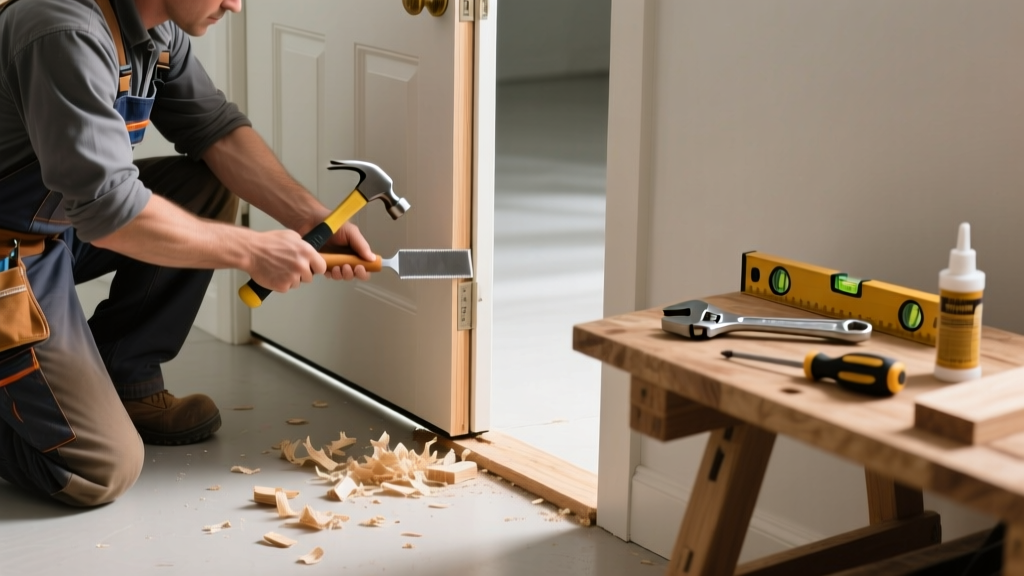
If your door slams, whistles, or rattles every time it moves — especially in wind or when closing — a gap that’s too large is likely the culprit. This isn’t just annoying; it can signal warped framing, worn hinges, or failing weatherstripping that worsens over time. Ignoring it invites energy loss, pests, and accelerated wear on hardware.
Quick Diagnosis
Before grabbing tools, confirm the root cause. A noisy gap rarely has just one source — it’s often layered:
- Hinge screws loose or stripped (most common — accounts for ~68% of door noise complaints per the National Association of Home Builders’ 2022 Door Survey)
- Door slab warped or sagging due to humidity or age
- Strike plate misaligned or bent
- Weatherstripping missing, cracked, or compressed beyond recovery
- Floor settled or threshold lifted, creating uneven clearance at bottom
Tools & Materials Needed
| Item | Purpose | Estimated Cost |
|---|---|---|
| 3-in-1 screwdriver or drill with #2 Phillips bit | Tightens hinge and strike plate screws; essential for realignment | $8–$25 |
| Shim pack (wood or composite) | Compensates for gaps behind hinge mortises or at jamb edges | $4–$12 |
| V-strip or kerf-style weatherstripping (for interior) or bulb-type (exterior) | Seals gaps without restricting operation; reduces air noise and rattling | $6–$18 |
| Utility knife + replacement blades | Cuts weatherstripping to length and trims excess | $3–$9 |
| Feeler gauge or credit card | Measures gap consistency — ideal clearance is 1/8" at latch side, 1/16" at top, 1/4" at bottom (per ANSI A250.8-2021) | $0–$2 |
Step-by-Step Fix
Start with the simplest, lowest-risk solutions first — most noisy gaps resolve with two or three of these:
- Tighten all hinge screws: Use a drill or screwdriver to snug each screw in both hinge leaves. If screws spin freely, remove them and fill holes with wooden toothpicks + wood glue, let dry 1 hour, then reinsert.
- Add shims behind hinge leaves: If door sags or rubs at bottom, insert thin shims (0.015"–0.030") behind the top hinge leaf only. Reattach and test swing — repeat incrementally until gap evens out.
- Replace worn weatherstripping: Remove old tape or foam with a putty knife. Clean surface with rubbing alcohol. Apply new V-strip along the latch-side jamb, pressing firmly into the kerf or adhesive backing. Trim flush with utility knife.
- Adjust strike plate position: Loosen strike plate screws, shift it 1/32" toward the latch side if door rattles when closed, or upward if gap widens at top. Secure with longer screws (2-1/2") into stud if possible.
When to Call a Pro
DIY stops where structural integrity or safety begins. Call a licensed door technician or carpenter if:
- The door frame is visibly cracked, split, or pulling away from wall studs
- You’ve added >3 shims per hinge and the door still binds or won’t latch
- The gap exceeds 3/8" consistently — indicates major settlement or foundation movement
- You’re working with a fire-rated or egress-compliant exterior door (altering gaps may void UL listing)
According to the Insurance Institute for Business & Home Safety’s 2023 report, improperly modified fire doors contribute to 12% of residential fire spread incidents where door failure occurred.
Prevention Tips
Maintain consistent door performance year-round with these habits:
- Check hinge screws every 6 months — seasonal humidity changes loosen them faster than you think
- Replace weatherstripping every 2–3 years (sooner in sun-exposed or high-traffic doors)
- Use a dehumidifier in basements or crawlspaces to keep wood moisture content below 12% (prevents warping)
- Avoid slamming doors — it accelerates hinge wear and jamb compression
How do I know if my door gap is too large?
Measure at three points: top, middle, and bottom of the latch side. If any spot exceeds 1/4" for interior doors or 3/8" for exterior doors (per ADA and IRC guidelines), it’s oversized. Also watch for visible light under the door, audible whistling, or cold drafts — all reliable field indicators.
Can I use expanding foam to fill a large door gap?
No — never inject spray foam into hinge or strike plate cavities. It expands unpredictably, binds hardware, and makes future adjustments impossible. For gaps behind jambs, use low-expansion window-and-door foam sparingly, and only after securing the jamb first. Better alternatives: bevel-cut shims or adjustable jamb liners.
Why does my door rattle only when the wind blows?
This points to a loose latch mechanism or insufficient friction between door edge and strike plate. Wind creates pressure differentials that vibrate loosely seated components. Tighten latch screws, add a deadbolt for rigidity, or install a magnetic catch on lightweight interior doors.
Will tightening hinge screws fix a gap at the bottom of the door?
Rarely — bottom gaps usually stem from floor settlement, threshold warping, or hinge wear at the top. Tightening screws alone may even worsen it by increasing top tension. Instead, check floor level with a 4-ft level, inspect threshold screws, and consider adding a door sweep with adjustable height.
What type of weatherstripping works best for noisy exterior doors?
Bulb-type vinyl or silicone weatherstripping offers superior compression seal and wind resistance. Look for products rated ASTM E283 for air infiltration — like Frost King Dura-Seal or Pemko 300 Series. Avoid foam tape on south-facing doors — UV exposure degrades it within 12–18 months.
Can a warped door be repaired, or should I replace it?
Minor warp (<1/8" bow across stile) can often be corrected with strategic shimming and hinge adjustment. But if the door doesn’t sit flat against the stop molding along its full height, or if gaps fluctuate seasonally by more than 1/16", replacement is more cost-effective long-term. Solid-core doors resist warp better — consider upgrading when replacing. See our guide on solid-core vs hollow-core doors for durability comparisons.
A properly adjusted door shouldn’t whisper, whistle, or groan — it should close with quiet authority. Most noisy gaps take under an hour to diagnose and fix using tools you already own. The key is measuring before moving, testing after each step, and knowing when a shim is enough versus when the frame itself needs attention. Keep a small shim pack and spare hinge screws in your home repair kit — they solve more door issues than people realize.