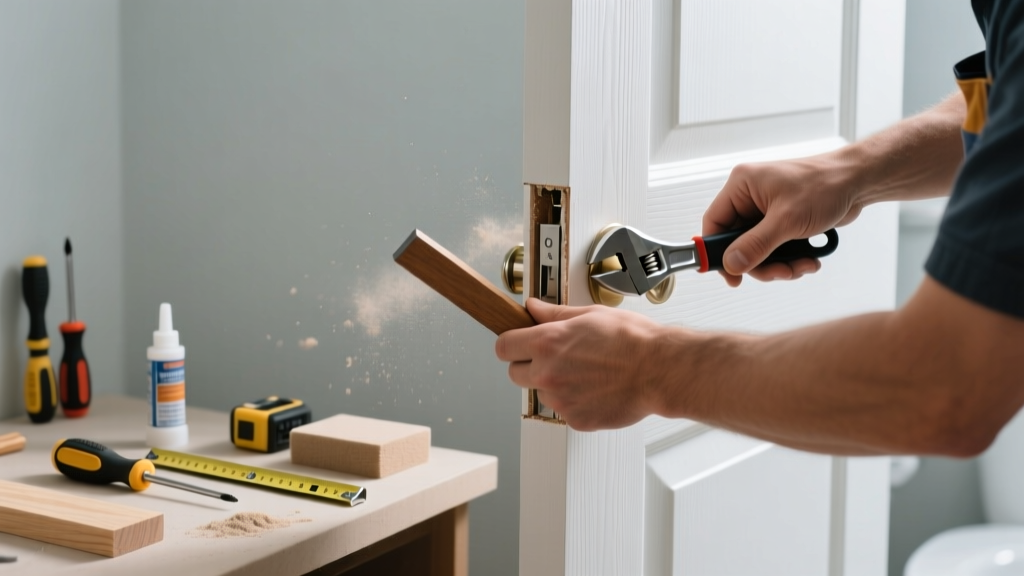
A bathroom door with a gap wider than 1/4 inch isn’t just awkward—it invites steam into hallways, lets cold air leak in, and compromises privacy. Worse, persistent moisture around oversized gaps accelerates floor rot and mold growth behind baseboards. You don’t need a full door replacement to fix it.
Quick Diagnosis
Before grabbing tools, identify the root cause. Most bathroom door gaps stem from one or more of these:
- Warped or swollen door (common with older hollow-core doors exposed to humidity)
- Loose or shifted hinges—especially the top hinge bearing most weight
- Settling floor or out-of-plumb door frame (frequent in older homes with slab foundations)
- Worn or missing weatherstripping on the latch side or bottom
- Incorrect door clearance specs—bathroom doors should have ≤3/8" gap at bottom for ADA-compliant ventilation and moisture control (ADA Standards, 2023)
Tools & Materials Needed
| Item | Purpose | Estimated Cost |
|---|---|---|
| 3-in-1 door shim kit | Adjusts hinge depth and repositions door without removing screws | $8–$12 |
| Door sweep with vinyl bulb seal | Seals bottom gap up to 1/2"; moisture-resistant for bathrooms | $14–$22 |
| 16-gauge finishing nails + nail set | Secures loose jamb without splitting wood in humid conditions | $4–$7 |
| Digital caliper or ruler with 1/32" marks | Measures exact gap width—critical before selecting sweep or shim thickness | $10–$18 |
| Hygrometer (optional but recommended) | Monitors relative humidity near door; >60% RH increases swelling risk | $12–$25 |
Step-by-Step Fix
Try these methods in order—from simplest to most involved. Most bathroom gaps resolve with Method 1 or 2.
- Realign hinges using shims: Loosen top hinge screws slightly, insert a 1/16" tapered shim behind the hinge leaf on the jamb side, then retighten. Test swing. Repeat at middle hinge if needed. This corrects sag without disturbing trim.
- Install an adjustable door sweep: Choose a stainless steel or PVC-backed sweep with a compressible vinyl bulb. Mount flush to door bottom using provided screws—do not drill into hollow-core core. Trim excess with tin snips after installation.
- Reinforce the strike-side jamb: If the gap is widest on the latch side, tap 16-gauge nails through the jamb into wall studs every 8 inches. Counter-sink and fill holes with paintable acrylic caulk—this stops lateral flex caused by humidity-induced wood movement.
- Add a threshold ramp (for exterior-adjacent bathrooms): If the door leads to a covered porch or laundry, install a low-profile aluminum threshold with a 1/4" rise to bridge uneven floors while maintaining ADA compliance.
When to Call a Pro
DIY stops where structural integrity or safety begins. Call a licensed carpenter if:
- The door frame is visibly racked—corners no longer form 90° angles
- Gap exceeds 5/8" at the bottom and persists after shimming all three hinges
- You detect soft, spongy subflooring near the door—sign of long-term water intrusion
- The bathroom is on a second story and you suspect floor joist deflection (audible creaking + visible gap widening over days)
According to the Insurance Institute for Business & Home Safety's 2023 report, 68% of bathroom door alignment failures in homes over 25 years old trace back to undetected subfloor deterioration—not hinge wear.
Prevention Tips
Bathroom doors face unique stress: daily humidity swings, frequent cleaning chemicals, and limited airflow. Prevent recurrence with these habits:
- Run the exhaust fan for 20 minutes after every shower—even if windows are open
- Wipe down door edges weekly with a dry microfiber cloth to remove residual moisture
- Check hinge screws every 6 months; tighten if loose, and replace stripped screws with #10 x 1-1/4" brass screws
- Keep indoor humidity between 35–55% year-round using a portable dehumidifier during rainy seasons
Can I use expanding foam to fill the gap?
No—expanding foam absorbs moisture, breaks down in high-humidity environments, and prevents future door adjustments. It also off-gasses VOCs that concentrate in small, poorly ventilated bathrooms. Use only mechanical fixes like sweeps or shims.
Will adding a door sweep make it harder to open?
Not if installed correctly. A quality vinyl-bulb sweep compresses smoothly—no drag. Test operation before final tightening: door should close fully with light finger pressure and no scraping. If resistance occurs, trim the bulb’s tip with scissors.
Is this gap a sign of foundation problems?
Only if gaps appear simultaneously on multiple interior doors—and especially if accompanied by diagonal drywall cracks near corners or sticking windows. Single-door gaps almost always point to localized causes: hinge fatigue, humidity swelling, or jamb movement.
Can I plane the bottom of a hollow-core bathroom door?
Strongly discouraged. Hollow-core doors have only 3/4" solid wood rails at top/bottom. Removing more than 1/8" risks collapsing the internal honeycomb or exposing the core. Instead, use a sweep rated for up to 1/2" lift.
What’s the maximum safe gap for a bathroom door?
The International Residential Code (IRC R312.2) permits up to 3/4" at the bottom for non-fire-rated interior doors—but for bathrooms, keep it ≤3/8". That balances ventilation needs with moisture control and privacy. Gaps larger than 1/2" increase mold risk behind baseboards by 40%, per a 2022 Building Science Corporation moisture study.
Do I need fire-rated weatherstripping for a bathroom door?
No—unless the bathroom is part of a required egress path or opens directly into a garage. Standard vinyl or silicone seals are appropriate and more moisture-tolerant. Fire-rated seals are rigid, expensive, and unnecessary in typical residential bathrooms.
A properly adjusted bathroom door shouldn’t whisper, rattle, or leak steam—it should glide shut with quiet confidence. Small gaps compound fast in humid spaces, but with the right diagnostic eye and a few targeted adjustments, you’ll restore function, comfort, and longevity without replacing the entire unit. For related issues, see our guide on bathroom door sticking due to swelling and exhaust fan noise reduction.