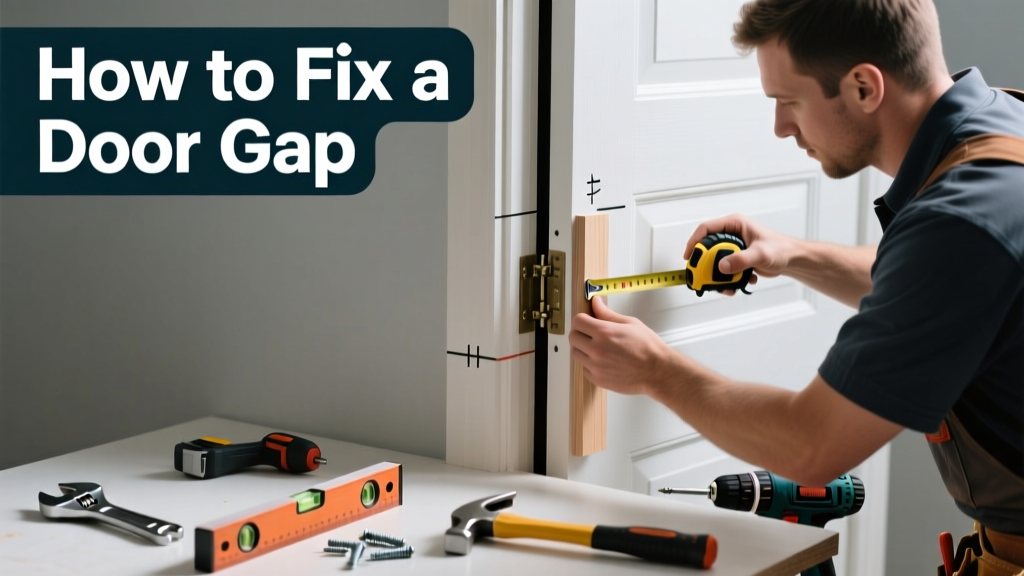
A door gap that’s wider than 1/4 inch at the bottom—or uneven along the jamb—lets in cold air, dust, and even insects. It also makes your HVAC work harder and can signal deeper structural or installation issues. Don’t ignore it: most gaps are fixable in under an hour with basic tools.
Quick Diagnosis
Before grabbing tools, identify the root cause. A large gap isn’t always about the door itself—it could be the frame, foundation, or hardware. Common culprits include:
- Warped or swollen door slab (especially in humid climates)
- Loose or misaligned hinges causing sagging
- Settling foundation shifting the door frame out of plumb
- Worn or improperly installed weatherstripping
- Incorrect door clearance during original installation
Tools & Materials Needed
| Item | Purpose | Estimated Cost |
|---|---|---|
| Shim pack (wood or plastic) | Realigns hinge side of door by packing behind hinge screws | $3–$8 |
| 3-in-1 weatherstrip (V-strip, foam tape, or kerf-mounted) | Seals gaps at bottom and sides without altering door fit | $5–$15 |
| Adjustable hinge screws (longer 3″ screws) | Anchor hinges into wall stud instead of weak jamb wood | $4–$10 |
| Plane or sandpaper (80–120 grit) | Trims minor swelling on door edge or bottom | $6–$25 |
| Level and 6-ft straightedge | Verifies if frame is plumb and door is square | $12–$35 |
Step-by-Step Fix
Choose the method that matches your diagnosis. Start simple—most gaps respond to hinge adjustment or weatherstripping before cutting or planing.
- Reinforce hinges with longer screws: Replace top and middle hinge screws with 3″ screws driven into the wall stud. This lifts a sagging door and closes gaps at the latch side and bottom.
- Add shims behind hinge plates: If the door sags toward the latch side, remove the middle hinge, insert a thin wood shim behind the plate, then reattach. Test swing and repeat as needed.
- Install adjustable threshold or door sweep: For bottom gaps over 3/8″, use a metal threshold with adjustable vinyl bulb (e.g., adjustable door threshold) or a brushed aluminum sweep with compression seal.
- Trim the door bottom (last resort): Only if swelling or misfit is confirmed. Mark cut line 1/8″ above desired gap, clamp door horizontally, and use a fine-tooth handsaw or circular saw guide. Sand smooth and seal end grain immediately.
When to Call a Pro
Some gaps indicate problems beyond DIY scope—especially when safety or building integrity is involved.
- The door frame is visibly racked, cracked, or pulling away from drywall
- Gaps appear suddenly after heavy rain or seismic activity (possible foundation movement)
- Multiple doors in the home show similar gaps, suggesting whole-house settlement
- You’ve tried hinge fixes and shimming but the door binds or won’t latch securely
According to the Insurance Institute for Business & Home Safety's 2023 report, 62% of door-related energy loss stems from unaddressed gaps larger than 1/4 inch—and half of those cases involve compromised framing requiring structural evaluation.
"A gap wider than 3/8 inch at the bottom almost always means either hinge failure or frame distortion—not just 'a loose door.' Measure twice, shim once." — Mike R., 28-year residential carpenter and IBS-certified door technician
Prevention Tips
Stop gaps before they start with smart maintenance habits:
- Check hinge screws every 6 months—tighten or replace with longer screws if loose
- Apply semi-transparent acrylic stain to exterior door bottoms annually to slow moisture absorption
- Install a storm door with its own sweep to reduce wear on primary door seals
- Use a dehumidifier in basements and crawlspaces to stabilize subfloor moisture levels
Can I fill a large door gap with caulk?
No—caulk isn’t flexible or durable enough for moving door seams. It cracks, collects dust, and prevents proper operation. Use compressible weatherstripping like kerf-mounted V-seal or magnetic gasket instead.
Why does my interior door gap get bigger in winter?
Low indoor humidity shrinks wood fibers, especially in older solid-core doors. The gap widens because the door contracts more than the frame. Maintain 35–45% relative humidity year-round with a hygrometer and humidifier.
Will adding a door sweep fix a gap at the latch side?
No—a sweep only addresses the bottom gap. Latch-side gaps require hinge realignment, jamb shimming, or professional frame adjustment. If the door rubs the strike plate or won’t close fully, the issue is vertical or lateral misalignment—not the sweep.
How much gap should a standard interior door have?
Per ANSI A250.8 standards, interior doors need 1/2″ clearance above floor for carpet, 3/4″ for hardwood, and no more than 1/8″ gap at hinge and latch sides. Exterior doors require tighter tolerances—max 1/4″ at bottom and 1/16″ at sides.
Can I use cardboard shims behind hinges?
Temporarily, yes—but avoid long-term use. Cardboard compresses and deteriorates, especially in humid areas. Use tapered cedar shims or composite hinge shims designed for load-bearing applications. They’re inexpensive and last decades.
Is a large door gap a fire code violation?
Yes—if it’s an exterior-rated fire door. NFPA 80 (2022) requires gaps no larger than 1/8″ at head and jambs, and 3/4″ maximum at the bottom for non-smoke-rated doors. Gaps exceeding these void the fire rating and may fail inspection.
A well-sealed door doesn’t just look better—it saves energy, blocks noise, and keeps your home safer and more comfortable. Most oversized gaps stem from small oversights during installation or seasonal shifts, not irreversible damage. With the right approach, you’ll restore tight, quiet operation without replacing the entire unit—or calling a contractor unless absolutely necessary.