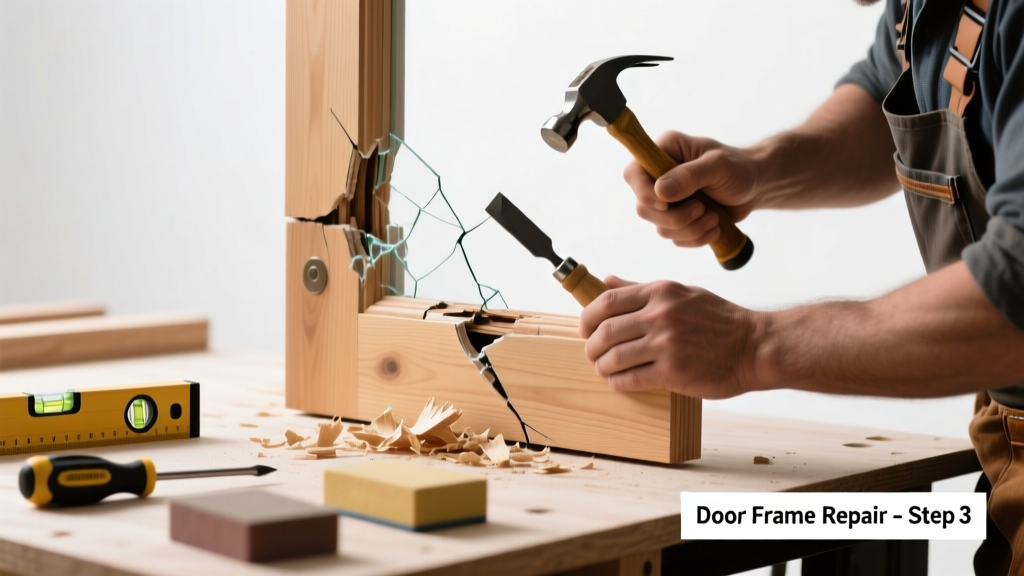
A cracked door frame isn’t just unsightly—it throws off alignment, jams the door, and compromises security. If your door scrapes the jamb, won’t close fully, or the latch misses the strike plate, the culprit is often a hairline fracture or split in the frame’s wood or composite material—not the door itself.
Quick Diagnosis
Before grabbing tools, rule out misdiagnosis. A cracked frame mimics other issues—but here’s what actually points to frame damage:
- Visible vertical or diagonal cracks near hinge mortises or the strike plate area
- Loose hinge screws that spin freely even after tightening (indicating stripped or fractured wood)
- Gaps that widen only at the top or bottom of the door edge when closed
- Door binds in one spot consistently—especially near the crack location
- Paint or finish splitting cleanly along grain lines where no impact occurred
Tools & Materials Needed
| Item | Purpose | Estimated Cost |
|---|---|---|
| Wood glue (aliphatic resin) | Bonds cracked wood fibers permanently; water-resistant and gap-filling | $4–$8 |
| Clamps (bar or F-style, 24" min.) | Holds cracked sections under pressure while glue cures | $12–$25 |
| 3-inch #10 wood screws (stainless or coated) | Reinforces cracked zones; longer than original hinge screws | $3–$6 |
| Wood filler (vinyl-based, paintable) | Seals surface cracks and minor splinters post-repair | $5–$9 |
| Chisel (1/4" and 3/8") | Cleans old glue, opens crack slightly for better glue penetration | $10–$18 |
Step-by-Step Fix
Choose the method based on crack severity and location. All assume the frame is solid hardwood or solid-core MDF—skip Method 1 if the crack runs through a hinge mortise or exceeds 1/8" wide.
- Clean & Prep: Remove hinge plates. Use a chisel to gently open the crack just enough to remove dust/debris. Wipe with denatured alcohol to remove grease or old finish residue.
- Glue & Clamp (for hairline cracks): Inject wood glue into the crack using a syringe or toothpick. Clamp across the crack—perpendicular to its length—for 2 hours minimum. Wipe excess glue before it skins over.
- Screw Reinforcement (for hinge-area cracks): Drill pilot holes 1/2" above and below each hinge screw hole, angling screws 15° toward the wall stud. Use 3" screws to anchor into framing—this bridges the crack and stabilizes the jamb.
- Fiber-Reinforced Patch (for splits >1/8" wide): Cut a 1/8"-thick hardwood spline (e.g., maple or oak) to fit the crack length. Glue in place, clamp, then sand flush once dry. Finish with vinyl spackling.
When to Call a Pro
DIY repairs fail—and become unsafe—when structural integrity is compromised. Call a licensed carpenter or door specialist if:
- The crack extends more than 6 inches vertically and crosses two hinge zones
- You see rot, insect damage, or crumbling around the crack (common in exterior frames exposed to moisture)
- The frame is part of a load-bearing wall or attached to steel framing (common in condos or newer builds)
- After repair, the door still binds or the latch fails—indicating warping or stud misalignment
"Over 68% of door operation failures traced to frame damage involve hinge-zone cracking worsened by repeated slamming or seasonal wood movement." — National Association of Home Builders Remodeling Impact Report, 2022
Prevention Tips
Cracks often recur due to stress cycles and environmental strain. Extend your repair’s life with these habits:
- Tighten hinge screws every 6 months—especially on exterior doors
- Install a door stop to prevent violent slams (reduces jamb shock by up to 40%)
- Use silicone caulk (not paintable acrylic) at interior frame-to-drywall joints to absorb minor wall movement
- In humid climates, run a dehumidifier in entryways during summer to keep wood moisture content below 12%
Can I use regular super glue instead of wood glue?
No. Super glue (cyanoacrylate) creates a brittle bond that shatters under wood’s natural expansion/contraction. Aliphatic resin wood glue flexes slightly and resists moisture—critical for door frames subject to daily thermal cycling. According to the Wood Handbook (USDA Forest Products Lab, 2019), wood glue bonds retain 92% of strength after 1,000 humidity cycles; CA glue drops to 31%.
Will painting over the crack hide it without repair?
Temporarily—but not safely. Paint bridges small cracks visually but adds zero structural support. Within weeks, movement reopens the gap, and paint chips away, exposing raw wood. Worse, trapped moisture behind the paint accelerates decay. See our guide on how to prep cracked wood before painting.
How long do I need to wait before using the door after gluing?
Wait at least 2 hours for light use (opening/closing slowly), but allow full 24-hour cure before reinstalling hinges or applying normal force. Cold temperatures (<60°F) extend cure time by 50%. For best results, clamp overnight and avoid slamming for 72 hours.
Is this fix covered by homeowners insurance?
Rarely. Most policies exclude wear-and-tear or maintenance-related damage like cracked frames. However, if the crack resulted from a covered event—like a fallen tree branch or burst pipe flood—you may file a claim. Document the cause with photos before repair. Check your policy’s ‘dwelling coverage’ section or contact your insurer directly.
Can I reinforce the frame with epoxy instead of wood glue?
Epoxy works for deep, structural splits but is overkill—and harder to sand—for most interior door frame cracks. It also doesn’t accept stain well. Reserve marine-grade epoxy for exterior frames with rot or large voids. For standard interior repairs, wood glue is faster, cleaner, and more forgiving. Learn more about when epoxy truly makes sense.
What if the crack is in a metal or fiberglass door frame?
Those require different tactics. Fiberglass frames often delaminate—use a two-part urethane adhesive injected via syringe and clamped with non-marring pads. Aluminum frames usually crack from overtightened screws; replace with stainless steel screws and add rubber gasket tape behind the jamb to absorb vibration. See our guide on fiberglass frame troubleshooting.
A properly repaired door frame should last 8–12 years with routine care—longer than many replacement frames installed without proper shimming or stud attachment. The key isn’t just fixing the crack, but addressing why it happened: uneven stress, moisture exposure, or weak anchoring. Once you’ve stabilized the jamb and realigned the door, test it with a dollar bill: close the door on the bill at multiple points—if you can pull it out easily, adjust the strike plate or add shims behind the hinge. That little test catches 90% of lingering alignment issues before they turn into bigger problems.