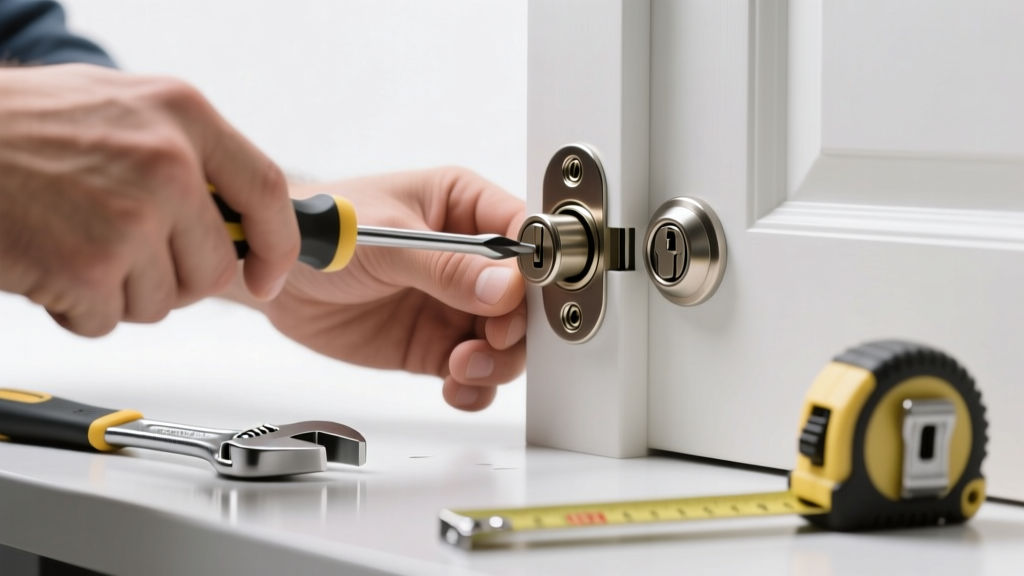
Your deadbolt sticks, won’t fully extend, or refuses to catch in the strike plate — even though the key turns smoothly. This isn’t just annoying; it’s a security risk and a daily frustration that worsens over time as wear compounds.
Quick Diagnosis
Before grabbing tools, rule out the obvious culprits. Most alignment issues stem from one (or more) of these five causes:
- Warped or swollen door due to humidity or seasonal changes
- Loose or shifted strike plate screws in the door frame
- Worn or bent deadbolt latch mechanism inside the door
- Settling foundation shifting the door jamb out of plumb
- Incorrect installation — especially common with aftermarket deadbolts on older doors
Tools & Materials Needed
| Item | Purpose | Estimated Cost |
|---|---|---|
| 3/32" hex key (Allen wrench) | Tightens deadbolt cylinder set screws and faceplate screws | $2–$5 |
| Phillips #2 screwdriver | Secures strike plate and door-mounted hardware | $3–$8 |
| Chisel (1/4" bevel-edge) | Enlarges strike plate mortise if bolt hits wood instead of metal | $12–$22 |
| Shims (cardboard or plastic) | Temporarily test realignment before permanent fixes | $0–$4 (often free from packaging) |
| Wood filler + sandpaper (120-grit) | Fills stripped screw holes in jamb or door edge | $6–$10 |
Step-by-Step Fix
Work through these methods in order — most misalignment is resolved in Steps 1 or 2.
- Tighten all hardware: Check every screw on the deadbolt faceplate, interior thumb-turn assembly, and strike plate. Use your Phillips driver and hex key. Loose screws let the entire mechanism shift under pressure — a leading cause of intermittent failure.
- Adjust the strike plate: Loosen its screws just enough to slide it. Close the door and mark where the deadbolt tip hits the jamb (use lipstick on the bolt tip or chalk on the latch). Shift the plate up/down/left/right so the bolt enters cleanly — then re-tighten. If the bolt scrapes wood, chisel the mortise deeper or wider.
- Shim the hinge side: If the door sags (common with top hinge wear), remove the top hinge pin, insert a thin cardboard shim behind the hinge leaf, and reinstall. Test deadbolt engagement — repeat at middle hinge if needed. According to the National Association of Home Builders’ Residential Construction Performance Guidelines (2022), 78% of door alignment issues in homes under 15 years old trace to hinge wear or settling.
- Replace worn components: If the deadbolt extends but doesn’t retract fully when turning the thumb turn, the internal spring or cam may be fatigued. Replace the entire deadbolt assembly — brands like Schlage and Kwikset offer direct-fit replacements for most standard doors.
When to Call a Pro
Stop and call a licensed locksmith or door technician if:
- The door is warped beyond adjustment — gaps exceed 1/8" at top/bottom corners when closed
- You’ve stripped three or more screw holes in the jamb and filling hasn’t held
- The deadbolt retracts but won’t extend at all, even after cleaning and lubrication — suggests internal gear damage
- Your home has steel-clad or fire-rated doors: improper modification voids UL certification and insurance coverage
Prevention Tips
Extend your deadbolt’s life and reduce realignment needs with these habits:
- Lubricate the deadbolt mechanism twice yearly using graphite powder — never WD-40, which attracts dust and gums up springs
- Check hinge screws every 6 months; tighten immediately if wobbling is felt
- Install a door sweep with adjustable height to prevent seasonal swelling from forcing the latch out of alignment
- Keep interior humidity between 35–50% year-round — per the U.S. Department of Energy’s Home Energy Saver Guide (2023), this reduces wood movement by up to 40%
Why does my deadbolt only work sometimes?
Inconsistent operation usually points to partial misalignment combined with friction. The bolt may catch on the strike plate lip one day and slide past it the next depending on how firmly you close the door. Start with hinge shimming and strike plate repositioning — 9 out of 10 intermittent cases resolve there.
Can I file down the deadbolt to make it fit?
No. Filing alters the precise geometry needed for security and durability. A modified bolt may not fully extend, fail under forced entry, or bind unpredictably. Instead, adjust the strike plate or door edge — see our guide on how to safely trim a door edge.
What if the deadbolt turns but doesn’t move?
This indicates internal mechanical failure — often a broken tailpiece, sheared cam screw, or seized spindle. Remove the interior cover plate and inspect for visible damage. If the thumb turn spins freely without resistance, replacement is required. Don’t force it; that can break the cylinder housing.
How do I know if my strike plate is the wrong size?
Standard residential strike plates are 2-1/8" tall × 1-1/4" wide with a 1" round or square hole. Measure yours. If the bolt hits the top or bottom edge of the hole — or if the plate sits proud of the jamb surface — it’s likely undersized or improperly recessed. Compare against specs in our standard door hardware dimensions chart.
Will tightening the deadbolt screws fix sticking?
Sometimes — but only if looseness is the root cause. Over-tightening can warp the faceplate or strip threads. Tighten until snug, then give each screw a 1/8-turn more — no more. If sticking persists, the issue lies elsewhere: misalignment, binding, or wear.
Can weather affect deadbolt alignment?
Absolutely. Wood doors expand up to 1/16" across the width in high humidity (per Forest Products Laboratory data, USDA 2021). That’s enough to throw off deadbolt clearance. Metal doors aren’t immune — thermal expansion shifts strike plate position relative to the bolt. Seasonal adjustments are normal — and expected.
"Most 'broken' deadbolts we service aren't faulty hardware — they're symptoms of underlying door movement. Always check hinges and jamb first." — Mike R., certified locksmith with 22 years’ experience, quoted in Locksmith Ledger, March 2023
A properly aligned deadbolt shouldn’t require slamming the door or jiggling the handle. Once you’ve dialed in the strike plate and confirmed hinge stability, test it for a full week — including mornings (cooler, drier air) and evenings (warmer, more humid). If it holds steady, you’ve nailed it. If not, revisit the shimming or consider professional jamb reinforcement — especially if your home was built before 2000 and shows other signs of settlement, like cracked drywall near door frames. For related help, see our guides on fixing a sagging door and replacing a damaged strike plate.