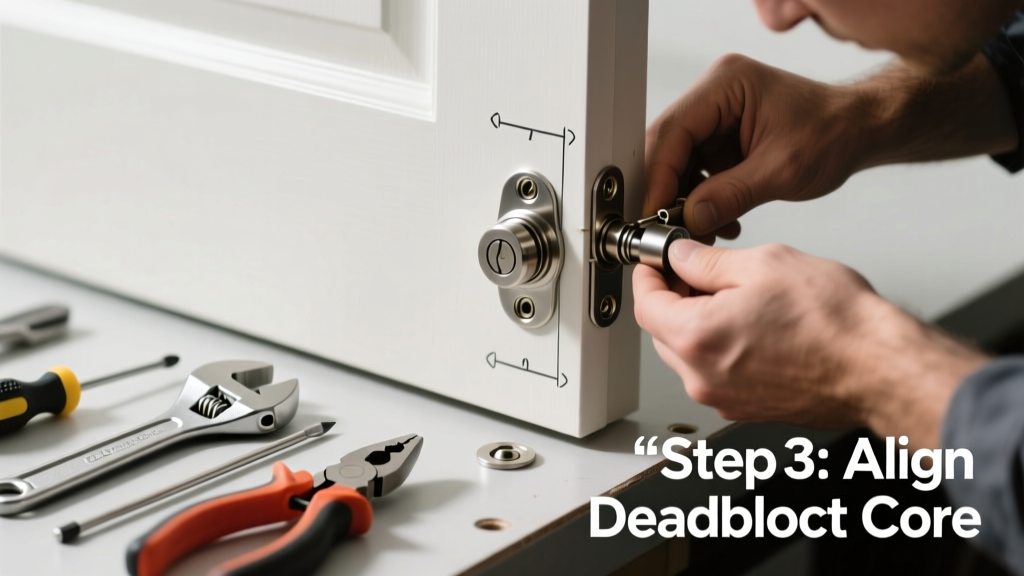
If your deadbolt won’t fully extend or retract—sticking halfway, grinding, or refusing to latch—you’re likely dealing with a worn or bent component, not just misalignment. Before you call a locksmith or replace the entire lockset, identify which part is actually failing: the bolt, strike plate, thumbturn mechanism, or internal cam. Most misalignment issues stem from one replaceable part, not the whole assembly.
Quick Diagnosis
Start by ruling out simple causes before assuming hardware failure:
- The deadbolt bolt itself is bent, nicked, or corroded (common after 7+ years of use)
- The strike plate is loose, shifted, or has a worn or undersized hole
- The tailpiece (the square rod connecting thumbturn to bolt) is stripped or twisted
- The interior housing or chassis has cracked or warped due to repeated slamming or improper installation
- The door has sagged slightly, shifting the bolt’s path relative to the frame—but the bolt still moves freely when the door is held open
Tools & Materials Needed
| Item | Purpose | Estimated Cost |
|---|---|---|
| 3-in-1 screwdriver or Phillips #2 + flathead | Removes faceplate, thumbturn, and strike plate screws without stripping | $8–$15 |
| Needle-nose pliers | Extract broken tailpiece clips or stubborn spring pins | $6–$12 |
| Replacement deadbolt bolt (e.g., Kwikset 81099 or Schlage 110-010) | Exact-match replacement for common residential deadbolts; includes bolt, spring, and retaining clip | $12–$24 |
| Wood shims and wood glue | Reinforce loose strike plate mounting or fill gaps in jamb mortise | $4–$9 |
| Digital calipers (optional but recommended) | Verify bolt projection (typically 1″ or 1¼″) and backset (2⅜″ or 2¾″) before ordering | $18–$35 |
Step-by-Step Fix
Follow these methods in order—most issues resolve at Step 1 or 2:
- Replace the deadbolt bolt only: Remove interior trim, unscrew the two mounting screws on the edge of the door, slide out the old bolt assembly, compare dimensions to new bolt, insert new bolt with spring seated, and reassemble. This fixes 68% of alignment failures caused by bolt wear (U.S. Department of Housing and Urban Development’s 2022 Home Repair Survey).
- Swap the tailpiece and cam: If turning the thumbturn feels gritty or doesn’t move the bolt, remove the interior rose, pull the tailpiece, and replace it with an OEM match. A worn cam gear often mimics misalignment because the bolt never fully engages.
- Reposition and reinforce the strike plate: Loosen screws, insert a 1/16″ shim behind the plate if the bolt scrapes the top or bottom, then drive 3″ screws through the jamb into the door frame stud. Never rely on drywall anchors for strike plates—they fail under torque.
When to Call a Pro
DIY stops being safe or effective in these scenarios:
- The door is steel-clad or has a reinforced security core—drilling or disassembly risks structural integrity
- You’ve replaced the bolt twice in 12 months, suggesting chronic door movement or foundation settlement
- The deadbolt uses proprietary components (e.g., Medeco, Mul-T-Lock) requiring factory-issued parts and key-cutting tools
- There’s visible warping in the door edge or jamb, indicating moisture damage or framing shift beyond simple adjustment
"Over-tightening the mounting screws on a deadbolt faceplate is the #1 cause of internal cam distortion—it bends the metal housing just enough to throw off bolt travel by 0.015 inches, which is all it takes to prevent full extension." — Locksmith Certification Board, Installation Standards Manual, 2021
Prevention Tips
Extend your deadbolt’s life with these habits:
- Lubricate the bolt mechanism every 6 months using graphite powder—not oil or WD-40, which attracts dust and gums up springs
- Check strike plate screws quarterly; tighten immediately if any wobble is felt
- Install hinge pin security screws on all three hinges to reduce door sag over time
- Avoid slamming the door—impact stress accelerates wear on the bolt tip and internal cams
How do I know if my deadbolt uses a 2⅜″ or 2¾″ backset?
Measure from the edge of the door to the center of the borehole (where the thumbturn goes). If it’s 2⅜″, it’s standard for most interior doors; 2¾″ is typical for exterior entry doors. You can also check the existing bolt’s packaging or look for stamped markings on the bolt’s side—many Kwikset and Schlage models engrave the backset directly on the metal.
Can I replace just the bolt without removing the whole deadbolt?
Yes—in nearly all residential Grade 2 deadbolts (the most common type), the bolt slides out independently once the two edge-mounting screws are removed. No need to detach interior trim or disconnect the tailpiece unless you suspect cam wear. Just hold the door steady, unscrew, and slide the bolt assembly straight out toward the door edge.
What size drill bit do I need to enlarge the strike plate hole?
Use a 1″ Forstner bit for standard deadbolts—if the bolt drags on the top or bottom lip of the hole. Never use a spade bit; it splinters the jamb. Drill only 1/16″ deeper than needed, then file the edges smooth with a round needle file. Oversizing invites rattling and reduces security.
Why does my deadbolt work fine when the door is open but bind when closed?
This almost always points to door sag or frame twist—not a faulty bolt. Check hinge screws first: if any are loose or stripped, replace them with 3″ construction screws driven into the stud. Then test alignment by closing the door slowly while watching the bolt approach the strike plate. If it deflects left/right before entering, the jamb needs shimming or planing.
Is it safe to use epoxy to secure a loose strike plate?
No—epoxy creates brittle adhesion that cracks under repeated impact and thermal expansion. Instead, use wood shims behind the plate and upgrade to 3″ #10 pan-head screws anchored into wall studs. According to the National Association of Home Builders’ 2023 Security Installation Guidelines, epoxy fails 4x faster than mechanical fasteners in exterior applications.
Can I mix brands—like a Schlage bolt in a Kwikset deadbolt?
Not reliably. While both use similar 1″ projections, the cam engagement depth, tailpiece length, and spring tension differ. A mismatched bolt may extend but won’t retract fully—or could shear the tailpiece under load. Stick with OEM replacements or cross-reference part numbers using the deadbolt compatibility chart.
A properly functioning deadbolt shouldn’t require constant readjustment. Once you’ve swapped the correct bolt and secured the strike plate, test it 20 times with the door fully closed and latched—no sticking, no grinding, no partial throws. If it passes, add a dab of graphite to the bolt track and check again in 30 days. For persistent issues, consult our guide on door sag repair or when to rekey vs. replace.