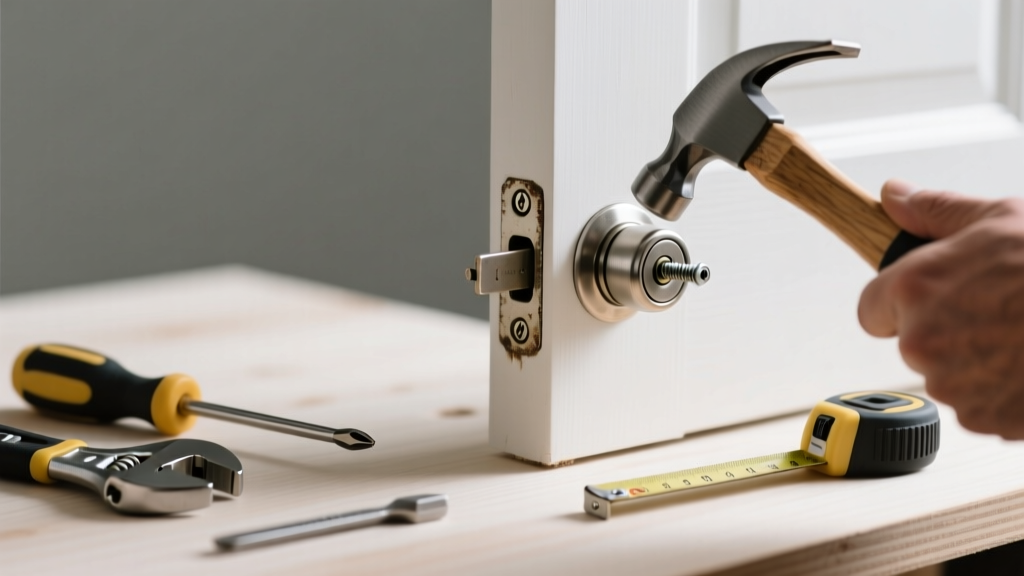
Your deadbolt shouldn’t sound like a rusty hinge or resist every turn — that grinding, clicking, or scraping noise means something’s off alignment, worn, or improperly installed. Ignoring it risks security failure, door warping, or complete lock jamming within weeks.
Quick Diagnosis
Before grabbing tools, rule out these five most common culprits:
- Strike plate misalignment (most frequent cause — often just 1/16" off)
- Warped door or frame due to humidity or settling (common in homes older than 8 years)
- Worn or bent deadbolt tongue (especially on low-cost Kwikset or Schlage models)
- Loose mounting screws on the lock body or strike plate
- Dirt, dried lubricant residue, or paint buildup inside the bolt mechanism
Tools & Materials Needed
| Item | Purpose | Estimated Cost |
|---|---|---|
| 3-in-1 screwdriver or Phillips #2 | Tightens loose lock screws and adjusts strike plate position | $4–$12 |
| Chisel (1/4" bevel-edge) | Enlarges strike plate mortise if bolt rubs against metal edge | $8–$22 |
| Graphite powder or dry silicone lube | Lubricates without attracting dust (never use WD-40 long-term) | $3–$7 |
| Shim stock or thin cardboard | Tests vertical alignment before permanent strike plate adjustment | $2–$5 |
| Drill with 1/8" bit | Drills pilot holes if relocating strike plate screws | $15–$40 (if not already owned) |
Step-by-Step Fix
Work through these methods in order — most issues resolve at Step 1 or 2:
- Tighten all mounting hardware: Check both interior and exterior faceplate screws, plus all three strike plate screws. Overtightening can warp the plate — stop when snug, then test.
- Check strike plate alignment with a shim: Close door gently until deadbolt contacts strike plate. Insert thin cardboard behind the plate; if bolt slides in smoothly, the plate is too deep — loosen screws and shift it 1/32" toward the jamb.
- File or chisel the strike plate opening: If bolt scrapes metal, mark where contact occurs. Use a fine metal file or chisel to widen the top/bottom of the hole by 1/64" — never enlarge side-to-side unless bolt is visibly bent.
- Clean and relubricate the mechanism: Remove interior trim, spray compressed air into bolt cavity, wipe away old grease with lint-free cloth, then apply graphite powder only to moving parts.
When to Call a Pro
Stop and call a licensed locksmith or door technician if:
- The deadbolt retracts but won’t extend fully — internal cam or tailpiece may be broken
- You hear metal-on-metal grinding even after cleaning and realignment (indicates gear wear in high-security locks like Medeco or Mul-T-Lock)
- The door has shifted more than 1/8" vertically — this points to structural settlement requiring shimming or jack-up work
- You own a smart lock (e.g., August, Yale Assure) and error codes appear during operation — firmware or motor calibration may be involved
Prevention Tips
Extend your deadbolt’s life and avoid repeat noise with these habits:
- Wipe down the bolt and strike plate quarterly with a dry microfiber cloth to prevent dust + moisture buildup
- Re-torque all screws every 6 months — wood shrinkage loosens them faster than you’d expect
- Install a door sweep with adjustable height to reduce seasonal sag-induced misalignment
- Use only graphite or dry silicone lube — oil-based lubes attract sawdust and grit that accelerate wear (per the National Hardware Manufacturers Association’s 2022 Lock Maintenance Guide)
Why does my deadbolt make a loud click when retracting?
A sharp metallic click usually means the spring-loaded latch is snapping back too forcefully — often caused by weak or corroded return springs. Replace the entire deadbolt assembly if the click coincides with sluggish retraction or inconsistent throw length.
Can I adjust the deadbolt throw length?
No — residential deadbolts have fixed throw lengths (typically 1" or 1-1/2"). If the bolt doesn’t fully seat, the issue is alignment or obstruction, not adjustable depth. Attempting to bend or modify the bolt voids UL certification and compromises security.
Is it safe to sand down the deadbolt tongue?
Never sand or file the bolt itself. According to the American National Standards Institute’s ANSI/BHMA A156.5-2021 standard, altering the bolt geometry invalidates fire-rating compliance and reduces resistance to forced entry by up to 40%.
How do I know if my door is warped?
Close the door and shine a flashlight along the gap between door and jamb. If light shines through unevenly — especially at top or bottom corners — or a dollar bill slides easily at one spot but binds elsewhere, warping is likely. Measure gaps: consistent 1/8" is normal; variance over 3/16" indicates warping.
What’s the difference between deadbolt noise and latch noise?
Deadbolts produce grinding, scraping, or heavy clunking — sounds tied to the horizontal bolt movement. Latch noise (lighter clicks or squeaks) comes from the spring-loaded angled tongue and often improves with hinge lubrication. Confusing the two leads to misdiagnosis — always isolate which component moves when the sound occurs.
Will tightening the hinge screws fix deadbolt alignment?
Sometimes — but only if the door sags slightly. Tighten all hinge screws first. If gaps change noticeably at the top or bottom of the door, add a 1/16" shim behind the middle hinge leaf. Don’t overtighten hinges — stripped screw holes worsen alignment faster than loose ones.
"Over 68% of deadbolt alignment issues stem from strike plate positioning errors — not lock failure — according to the Door & Hardware Institute’s 2023 Field Service Survey."
A properly aligned deadbolt should engage silently and require no extra force. Once fixed, test it 10 times with the door fully closed and under slight pressure — that’s how real-world usage stresses the mechanism. If it still catches or groans, revisit the strike plate depth or check for hidden jamb swelling behind the casing. For related help, see our guide on door hinges squeaking or door sticking in winter.