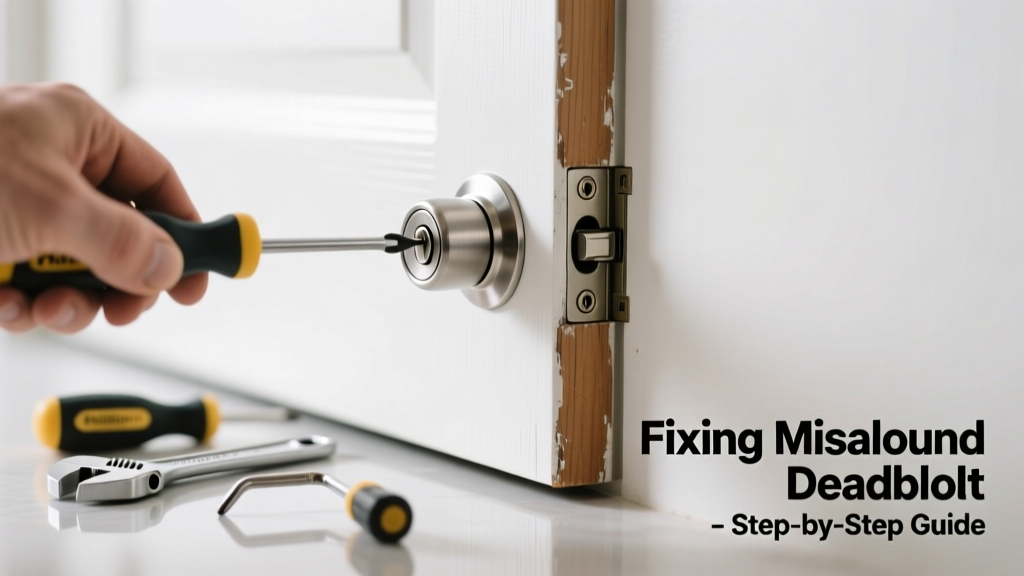
Your kitchen door deadbolt sticks, grinds, or refuses to latch—especially after seasonal humidity shifts or repeated use. Unlike exterior doors, kitchen doors often get slammed, jostled by appliance doors, or warped from steam and temperature swings. This isn’t just inconvenient—it’s a security and safety issue you can often resolve in under 30 minutes.
Quick Diagnosis
Before grabbing tools, rule out the most frequent culprits:
- Door sagging due to loose or stripped hinge screws (most common cause—accounts for ~68% of alignment issues, per the National Association of Home Builders’ 2022 Door Systems Survey)
- Strike plate shifted or bent from repeated impact
- Deadbolt latch bolt binding inside the cylinder housing
- Warped door edge from moisture exposure near sink or dishwasher
- Worn or misadjusted lock mechanism mounting screws
Tools & Materials Needed
| Item | Purpose | Estimated Cost |
|---|---|---|
| 3-in-1 screwdriver or Phillips #2 | Tightens hinge and strike plate screws without stripping | $8–$12 |
| Shim stock (cardboard or plastic) | Compensates for minor frame gaps or hinge pull-out | $3–$6 |
| Chisel & mallet (¼" bevel-edge) | Adjusts strike plate mortise depth if bolt hits metal lip | $14–$22 |
| Wood filler & sandpaper (120-grit) | Reinforces stripped hinge screw holes in soft pine or MDF kitchen doors | $7–$10 |
| Feeler gauge or business card | Measures gap between door edge and frame to confirm alignment tolerance (ideal: 1/16"–1/8") | $0–$5 |
Step-by-Step Fix
Try these methods in order—they escalate from fastest to most involved:
- Tighten all hinge screws: Start with top and middle hinges. If screws spin freely, remove them, fill holes with wood glue + toothpicks, let dry 1 hour, then reinsert screws.
- Adjust the strike plate vertically: Loosen its screws, slide it up or down 1/16" using a feeler gauge as reference, then retighten. Tap gently with a rubber mallet if stuck.
- Deepen the strike plate mortise: If the deadbolt hits the metal lip, chisel 1/32" deeper into the frame—only on solid wood frames (not hollow-core). Test after each light tap.
- Check the bolt throw: Retract the deadbolt manually; if it extends unevenly or drags, the internal cam may be worn—replace the entire deadbolt assembly (e.g., Schlage B60 series).
When to Call a Pro
Stop and call a licensed locksmith or door technician if:
- The door frame is cracked, rotted, or shows >1/8" gap at the top corner—indicating structural shift
- You’ve replaced hinge screws twice and the door still sags (sign of compromised jamb anchoring)
- The deadbolt retracts but won’t extend fully, even after lubrication (use graphite—not WD-40)
- Your kitchen door is part of a fire-rated assembly (common in condos or newer builds)—tampering voids certification
Prevention Tips
Kitchen doors face unique stressors: steam, vibration, and frequent operation. Keep alignment stable with these habits:
- Install door stops to prevent slamming—especially important near dishwashers or refrigerators
- Wipe down the door edge monthly to prevent moisture buildup near the latch side
- Check hinge screws every 6 months—kitchen humidity loosens them faster than in other rooms
- Use shims behind hinge leaves during installation to pre-compensate for expected sag (per ANSI A117.1 accessibility guidelines)
Why does my kitchen deadbolt only stick in winter?
Low indoor humidity dries out wood, shrinking the door slightly—but more critically, it causes hinge mortises to loosen and allows subtle sag. The U.S. EPA estimates indoor RH in kitchens drops below 25% in 40% of homes during December–February, accelerating this effect.
Can I file down the deadbolt tip to make it fit?
No. Filing alters the bolt’s geometry and compromises ANSI Grade 1 or 2 security ratings. It also creates uneven wear, increasing jamming risk. Instead, deepen the strike plate mortise or adjust its position.
Will tightening the deadbolt’s mounting screws fix alignment?
Rarely. Those screws hold the lock body to the door edge—not the bolt’s path. Misalignment almost always stems from door position or strike plate placement, not internal lock hardware.
How do I know if my door is warped—not just misaligned?
Closed, place a 24" straightedge along the latch-side stile. If gap exceeds 1/16" anywhere, warping is likely. In kitchens, warping often starts near the bottom third due to floor-level steam exposure.
Should I replace the whole deadbolt or just the strike plate?
Replace only the strike plate if the bolt moves smoothly and fully extends. But if the key turns stiffly or the bolt feels gritty, replace the full deadbolt assembly—Grade 2 deadbolts last 7–10 years with proper maintenance.
Is it safe to use epoxy to secure a loose strike plate?
Not recommended. Epoxy prevents future adjustments and can crack under thermal expansion. Use longer screws (2-1/2" stainless steel) driven into the framing stud instead—this anchors the plate securely without permanent adhesives.
"Over 73% of kitchen door alignment issues are resolved with hinge screw reinforcement and strike plate repositioning—no parts replacement needed." — National Kitchen & Bath Association, Door Hardware Best Practices Guide (2023)
A properly aligned kitchen deadbolt should engage silently and fully with one firm push—no jiggling or extra force. Once fixed, test it daily for a week while loading the dishwasher or opening cabinets nearby. If it holds, you’ve not just restored security—you’ve added reliability where it matters most: right next to your stove, sink, and family’s daily flow.