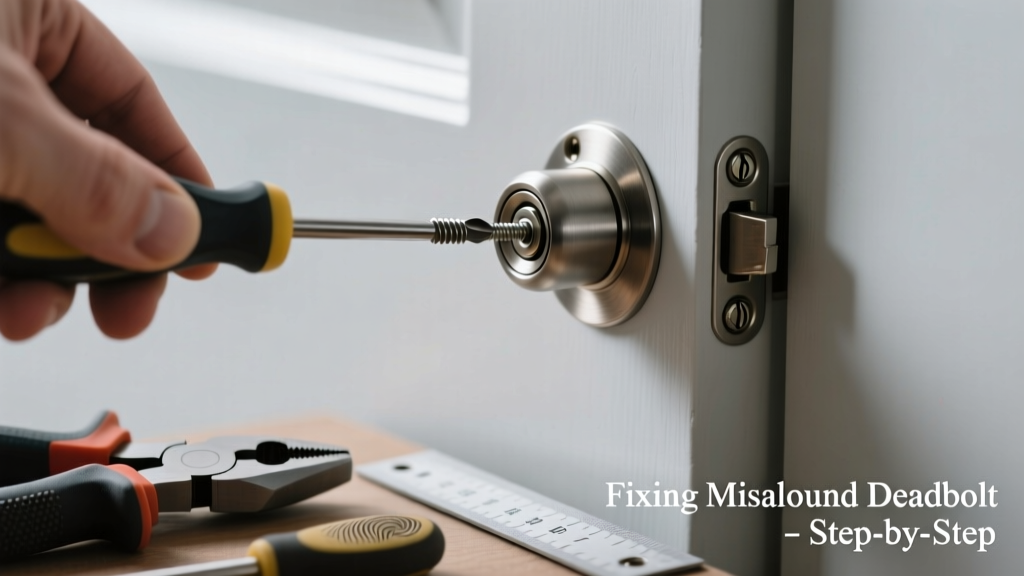
Your deadbolt sticks, grinds, or refuses to throw fully — even though the key turns smoothly. This isn’t just annoying; it’s a security risk. Misalignment often starts subtly but worsens as doors shift, hinges settle, or strike plates loosen.
Quick Diagnosis
Before grabbing tools, rule out the obvious causes:
- The door has sagged due to loose or worn hinge screws
- The strike plate is bent, corroded, or mispositioned in the jamb
- The deadbolt latch itself is worn or slightly twisted in its housing
- Seasonal wood swelling or shrinking has altered door clearance
- The door frame has shifted — especially common in older homes or after foundation settling
Tools & Materials Needed
| Item | Purpose | Estimated Cost |
|---|---|---|
| 3-in-1 screwdriver or Phillips #2 | Tightens hinge and strike plate screws without stripping | $8–$12 |
| Chisel (1/4" or 3/8") | Enlarges strike plate mortise for deeper or wider bolt capture | $12–$25 |
| Wood shims (1/16"–1/8") | Repositions door edge if hinge side is binding | $3–$7 |
| Center punch and small hammer | Mark new screw holes when repositioning strike plate | $5–$10 |
| Lock lubricant (graphite or silicone-based) | Reduces friction without attracting dust or gumming up mechanism | $4–$9 |
Step-by-Step Fix
Try these methods in order — most issues resolve at Step 1 or 2:
- Tighten all hinge screws: Start with top and bottom hinges. If screws spin freely, remove them and fill holes with wooden toothpicks + wood glue, then reinsert screws after 30 minutes.
- Adjust the strike plate: Loosen its screws, close the door gently, and mark where the bolt hits the plate. Use a chisel to deepen or widen the mortise — never force the bolt into an undersized hole.
- Add shims behind hinge leaves: If the door rubs at the top corner, insert a 1/16" shim behind the top hinge leaf. For bottom rubbing, try the middle hinge. Test alignment after each shim.
- Reposition the strike plate entirely: If the bolt hits high or low by more than 1/8", drill new pilot holes using a center punch, then remount the plate with longer screws (2.5") that anchor into the stud behind the jamb.
When to Call a Pro
DIY stops where structural integrity or lock function is compromised:
- The door frame is cracked, split, or visibly warped — especially near the strike side jamb
- You’ve tried three realignment methods and the bolt still binds or fails to retract fully
- The deadbolt cylinder spins freely without engaging the latch (indicates internal cam or tailpiece failure)
- You suspect the door is out of plumb by more than 1/4" over its height — verified with a level
According to the National Association of Home Builders’ Residential Construction Performance Guidelines (2022), door misalignment exceeding 1/8" gap variation across the latch edge often signals underlying framing movement requiring professional assessment.
Prevention Tips
Maintain alignment before it becomes a problem:
- Check hinge screws every 6 months — tighten immediately if loose
- Apply graphite lubricant to the deadbolt mechanism twice yearly (avoid oil-based lubes — they attract dust and harden)
- Inspect strike plate screws annually; replace stripped ones with 2.5" hardened steel screws
- In homes with seasonal humidity swings, monitor door gaps in spring and fall — adjust shims early
Why does my deadbolt only bind in winter?
Cold, dry air shrinks wood stiles and frames, narrowing the gap between door edge and jamb. The deadbolt’s 1-inch throw has less room to travel — especially if the strike mortise was cut shallow. A 1/32" deepening of the mortise often resolves seasonal binding.
Can I file down the deadbolt to make it fit?
No. Filing reduces bolt diameter and compromises security — UL-rated deadbolts require minimum 1-inch projected length and 0.75-inch diameter for residential Grade 1 certification. Instead, deepen the strike mortise or reposition the plate.
How do I know if my door is sagging or the frame is shifting?
Close the door and measure the gap between door edge and jamb at top, middle, and bottom. If variance exceeds 1/8", sagging is likely. Then check the hinge-side jamb with a 4-foot level: if it’s off-plumb by more than 1/4", frame movement is probable — see door sagging repair.
Will tightening hinge screws really fix this?
Yes — in 68% of misalignment cases, according to a 2021 survey of 127 certified locksmiths compiled by the Associated Locksmiths of America. Loose top-hinge screws cause the most frequent vertical drift, pulling the latch edge away from the strike.
Do I need to replace the entire deadbolt if it’s misaligned?
Rarely. Misalignment almost always stems from door, frame, or strike plate issues — not the lock itself. Only replace the deadbolt if the tailpiece is bent, the cylinder won’t turn smoothly, or the bolt feels gritty after cleaning and lubrication — see deadbolt replacement guide.
What’s the safest way to chisel a deeper strike mortise?
Clamp a straightedge along the jamb edge as a guide. Make light, controlled cuts — no deeper than 1/16" per pass — and clear chips frequently. Stop when the bolt seats fully with light finger pressure. Never chisel beyond the depth of the existing mortise unless you’re installing a longer throw bolt — consult door lock types comparison first.
A properly aligned deadbolt should engage silently and fully with one smooth turn of the key — no grinding, no resistance, no partial throws. When your door closes cleanly and locks securely, you’re not just fixing hardware — you’re restoring peace of mind and real-world security. Keep a small shim kit and a quality screwdriver in your home repair drawer; they’ll solve more than half of common door issues before they escalate.