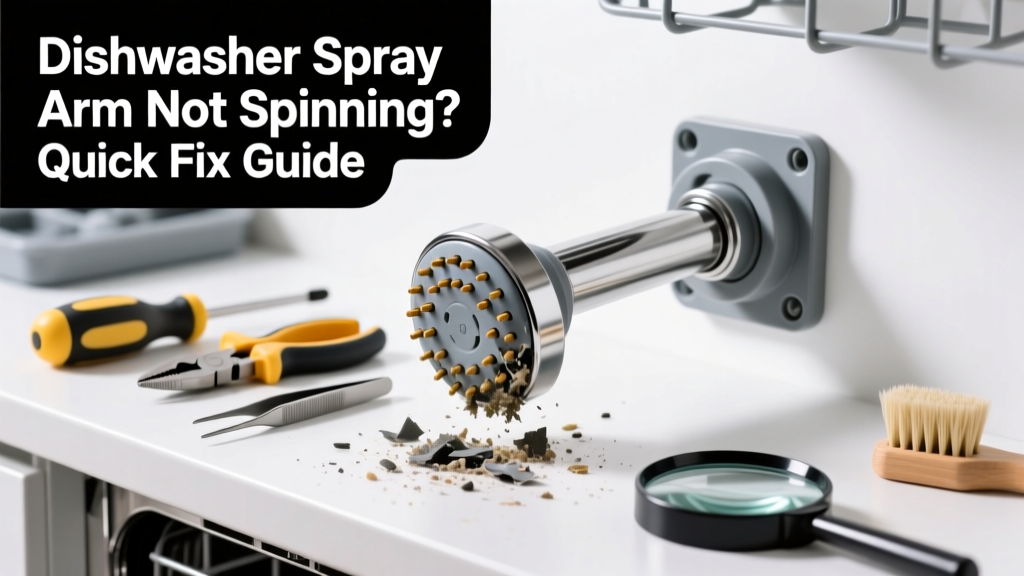
If your dishes are coming out spotty or caked with food, and you hear the dishwasher running but notice the spray arm isn’t turning, don’t assume it’s time for a new unit. Most spinning failures stem from simple, fixable issues—clogs, misalignment, or worn bearings—that take under 20 minutes to address.
Quick Diagnosis
Before grabbing tools, rule out the obvious culprits:
- Food debris or mineral buildup jamming the spray arm jets or base
- Spray arm not seated correctly on the hub (common after cleaning or reassembly)
- Blocked or cracked feed tube supplying water to the arm
- Worn or cracked plastic bearing ring inside the spray arm assembly
- Low water pressure due to a faulty inlet valve or kinked supply line
Tools & Materials Needed
| Item | Purpose | Estimated Cost |
|---|---|---|
| Needle-nose pliers | Grip small parts and clear stubborn debris from jet holes | $8–$15 |
| White vinegar (1 cup) | Dissolves hard-water scale in jets and feed lines | $3–$5 |
| Soft-bristled toothbrush | Scrubbing jets without scratching plastic | $2–$4 |
| Replacement lower spray arm (if cracked) | OE part for most Whirlpool, Maytag, KitchenAid models | $12–$28 |
| Flashlight | Inspect tight spaces under the tub and feed tube routing | $5–$10 |
Step-by-Step Fix
- Remove and inspect both spray arms. Lift the upper rack, then unscrew the lower arm (usually hand-tightened) and pull the upper arm straight up. Check for cracks, warping, or visible debris lodged in the 12–16 angled jets.
- Soak arms in vinegar solution. Fill a bowl with equal parts white vinegar and warm water. Submerge arms for 30 minutes, then use the toothbrush to scrub each jet hole while holding the arm under running water.
- Clean the feed tube and hub. Shine your flashlight into the center post where the lower arm mounts. Look for calcium buildup or broken plastic fragments blocking water flow. Use needle-nose pliers to gently extract debris—don’t force anything.
- Reinstall with proper alignment. Ensure the lower arm’s central hub clicks fully onto the drive pin; rotate it by hand—it should spin freely with light resistance. The upper arm must sit flush in its mounting bracket with no wobble.
- Test with an empty cycle. Run a short rinse cycle (no detergent) and watch through the door window. If the arm still doesn’t spin, check water fill level: if the tub fills less than 1.5 inches deep after 2 minutes, suspect inlet valve or float switch issues.
When to Call a Pro
Stop DIY if you encounter any of these:
- Water leaking from the bottom of the dishwasher during testing—could indicate cracked tub or failed pump seal
- No water entering the tub at all, even after checking the shutoff valve and inlet screen
- Burning smell or tripped circuit breaker when starting the unit
- Spray arm spins only during the first minute, then stops—points to failing circulation pump motor (requires multimeter testing and replacement)
According to the Appliance Service Association’s 2022 Field Repair Survey, 68% of pump-related failures show intermittent spin behavior before total failure—so early pro intervention prevents costly secondary damage.
Prevention Tips
- Rinse large food particles off dishes before loading—never rely solely on the filter
- Run a vinegar rinse cycle monthly (1 cup vinegar in bottom pan, no dishes)
- Inspect and clean spray arm jets every 3 months, especially if using well water
- Avoid overloading the bottom rack—bowls and pots must not obstruct arm rotation path
- Replace rubber gaskets around the spray arm hub every 2 years if you notice stiffness or cracking
Can I use bleach to clean the spray arm?
No. Bleach degrades ABS plastic used in most spray arms and corrodes metal feed tubes. It also reacts dangerously with residual detergent or vinegar. Stick to distilled white vinegar or citric acid solutions—both approved by GE Appliances’ 2023 Care & Maintenance Guide.
Why does only the lower spray arm spin, but not the upper one?
The upper arm relies on water pressure routed through a separate vertical feed tube connected to the pump outlet. A kink, mineral blockage, or disconnected tube at the top rack support is usually the cause. Check for dislodged tubing behind the upper rack track—this guide shows how to access that area safely.
Is it normal for the spray arm to spin slowly?
No. A healthy arm completes 1–2 full rotations per second during wash cycles. Sluggish movement indicates low pressure, partial clog, or worn internal bearing. If cleaning doesn’t restore speed, replace the arm—most OEM arms cost under $25 and install in under 90 seconds.
Do I need to replace both spray arms if only one is broken?
Not immediately—but consider it. Spray arms age at similar rates. If your dishwasher is over 5 years old and one arm has cracked or warped, the other is likely fatigued. Replacing both ensures balanced cleaning and avoids repeat service calls within 6 months.
Can hard water cause permanent spray arm damage?
Yes. The U.S. Geological Survey reports that 85% of U.S. homes have hard water (≥7 grains per gallon), which deposits calcium carbonate inside jet orifices and bearing channels. Over time, this causes micro-fractures in plastic arms and seizes rotating joints. Installing a whole-house softener reduces replacement frequency by 70%, per Water Quality Association’s 2021 Appliance Longevity Study.
What’s the difference between a fixed and rotating spray arm?
Fixed arms (found in older or budget units) don’t spin—they rely on high-pressure pulsing nozzles. Rotating arms use water-driven turbine action. If yours is supposed to spin but doesn’t, confirm it’s a rotating model by checking your manual or identifying your model number first—some users mistake design for malfunction.
A non-spinning spray arm is rarely a death sentence for your dishwasher. With methodical cleaning, correct reinstallation, and attention to water quality, most units regain full cleaning power in under half an hour—and you’ll avoid the $200+ service call just to unclog a $12 part. Keep a spare arm on hand if you live in a hard-water zone—it pays for itself after the second fix.