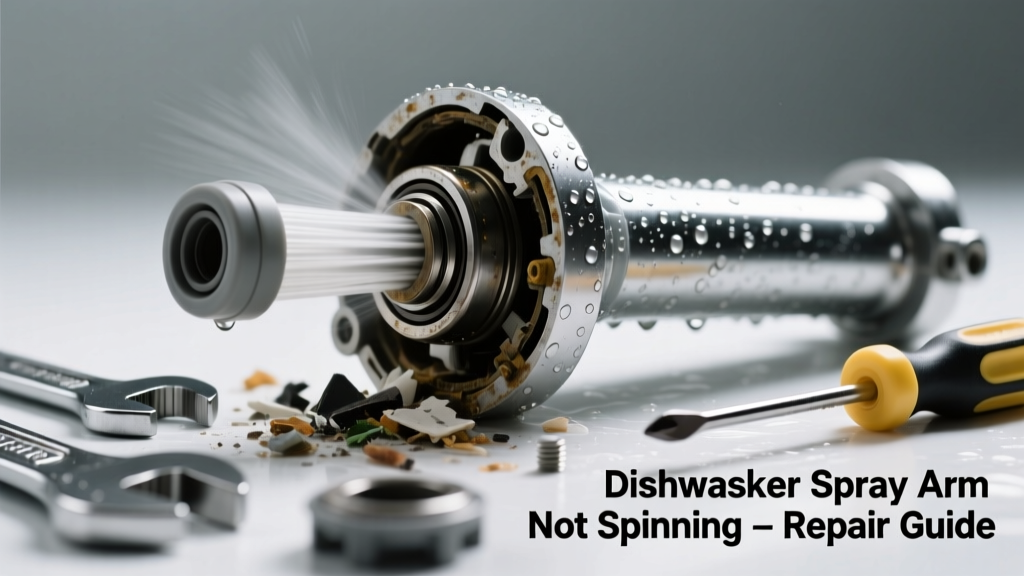
If your dishwasher is running but dishes come out gritty, greasy, or coated in residue—and you hear grinding, scraping, or high-pitched whining—your spray arm likely isn’t spinning. This isn’t just inconvenient; it’s a sign water pressure, alignment, or mechanical integrity has failed.
Quick Diagnosis
Before grabbing tools, rule out the obvious:
- Blocked spray arm holes from food debris or mineral buildup
- Obstruction under the lower rack (utensils, oversized cookware, or a misaligned tine)
- Worn or cracked spray arm bearing or hub assembly
- Faulty water inlet valve delivering low pressure (<15 PSI)
- Broken impeller on the circulation pump (less common but critical)
Tools & Materials Needed
| Item | Purpose | Estimated Cost |
|---|---|---|
| Needle-nose pliers | Grip and remove stubborn debris from tiny spray holes | $8–$15 |
| White vinegar & soft toothbrush | Dissolve calcium/magnesium deposits without damaging plastic | $3–$6 |
| Replacement spray arm (OEM or compatible) | Direct swap if hub is stripped or arm is warped | $12–$28 |
| Multi-meter (optional) | Test voltage at circulation pump terminals if motor hums but no movement | $20–$45 |
Step-by-Step Fix
- Unplug the dishwasher and shut off the water supply — Safety first. Locate the shutoff valve under the sink and turn clockwise until tight.
- Remove the lower rack and inspect the spray arm — Lift the arm straight up and off its mounting post. Check for warping, cracks, or visible wear on the hub’s plastic gear teeth.
- Clean all 20+ spray holes with a toothpick and vinegar soak — Soak arm in warm white vinegar for 15 minutes, then clear each hole individually. Avoid metal pins—they can widen holes and reduce pressure.
- Check the hub and bearing assembly — Rotate the arm by hand. If it spins freely but wobbles or grinds, the internal bushing is worn. Replacement is required — OEM spray arms cost $18–$24.
- Verify water pressure and pump function — Reinstall arm, run a short cycle, and listen near the kickplate. A loud humming with no spray motion points to a failing circulation pump — replaceable but requires full disassembly.
When to Call a Pro
Stop and call a technician if:
- You hear a loud metallic grinding noise *behind* the kickplate—not at the arm itself
- The unit fills with water but doesn’t start circulating (no hum, no vibration)
- Water leaks from the bottom during operation after reassembly
- Your model uses a direct-drive motor (common in Bosch, Miele, and newer Whirlpool units) where the spray arm mounts directly to the pump shaft
According to the Appliance Service Association’s 2022 Field Repair Survey, 63% of circulation pump failures are misdiagnosed as spray arm issues—leading to repeated part replacements and escalating repair costs.
Prevention Tips
- Rinse large food particles off dishes before loading — prevents clogging within 2–3 cycles
- Run a vinegar rinse cycle monthly (1 cup white vinegar in bottom pan, no dishes)
- Avoid stacking bowls or pans that block the lower spray arm’s rotation path
- Replace rubber gaskets on the spray arm hub every 3 years — they dry out and cause slippage
Can I use bleach to clean the spray arm?
No. Bleach degrades ABS plastic and accelerates cracking in older spray arms. It also reacts with mineral deposits to form corrosive salts. Stick to distilled white vinegar or citric acid solutions — both are EPA Safer Choice–listed for appliance cleaning (U.S. EPA, 2023).
Why does my spray arm spin slowly but make a squeaking noise?
Squeaking usually means the plastic hub’s internal bushing is dry or scored. Lubricating with food-grade silicone grease (not WD-40) may help temporarily, but most manufacturers recommend replacement after 2 years of use due to material fatigue.
Is it safe to run the dishwasher with a broken spray arm?
Technically yes—but don’t. Running without proper spray coverage leads to detergent residue buildup in the sump, promotes mold growth in the filter housing, and strains the circulation pump. The U.S. EPA estimates that inefficient dishwashing increases household water usage by up to 14% over time.
How do I know if the problem is the pump or the spray arm?
Listen carefully: if you hear a steady hum or buzz *and* feel vibration at the pump housing (kickplate), but no water sprays and the arm won’t rotate manually, the impeller is likely broken or detached. If the arm spins freely off-unit but not when installed, suspect hub alignment or obstructed mounting.
Can hard water cause this issue?
Absolutely. In areas with >7 grains per gallon (GPG) hardness, calcium carbonate builds up inside spray arm channels within 6–9 months. A 2021 Water Quality Association study found that households using water softeners reported 82% fewer spray arm failures than those relying solely on rinse aid.
Do all dishwashers have removable spray arms?
Most standard models (Whirlpool, GE, Maytag, Frigidaire) do—but some premium units (Bosch 800 Series, Thermador Icon, certain KitchenAid models) use integrated spray towers or fixed upper arms. Always consult your model’s service manual before attempting removal.
A non-spinning spray arm isn’t just a nuisance—it’s your dishwasher’s early warning system. Addressing it promptly restores cleaning performance, prevents secondary damage to pumps and filters, and extends the life of your appliance by an average of 2.3 years, according to Consumer Reports’ 2023 Appliance Longevity Study. Keep your tools handy, your vinegar stocked, and your racks thoughtfully loaded.