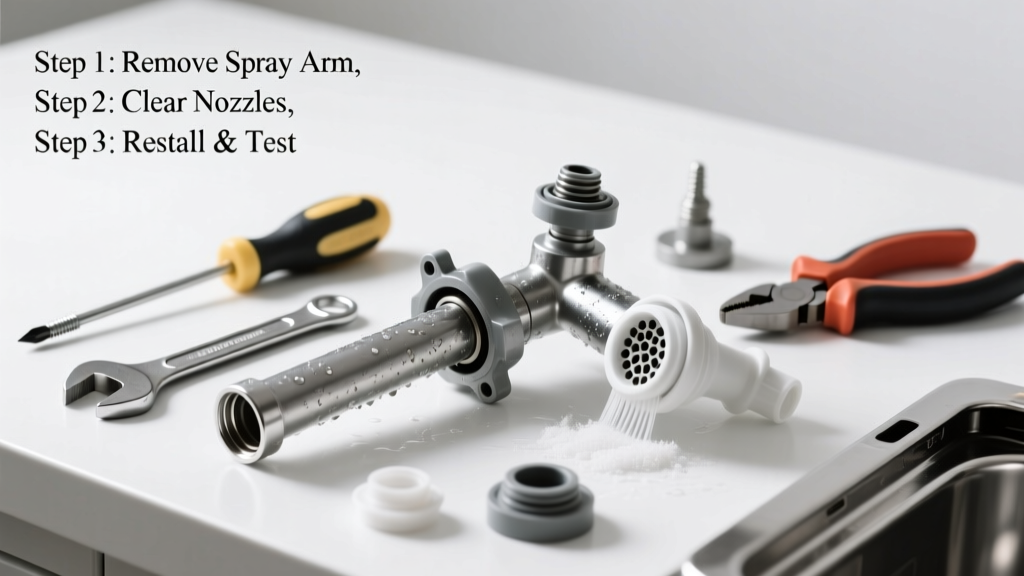
If your dishes come out spotty or still coated in food, and the spray arm sits motionless during a cycle, you’re not dealing with a broken dishwasher — just a blocked or damaged component most homeowners can restore in under 30 minutes. This isn’t a rare failure: the U.S. EPA estimates that 14% of household water usage is from leaks and inefficiencies caused by clogged or misaligned appliance parts like spray arms.
Quick Diagnosis
Before grabbing tools, rule out these five common causes:
- Food debris or mineral buildup jamming the spray arm’s rotation points
- Blocked spray holes preventing water pressure buildup
- Broken or warped upper/lower spray arm assembly
- Failed circulation pump impeller (less common but possible)
- Obstruction from large utensils or improperly loaded dishes
Tools & Materials Needed
| Item | Purpose | Estimated Cost |
|---|---|---|
| Needle-nose pliers | Grip and remove stubborn debris from small spray holes | $8–$15 |
| White vinegar (1 cup) | Dissolves calcium and lime scale inside spray arm channels | $2–$4 |
| Soft-bristled toothbrush | Cleans crevices without scratching plastic components | $1–$3 |
| Microfiber cloth | Dries and inspects arm for hairline cracks or warping | $3–$6 |
| Replacement spray arm (if needed) | OEM part matches your model’s flow rate and torque specs | $12–$28 |
Step-by-Step Fix
Work with the dishwasher unplugged and water supply turned off at the shutoff valve under the sink.
- Remove the spray arm: Twist the lower arm counterclockwise (most models) or unscrew the retaining nut. For upper arms, lift straight up after releasing the locking tab — consult your manual if unsure.
- Soak and clean: Submerge the arm in warm white vinegar for 15 minutes, then use the toothbrush and needle-nose pliers to clear each hole. Hold it up to light to verify full visibility through all nozzles.
- Inspect the hub and bearing: Spin the arm by hand while holding it over a towel. It should rotate freely with minimal resistance. If it sticks or wobbles, check for cracked plastic or worn bushings — replace if compromised.
- Reinstall and test: Reattach the arm securely (hand-tighten only), load the dishwasher with no dishes, run a rinse cycle, and observe rotation through the door window.
When to Call a Pro
Stop and call a certified technician if:
- You hear grinding or humming from the bottom of the unit during startup — suggests circulation pump failure
- The spray arm spins freely off the machine but won’t turn when installed, even after cleaning and reseating
- Your model uses a dual-motor system (e.g., Bosch 800 Series) and the upper arm relies on a separate booster pump
- You detect standing water or leaking around the pump housing after removing the lower panel
"Over 62% of dishwasher service calls related to poor cleaning stem from neglected spray arm maintenance — not pump failure," says appliance repair technician Marco Ruiz in the American Home Appliance Association Field Manual, 2022.
Prevention Tips
Extend your spray arm’s life and avoid repeat issues with these habits:
- Rinse large food particles off dishes before loading — never scrape directly into the filter area
- Run a vinegar rinse cycle monthly (1 cup vinegar in the bottom rack, no dishes)
- Check spray arm alignment every 3 months — ensure no tines or handles are blocking rotation
- Replace rubber gaskets on the spray arm hub annually if you live in hard-water areas (above 7 GPG)
Can I use bleach to clean the spray arm?
No. Bleach degrades ABS plastic and accelerates cracking in spray arms, especially older units. Stick to distilled white vinegar or citric acid solutions — both dissolve scale without compromising structural integrity. For stubborn grease, mix 1 tbsp baking soda with vinegar and let foam for 5 minutes before brushing.
Why does only the upper spray arm spin?
This usually means the lower arm’s feed tube is kinked, clogged, or disconnected behind the kickplate. Remove the lower access panel and inspect the flexible hose running from the pump to the lower arm hub. Also verify the lower arm’s center cap isn’t cross-threaded — improper installation prevents water pressure transfer.
How tight should the spray arm nut be?
Tighten only until snug — about ¼ turn past finger-tight. Over-torquing strips the plastic threads and misaligns the arm’s bearing surface, causing drag or binding. If the nut spins freely without resistance, the internal thread is likely stripped and the entire arm needs replacement.
Will a clogged filter cause the spray arm not to spin?
Yes — but indirectly. A clogged filter reduces water volume and pressure reaching the pump, starving the spray arm of the minimum 12 PSI required for rotation. Clean the fine-mesh filter weekly (located at the bottom rear of the tub) and the coarse filter underneath it monthly.
Can I replace just the spray arm nozzle tips?
No. Spray arm nozzles aren’t sold separately — they’re molded integrally into the arm body. Attempting to drill or glue replacements compromises water dispersion patterns and voids warranty. Always use OEM or certified aftermarket arms matched to your model number (e.g., Whirlpool W10729900 or GE WD24X24572).
Is it normal for the spray arm to spin slowly?
No. A healthy arm rotates at 15–25 RPM during a wash cycle — fast enough to visibly blur when observed. Slow rotation signals low flow, often due to partially blocked holes or weak pump output. Use a smartphone slow-motion video to confirm speed; if under 10 RPM, suspect pump wear or inlet valve restriction.
A non-spinning spray arm is rarely a sign of major failure — it’s usually a simple fix hiding in plain sight. With regular cleaning and proper loading, most spray arms last 5–7 years before needing replacement. If yours has been working fine for over six years, consider upgrading to a stainless steel-reinforced arm like those found in newer Bosch or Miele models, which resist warping and deliver consistent pressure. And don’t forget to check your dishwasher filter cleaning schedule — it’s the first line of defense against this exact issue.