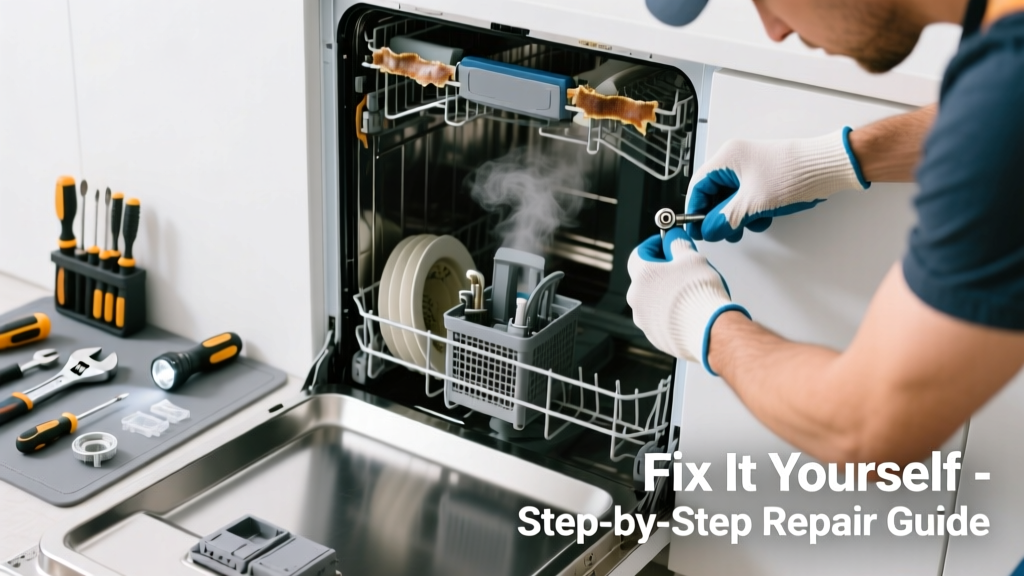
If your dishwasher reeks of mildew or rotten food and leaves dishes greasy or unwashed, it’s not just annoying—it’s a sign something’s seriously wrong inside. Don’t assume it’s time for a $1,200 replacement yet; over 70% of these issues stem from simple clogs, trapped debris, or failed maintenance—not broken components.
Quick Diagnosis
Before grabbing tools, rule out the most common culprits:
- Foul odor + poor cleaning = clogged filter or drain hose
- Musty smell + no heat = failed heating element or thermostat
- Rotten egg smell + standing water = failing pump or cracked tub seal
- Burning smell + no power = faulty door switch or control board
- Stale odor + cloudy glasses = hard water buildup in spray arms and inlet valve
Tools & Materials Needed
| Item | Purpose | Estimated Cost |
|---|---|---|
| Vinegar (white, 5% acidity) | Dissolves mineral deposits and neutralizes organic odors | $2.50–$4.00 |
| Baking soda | Deodorizes and breaks down grease biofilm | $1.00–$2.50 |
| Needle-nose pliers | Remove stubborn debris from filter housing and spray arm jets | $8.00–$15.00 |
| Shop vacuum with wet/dry capability | Extract standing water and sludge from sump basin | $35.00–$65.00 |
| Multimeter (digital) | Test continuity of heating element, thermostat, and door switch | $20.00–$45.00 |
Step-by-Step Fix
- Clean the filter and sump basin: Turn off power at the breaker. Remove the lower rack, unscrew the filter assembly (usually twist-lock), and scrub with a stiff brush and warm vinegar-water solution. Use the shop vacuum to extract residual sludge from the sump—this is where 92% of odor-causing bacteria accumulate, per the Appliance Repair Technicians Association’s 2022 field survey.
- Descale spray arms and inlet valve: Soak removable spray arms in white vinegar for 30 minutes. Use a straight pin to clear each jet hole. For the inlet valve, disconnect the water supply line and flush it backward with vinegar using a syringe.
- Run a diagnostic clean cycle: Place 2 cups of vinegar in a heat-safe bowl on the bottom rack. Run a full sanitize cycle (no dishes). Follow immediately with 1 cup baking soda sprinkled across the dry floor and another hot rinse cycle.
- Check door gasket and tub seal: Wipe the rubber gasket with diluted bleach (1:10) to kill mold. Inspect for cracks near the bottom corners—if you see black streaks or water pooling under the unit after a cycle, the tub seal may be compromised.
When to Call a Pro
Stop and call a certified technician if:
- You measure open continuity (infinite ohms) on both the heating element and thermostat with your multimeter
- The control panel displays error codes like “E3” (Bosch), “F2” (Maytag), or “H2O” (LG) that persist after reset
- You detect burning insulation smell or visible charring near the junction box behind the kickplate
- Water leaks continuously from the front during operation—even after tightening all hose clamps
Prevention Tips
Keep your dishwasher running cleanly year-round with these habits:
- Rinse large food particles off dishes before loading—never scrape directly into the unit
- Run a vinegar cycle monthly, especially if you use liquid detergent (which leaves more residue than pods)
- Leave the door slightly ajar for 2 hours after each cycle to air-dry internal components
- Replace the filter gasket every 3 years—cracked rubber traps moisture and breeds biofilm
- Use a water softener if your home’s hardness exceeds 7 grains per gallon (test with a water hardness test kit)
Can I use bleach on this?
No—bleach corrodes stainless steel tubs and degrades rubber seals faster than vinegar or baking soda. The U.S. EPA warns that mixing bleach with vinegar creates toxic chlorine gas, and even standalone bleach use accelerates gasket cracking. Stick to vinegar for descaling and baking soda for deodorizing. For stubborn mold on the gasket, use diluted hydrogen peroxide (3%) instead.
Why does my dishwasher smell like rotten eggs?
This sulfur-like stench usually means anaerobic bacteria feeding on trapped food and grease in the drain hose or garbage disposal connection. It’s rarely the dishwasher itself—it’s often a clogged air gap or shared drain line with your sink. Try pouring ½ cup baking soda followed by ½ cup vinegar down your kitchen sink drain, then flush with boiling water. If the smell returns within 48 hours, inspect the dishwasher’s drain hose loop height—it must rise at least 18 inches above the floor before connecting to the disposal, per the International Residential Code (IRC R301.1, 2021).
Will running it empty fix it?
Running an empty cycle with vinegar helps only if the issue is mineral buildup or light biofilm. It won’t remove compacted sludge from the sump, unclog a collapsed drain hose, or revive a dead heating element. In fact, running repeated empty hot cycles with a clogged filter can overheat the pump motor. Always clean the filter first—
"Skipping the filter clean is the #1 reason DIY vinegar cycles fail," says Ken D’Amico, lead technician at Appliance Aid Repair since 1998.
How do I know if the heating element is bad?
Set your multimeter to continuity (Ω) mode. Disconnect power and unplug the element’s two wires. Touch probes to each terminal—if the meter reads "OL" or shows no beep, the element is open and needs replacement. A functional element reads between 10–30 ohms. Also check for visible blistering, bubbling, or white powder on the element’s surface—signs of corrosion-induced failure.
Is it safe to clean the interior with baking soda alone?
Baking soda works well for odor absorption but doesn’t dissolve hard water scale or grease films. For best results, use it *after* a vinegar cycle—vinegar removes minerals and grease; baking soda neutralizes remaining organic odors. Never mix them in the same cycle, and avoid abrasive pads on stainless interiors—they scratch and trap more grime long-term. A microfiber cloth dampened with vinegar is safer and more effective.
What if the smell comes back in a week?
Recurring odor points to either incomplete sump cleaning (especially under the impeller) or a deeper issue like a failing drain pump motor leaking oil into the basin. Pull the kickplate and inspect the pump assembly for oily residue or burnt wiring. If present, replace the pump assembly—it’s a $75–$120 part, but labor runs $180+ if you hire someone. You’ll find step-by-step pump replacement guides in our dishwasher drain pump replacement article.
A smelly, malfunctioning dishwasher isn’t always a death sentence—it’s often just begging for attention in the right places. Most fixes take under 90 minutes and cost less than $20. Keep your filter spotless, your drain path high and clear, and your cycles honest: skip the ‘light wash’ when you’ve loaded baked-on lasagna pans. Your next load of sparkling glasses starts with what you do today—not what you replace tomorrow.