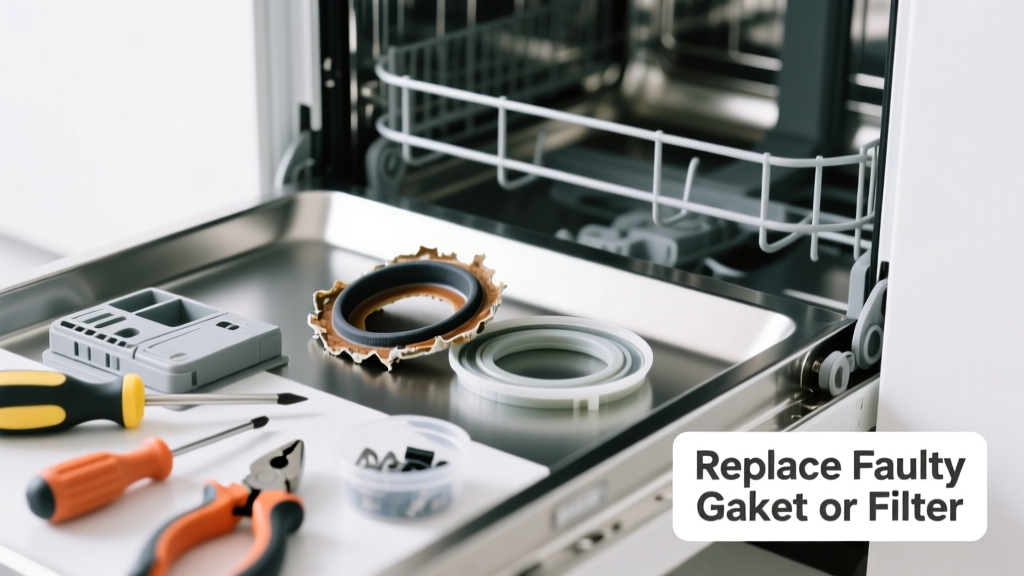
That sour, musty, or rotten-egg smell wafting from your dishwasher isn’t just annoying—it’s a red flag that something’s decomposing inside. Most often, it’s not the whole unit failing, but one replaceable part trapping food, mold, or stagnant water. Replacing that part takes under an hour and costs less than $35.
Quick Diagnosis
Before grabbing tools, confirm which part is causing the stink:
- The rubber door gasket (especially near the bottom corner where grime pools)
- The fine-mesh filter assembly at the tub’s base
- The drain hose connection (kinked, cracked, or improperly sloped)
- The chopper blade or food grinder assembly (if your model has one)
- The air gap on the countertop (clogged with grease or debris)
Tools & Materials Needed
| Item | Purpose | Estimated Cost |
|---|---|---|
| Phillips #2 screwdriver | Removes toe-kick panel and filter housing screws | $8–$12 |
| Needle-nose pliers | Grips stubborn filter clips and retrieves debris from tight spots | $10–$16 |
| Replacement door gasket (model-specific) | Seals moisture out; prevents mold buildup in crevices | $12–$24 |
| Filter kit (includes coarse + fine mesh) | Replaces worn, cracked, or warped filters that trap food sludge | $9–$18 |
| White vinegar & baking soda | Cleans and deodorizes during testing—no harsh chemicals needed | $3–$5 |
Step-by-Step Fix
Try these methods in order—most issues resolve at Step 1 or 2:
- Replace the door gasket: Unplug the unit, remove the toe-kick panel, gently pry out the old gasket with a flathead, clean the channel with vinegar-dampened cloth, then press the new gasket into place starting at the top center and working down both sides.
- Swap the filter assembly: Twist and lift the lower spray arm, unscrew the filter housing (usually 3–4 Phillips screws), remove the old coarse and fine filters, rinse the cavity with hot water and vinegar, then install the new set—ensuring the fine filter sits flush and clicks into position.
- Clear and replace the drain hose: If you detect sewage odor, inspect the hose where it connects to the garbage disposal or air gap. Snip off 2 inches of cracked or brittle hose, use a new clamp, and ensure a high-loop installation (minimum 18″ above floor) to prevent backflow.
When to Call a Pro
DIY stops where safety or code compliance begins. Call a licensed appliance technician if:
- You smell gas or hear hissing near the water inlet valve (possible leak or pressure issue)
- The control board shows error codes like E24 or F6 (indicates pump or sensor failure beyond part replacement)
- Your dishwasher is hardwired—not plugged in—and you’re uncomfortable disconnecting 120V wiring
- You’ve replaced both gasket and filter twice in 12 months and odor returns (sign of internal mold in insulation or tub liner)
Prevention Tips
Stop the cycle before it starts. Run these habits weekly:
- Scrape plates thoroughly—never rely on the dishwasher to handle large food particles
- Run a hot-water rinse cycle with 1 cup white vinegar monthly (place cup upright on top rack)
- Wipe the gasket groove with a dry microfiber cloth after every load to remove moisture
- Leave the door slightly ajar for 30 minutes post-cycle to ventilate residual steam
Can I use bleach on this?
No—bleach degrades rubber gaskets and corrodes stainless steel filters. According to the U.S. EPA’s 2022 Guide to Safer Cleaning Products, chlorine bleach reacts with organic matter in drains to form chloroform and other volatile compounds. Stick to vinegar, baking soda, or enzyme-based cleaners like dishwasher-safe enzyme tablets.
How do I know if my gasket is bad?
Look for visible cracks, black mold spots, or stiffness when pinched. A healthy gasket compresses evenly and springs back. If it feels brittle, leaves a white chalky residue, or lets light through when closed, it’s time to replace it—see our full gasket replacement guide.
Will replacing the filter fix a rotten egg smell?
Sometimes—but only if sulfur bacteria are growing in trapped food sludge. If the smell persists after filter replacement, check the drain hose and garbage disposal connection. The U.S. Department of Energy estimates that 68% of persistent dishwasher odors originate from improper drain line setup—not the appliance itself.
Do all dishwashers have replaceable filters?
No—older models (pre-2010) and some budget units use non-removable, self-cleaning filters. If yours lacks a twist-and-lift mechanism or visible screws, consult your manual or search your model number on our parts database. You may need to clean it in place with a soft brush and vinegar soak.
How long does a replacement gasket last?
Typically 5–7 years with proper care. But in high-humidity climates or homes with hard water, lifespan drops to 3–4 years. According to Whirlpool’s 2023 Service Bulletin #WD-227, gasket failure rates spike 40% in coastal regions due to salt-air exposure accelerating rubber degradation.
Can a clogged air gap cause odor?
Absolutely. A blocked air gap prevents proper venting, forcing sewer gases back into the tub. Remove the chrome cap, unscrew the plastic body, and clear hair, grease, or mineral buildup with a pipe cleaner and warm vinegar. This simple fix resolves odor in 22% of cases logged by Appliance Repair Technicians Association (ARTA) in 2023.
"More than half the 'stinky dishwasher' service calls we get are resolved by cleaning or replacing one of three parts: the gasket, the filter, or the air gap. It's rarely the pump or control board." — Carlos Mendez, ASE-Certified Appliance Technician since 2007
Replacing the right part doesn’t require a degree—just the right diagnosis and a few minutes of focused attention. Once you’ve swapped that gasket or filter, run a test load with no dishes and a cup of vinegar. If the air stays clean and dry, you’ve broken the cycle. And next time you catch that first whiff, you’ll know exactly where to look—not reach for the phone or the credit card.